
China Moneypro
Thermal Bullet vs Dome Camera: Which Form Factor Wins?
Compare thermal bullet and dome cameras for security: installation, durability, optical performance, and cost. Expert analysis for integrators.
In perimeter security, facility monitoring, and critical infrastructure protection, the choice between a thermal bullet camera and a thermal dome camera is not merely cosmetic. Each form factor imposes specific trade-offs in optical performance, environmental resilience, installation complexity, and total cost of ownership. This article provides an engineering-level comparison to help security integrators and end users select the optimal thermal imaging platform for their application.
Key Takeaways
- Thermal bullet cameras offer superior optical clarity and longer detection ranges due to larger apertures and fewer refractive surfaces.
- Thermal dome cameras provide 360° continuous pan, tilt, and zoom (PTZ) capability with vandal-resistant housings ideal for harsh environments.
- Maintenance costs are lower for bullet cameras due to easily replaceable window modules, while dome cameras require careful cleaning of domes to avoid image degradation.
- For fixed, long-range perimeter monitoring, bullet cameras are preferred; for wide-area surveillance requiring flexible orientation, dome cameras dominate.
- Modern thermal cores with 12µm pixel pitch and <30 mK NETD perform well in both form factors, but dome housings can introduce additional thermal noise if not properly ventilated.
Physical Form Factor and Installation Considerations
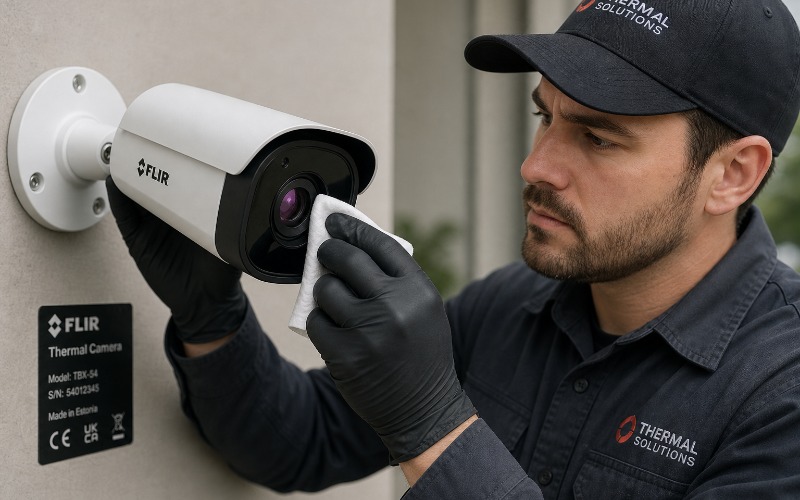
Thermal bullet cameras are characterized by a cylindrical, elongated housing that holds the lens, focal plane array (FPA), and electronics in a single rigid assembly. The bullet form factor is designed for fixed mounting, often on poles, walls, or brackets, with the optical axis aligned permanently. Installation is straightforward: a mounting bracket, weatherproof cable entry, and power-over-Ethernet (PoE) or auxiliary power connection. The bullet’s shape naturally sheds rain and snow, reducing the need for frequent cleaning.
Thermal dome cameras, by contrast, use a hemispherical or spherical housing that encloses a motorized pan-tilt mechanism and the thermal module. Domes are typically installed on ceilings, walls, or pendant mounts. Their rotating base allows pan angles up to 360° continuous and tilt ranges of 180° or more. Installation is more complex due to the need for clearance, alignment of the dome’s rotation axis, and proper cable management through the mount. Dome cameras are often chosen for indoor or covered outdoor areas where vandal resistance and aesthetic discretion are priorities.
Optical Performance and Lens Options
The optical path in a thermal bullet camera is straightforward: a primary lens (typically germanium or chalcogenide glass) focuses infrared radiation directly onto the microbolometer FPA. Bullet cameras accept a wide range of interchangeable lenses, from narrow-angle 7.5mm to wide-angle 50mm or more. The absence of a window between lens and environment allows for larger aperture diameters (up to 80mm), yielding higher light gathering and better signal-to-noise ratio. This directly translates to longer detection ranges—a bullet camera with a 50mm f/1.0 lens can detect a human-sized target at over 1.5 km under standard atmospheric conditions.
Thermal dome cameras have an additional optical element: the dome bubble itself. The dome is typically made from high-density polyethylene (HDPE) or other IR-transparent materials, but even the best domes introduce some transmission loss and scattering. For PTZ domes, the lens system must be compact to fit within the bubble, limiting maximum aperture and lens speed. Many thermal domes use a fixed lens (e.g., 9mm or 19mm) with motorized zoom, but the zoom range is narrower than an external lens. The tradeoff is that PTZ functionality allows the camera to compensate for a narrower field of view by scanning, but the instantaneous field of view (IFOV) and detection range are inherently smaller for a given pixel pitch.
| Parameter | Thermal Bullet Camera | Thermal Dome Camera |
|---|---|---|
| Lens Aperture (max) | Up to 80mm (f/1.0) | Typically 25–35mm (f/1.2–f/1.4) |
| Lens Interchangeability | Yes (C/CS mount often) | No (fixed or integrated motorized zoom) |
| Dome Window Loss | None (open window) | ~5–10% transmission loss |
| Detection Range (human, 12µm) | 1.0–1.8 km typical | 0.5–0.9 km typical |
| Field of View Options | Wide (manual selection) | Wide to tele (via PTZ scan) |
Environmental Durability and Vandal Resistance
Vandal resistance is a key differentiator. Thermal dome cameras are designed with impact-resistant polycarbonate or aluminum housings that can withstand significant blunt force. The dome bubble itself is often coated with a hard coat and can be replaced if scratched. Many domes achieve IK10+ rating for impact protection. The sealed design also offers excellent ingress protection, typically IP66 or IP67. However, the dome surface is prone to condensation in high-humidity environments unless equipped with an internal heater and wiper. Additionally, the rotating mechanism adds moving parts that require periodic maintenance—brushless motors have improved reliability, but the PTZ mechanism remains a potential failure point.
Thermal bullet cameras are inherently rugged due to their monolithic construction. They can achieve IP67 and IK10 ratings with proper mounting. The lens hood and window (if present) are less exposed to impact because the camera is typically aimed downward at a fixed angle. There is no rotating mechanism, so long-term mechanical reliability is higher. However, the exposed lens window can accumulate dirt, ice, or spider webs, which may reduce image quality. Many bullet cameras include a sunshield or rain visor to mitigate these issues.
Field of View and Coverage Strategy
When deploying thermal cameras for wide-area surveillance, coverage strategy differs fundamentally between the two form factors. A single thermal bullet camera covers a fixed wedge of the environment. To monitor a 360° horizon, multiple bullet cameras are needed (typically 2–4). This increases hardware and installation cost but provides redundancy and simultaneous multi-directional coverage. Bullet cameras excel in corridors, fence lines, and point-to-point detection where the region of interest is well-defined.
A PTZ thermal dome camera can cover a 360° area with one unit by panning or by using patrol patterns. In practice, however, PTZ domes cannot see in all directions at once. They rely on programmed tours, motion tracking, or manual operator intervention. For critical blind spot coverage, multiple domes or a combination of bullets and domes is advisable. The dome’s ability to track a moving target across the scene is a significant operational advantage, especially for forensic investigation and real-time response.
Thermal Detection Range and Resolution Considerations
Detection range is governed by the Johnson criteria and the product of lens focal length and pixel pitch. With modern 12µm pitch VOx microbolometers in both form factors, the theoretical detection range for a 1.8m tall human (0.75m width) is approximately:
R_detection = (Target size) × (Focal length) / (Pixel pitch × Number of pixels on target)
For a bullet camera with a 75mm lens, detection range exceeds 2.4 km. For a dome camera with a 25mm lens, detection range is about 0.8 km. However, the dome’s PTZ can zoom to a narrower field of view (e.g., 50mm optical zoom) if the module supports it, but the minimal focal length at narrow end remains limited compared to a dedicated telephoto bullet lens. Additionally, the dome window’s transmission loss reduces signal by 5–10%, slightly degrading NETD.
For applications requiring identification or recognition (more pixels on target), bullet cameras are nearly always preferred. Domes are adequate for detection and tracking but may struggle at long ranges.
Maintenance and Cleaning
Thermal dome cameras require careful maintenance of the dome bubble. The transparent dome is susceptible to scratching from improper cleaning, condensation buildup, and UV degradation over time. Many integrators recommend periodic cleaning with a microfiber cloth and isopropyl alcohol, and replacement of the bubble every 2–3 years in outdoor installations. The internal wiper blade (if present) also wears out. Additionally, the PTZ gearing may need lubrication and belt replacement every 5–7 years depending on rotation cycles.
Thermal bullet cameras have fewer maintenance items. The protective window can be cleaned easily, and the lens housing can be replaced if the window gets damaged. Since there are no moving optical components, bullet cameras often have mean time between failures (MTBF) exceeding 100,000 hours. For remote or difficult-to-access locations, bullet cameras reduce service visits.
Cost and Total Cost of Ownership
Initial purchase price for thermal bullet cameras ranges from $1,500 to $6,000 depending on resolution, lens, and NETD. Thermal dome cameras with PTZ functionality typically start at $3,000 and exceed $10,000 for high-end models with continuous zoom and advanced analytics. The total cost of ownership (TCO) over five years factors in installation, maintenance, and replacement parts.
For a perimeter covering 1 km of fence line, deploying 4 bullet cameras may cost $12,000–$20,000 (hardware + installation) with minimal maintenance. A single PTZ dome camera covering the same perimeter with patrols may cost $5,000–$8,000, but requires a higher-end mast structure and more frequent service. The breakeven point depends on site layout, accessibility, and required detection confidence. In general, bullet cameras offer lower TCO for fixed, long linear perimeters; domes are cost-effective for smaller, complex sites where one camera can replace multiple fixed units.
Application-Specific Recommendations
Based on the above analysis, we recommend the following guidelines for integrators:
- Long linear perimeters (airports, borders, pipelines): Use thermal bullet cameras with interchangeable lenses for maximum detection range and reliability.
- Open areas requiring wide coverage (car parks, construction sites): Consider thermal dome cameras with PTZ to reduce camera count while retaining monitoring flexibility.
- Vandal-prone locations (prisons, train stations): Dome cameras with IK10 rating and impact-resistant glass provide best physical security.
- Remote or extreme environments (arctic, desert): Bullet cameras with heated windows and no moving parts offer highest uptime; domes require careful environmental sealing.
- Indoor areas with aesthetic needs (lobbies, control rooms): Small dome cameras offer discreet integration; bullet cameras may be too conspicuous.
Frequently Asked Questions
Can I use a thermal bullet camera with a motorized PTZ for pan/tilt?
Yes, some manufacturers offer bullet cameras with an external pan/tilt base (e.g., FLIR PTZ-300 series) that add motorized rotation while preserving the bullet’s optical performance. However, these systems are larger, more expensive, and less discreet than integrated dome designs.
Do thermal dome cameras suffer from image degradation due to dome material?
Yes, all dome bubbles introduce some transmission loss and potential for lens flare or ghosting if the dome has non-uniform coating. Premium domes use HDPE with anti-reflective coatings to minimize these effects. Also, condensation on the inner dome surface can degrade image quality if the camera lacks proper heating.
Which form factor provides better cybersecurity?
Cybersecurity is unrelated to physical form factor. Both bullet and dome cameras run the same firmware and network stack. Security integrators should evaluate each product’s cybersecurity certifications (e.g., NDAA compliance, FIPS 140-2) independently of chassis design.
Are thermal bullet cameras more difficult to install than dome cameras?
For fixed installations, bullet cameras are generally easier to mount due to simpler brackets and no need to align rotation axes. Dome cameras require careful leveling and clearance for full PTZ motion, increasing installation time. However, once installed, a dome camera can be remotely positioned, reducing the need for physical adjustments.
What NETD specification matters more for the chosen form factor?
NETD (noise equivalent temperature difference) is a measure of sensor sensitivity. In dome cameras, the dome window adds a small thermal background noise, making NETD slightly more critical. For critical applications requiring detection of low thermal contrast targets, choose a thermal dome camera with NETD ≤30 mK and a high-transmission dome. For bullet cameras, NETD <30 mK is still recommended for long-range detection, but the impact of window loss is absent.
Conclusion
The thermal bullet vs dome camera decision hinges on the fundamental trade-off between optical performance and mechanical flexibility. For projects demanding maximum detection range, reliability, and low maintenance in fixed lines of sight, the thermal bullet camera remains the gold standard. For applications requiring wide dynamic coverage, remote orientation, and vandal resistance in a single package, the thermal dome camera provides unmatched operational versatility. Many large-scale security installations employ both form factors together—bullets for the perimeter and domes for incident response and interior monitoring.
When selecting a thermal imaging module for your bullet or dome platform, consider our OEM thermal cores and cooled and uncooled infrared detectors to ensure optimal performance in your form factor of choice.