
China Moneypro
What Is a Thermal Bullet Camera? A Complete Technical Guide
Learn how thermal bullet cameras work, their key specs like NETD and resolution, and how they compare to standard security cameras. Ideal for perimeter surveillance.
A thermal bullet camera is a specialized infrared imaging device housed in a long, cylindrical enclosure designed for long-range perimeter surveillance and critical infrastructure protection. Unlike conventional security cameras that rely on visible light, thermal bullet cameras detect heat signatures emitted by objects, people, and vehicles, making them effective in complete darkness, through fog, smoke, and harsh weather conditions. This deep-dive guide explains the technology, specifications, and practical applications of thermal bullet cameras for buyers and technology enthusiasts.
Key Takeaways
- Thermal bullet cameras use uncooled VOx microbolometers to detect long-wave infrared (LWIR) radiation from 8–14 µm.
- They offer NETD values below 30 mK and resolutions up to 640×512 pixels with 12 µm pixel pitch for long-range detection.
- Bullet form factor provides superior heat dissipation, weatherproofing (IP67+), and integrated lens heating for all-weather operation.
- Unlike dome thermal cameras, bullet designs reduce internal reflections and allow for easier integration with gimbals and pan-tilt units.
- Primary applications include border security, pipeline monitoring, and military perimeter protection where 24/7 covert detection is critical.
How a Thermal Bullet Camera Works
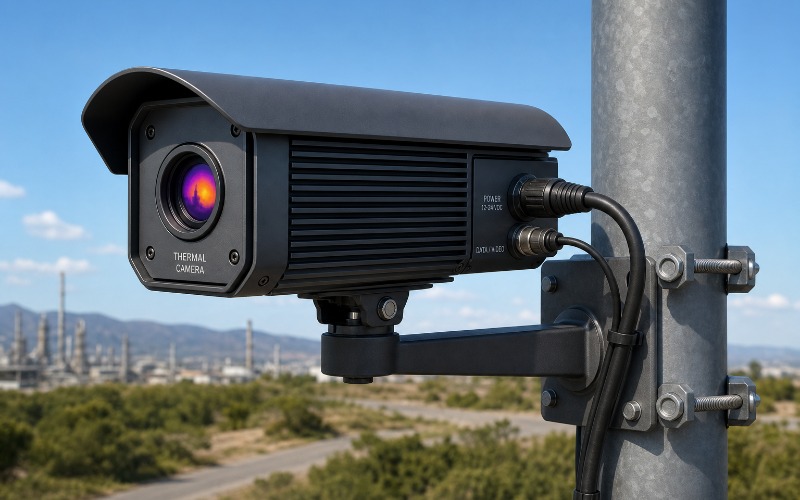
At the core of every thermal bullet camera lies a focal plane array (FPA) of vanadium oxide (VOx) microbolometers. Each pixel acts as a tiny thermometer that changes electrical resistance when heated by infrared radiation. The array is typically cooled only by a temperature stabilizer (TEC) to maintain consistent sensitivity, making it an uncooled detector—no cryogenic cooling required.
The incoming LWIR energy passes through a germanium or chalcogenide lens, which is transparent to 8–14 µm radiation. A mechanical shutter periodically calibrates the sensor to compensate for drift. The readout integrated circuit (ROIC) converts the resistance changes into a digital grayscale video signal. Proprietary algorithms then apply non-uniformity correction (NUC) and digital detail enhancement to produce a crisp thermal image.
Key Sensor Specifications
| Parameter | Typical Range | Impact on Performance |
|---|---|---|
| Resolution (FPA) | 320×240 to 640×512 | Higher resolution = more pixels on target = longer detection range |
| Pixel Pitch | 12 µm to 17 µm | Smaller pitch = smaller optics for same range; 12 µm is modern standard |
| NETD (Noise Equivalent Temperature Difference) | <30 mK (typical), <15 mK (high-end) | Lower NETD = better thermal contrast in low-temperature scenes |
| Frame Rate | 30 Hz or 60 Hz | 60 Hz needed for fast-moving objects (e.g., vehicles) |
| Field of View (FoV) | 6° to 50° (depends on lens) | Narrower FoV = longer range; wider FoV = situational awareness |
Comparison: Thermal Bullet Camera vs Standard Bullet Camera vs Thermal Dome
Choosing the right form factor depends on the environment and required detection capability. The table below compares the three common types.
| Feature | Thermal Bullet Camera | Standard (Visible) Bullet Camera | Thermal Dome Camera |
|---|---|---|---|
| Detection Basis | Infrared radiation (heat) | Visible light | Infrared radiation (heat) |
| Night Vision Without Illumination | Yes, complete darkness | Requires IR LEDs or low‑light sensor | Yes, complete darkness |
| Weather Performance | Excellent (fog, smoke, rain) | Poor in fog, glare | Good, but dome can fog up |
| Heat Dissipation | Superior (finned body) | Moderate | Limited (sealed dome) |
| Integration with PTZ | Easy (rigid mount) | Easy | Built‑in motor (more complex) |
| Typical Detection Range | 500 m to 5 km | <100 m (without IR) | Similar to bullet |
| Cost | Moderate to high | Low | High (includes gimbal) |
| Best Use Case | Long‑range perimeter, border, critical infrastructure | Short‑range access control | 360° coverage on poles, ships |
Design and Construction
Thermal bullet cameras are built for ruggedness. The cylindrical aluminum housing acts as a heatsink to pull heat away from the TEC and electronics, maintaining sensor stability in ambient temperatures from -40°C to +70°C. An integrated heater prevents the window from icing. The housing is typically IP67 or IP68 rated, with a sun shield and reinforced cable glands.
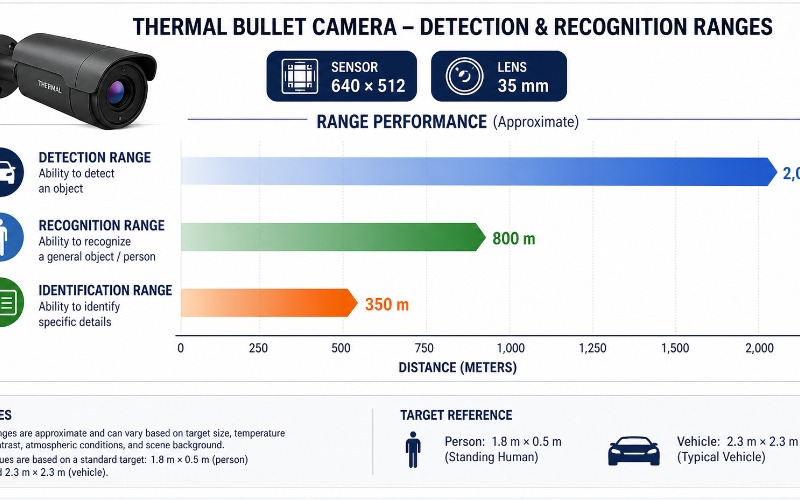
Lens options include fixed focal lengths like 13 mm, 19 mm, 25 mm, 35 mm, or motorized continuous zoom (e.g., 10–50 mm). The f-number (often f/1.0 or f/1.2) determines light gathering ability. For long-range applications, a narrow FoV (e.g., 6° with a 100 mm lens) combined with a 640×512 sensor and 12 µm pixel pitch can detect a human-sized object at over 4 km.
Applications of Thermal Bullet Cameras
Thermal bullet cameras excel where conventional cameras fail. Key sectors include:
- Critical Infrastructure: Power substations, oil & gas pipelines, and water treatment plants require 24/7 intrusion detection. Thermal bullets see through steam and dust.
- Border and Maritime Security: Mounted on towers or buoys, these cameras detect illegal crossings or small boats at night. Some models offer built-in video analytics for tripwire and loitering alarms.
- Military Force Protection: Forward operating bases use thermal bullets to detect persons carrying concealed weapons (since body heat reveals them) even through camouflage netting.
- Perimeter Fencing: Combined with radar, thermal bullets provide layered defense. A typical setup includes a 25mm lens enabling detection at 1.5 km.
- Airport and Seaport Surveillance: Runway inspections for foreign object debris (FOD) and detecting stowaways in cargo areas.
Advantages and Limitations
Advantages
- Passive operation: no emitted radiation, so undetectable by adversaries.
- Zero light dependence: works in total darkness without IR illuminators.
- Penetrates obscurants: can see through light fog, smoke, and dust.
- Reduces false alarms: thermal signature differentiates animals from humans.
- Low maintenance: sealed optics, no moving parts (except shutter).
Limitations
- Lack of color and texture: images are grayscale only, making license plate or facial recognition impossible.
- Lower resolution than visible cameras: even 640×512 is far less than 4K visible.
- Cost: typically 3–5 times more than an equivalent visible bullet camera.
- Environmental constraints: heavy rain or thick fog reduces effective range.
- Requires careful lens selection: wrong FoV can miss targets or sacrifice detail.
Selecting the Right Thermal Bullet Camera
When evaluating thermal bullet cameras for a project, consider the following parameters in order of priority:
- Detection Requirement: Define the target size (human, vehicle) and maximum distance. Use the Johnson Criteria to compute needed pixel resolution on target.
- Lens and FoV: Match the FoV to the area you need to monitor. Narrower FoV gives longer range but less coverage.
- Sensor Resolution and Pixel Pitch: 640×512 with 12 µm is the industry sweet spot for long range. For shorter distances, 320×240 with 17 µm may be cost-effective.
- Environmental Rating: IP67 minimum; IP68 for submerged or dusty environments. Look for an operating temperature range that matches your climate.
- Video Analytics: Built-in analytics (e.g., tripwire, intrusion detection, counting) reduce false alarms and bandwidth. Ensure compatibility with your VMS.
- Integration: Check for ONVIF compliance, PoE power, and support for h.264/h.265 compression.
Conclusion
A thermal bullet camera is the go-to choice for professionals who need reliable, long-range threat detection in darkness and adverse weather. Its uncooled VOx microbolometer technology, rugged bullet form factor, and ability to operate passively make it indispensable for critical infrastructure, border control, and military perimeters. While not a replacement for visible cameras in all scenarios, it excels where conventional surveillance breaks down. When selecting a thermal bullet camera, focus on NETD, lens selection, and resolution to match your specific detection distance and environmental conditions.
For more technical details on infrared detectors and thermal imaging modules, explore our resources on thermal camera cores and infrared detectors.
Frequently Asked Questions
Can a thermal bullet camera see through walls?
No. Thermal cameras detect surface temperature only. They cannot see through solid walls, glass, or thick foliage. However, they can detect heat from a person behind a thin curtain or through light smoke.
What is the difference between a thermal bullet camera and a thermal scope?
A thermal bullet camera is a fixed security camera designed for continuous perimeter monitoring. A thermal scope is a handheld or weapon-mounted monocular or binocular for short-term observation. Scopes often use cooled detectors for faster response, while bullet cameras use uncooled sensors for long life.
How far can a thermal bullet camera detect a person?
Detection range depends on sensor resolution, lens focal length, and weather. With a 640×512 sensor and 35 mm lens (about 17° FoV), a person-size target can be detected at 2–3 km. Recognition (determining if it’s a person vs. animal) typically happens at about 800 m–1 km. Identification (seeing details like uniform) is not possible with thermal alone.
Do thermal bullet cameras need Wi-Fi?
No, they typically use Power over Ethernet (PoE) or dedicated coaxial cables for video and control. Wi-Fi is rarely used because of interference and bandwidth limitations for high-resolution thermal video. Many models also support RS-485 for PTZ control.
What does NETD mean and why is it important?
NETD (Noise Equivalent Temperature Difference) measures the smallest temperature difference a thermal camera can detect. A lower NETD (e.g., 20 mK) provides sharper contrast in scenes with small thermal gradients, such as a person against a warm background. For security applications, an NETD ≤ 30 mK is recommended.