
China Moneypro
Types of Thermal Bullet Cameras for Security
Compare uncooled VOx and cooled InSb thermal bullet cameras for security. NETD, resolution, lens options, environmental ratings, and integration guidance for procurement.
Thermal bullet cameras are critical components in modern security systems, enabling detection and identification of threats in total darkness, through smoke, fog, and adverse weather. Their elongated form factor integrates a high-performance thermal sensor, optics, and processing electronics into a compact housing suitable for fixed-mount perimeter surveillance, critical infrastructure protection, and border security. For procurement officers and system designers, selecting the right thermal bullet camera requires deep understanding of detector types, resolution, optical design, and environmental toughness. This article delivers a definitive technical comparison of the key types and parameters you must evaluate.
Key Takeaways
- Uncooled VOx microbolometers dominate commercial thermal bullet cameras, offering NETD <30 mK and 12–17 μm pixel pitch for general security.
- Cooled InSb FPA detectors provide superior sensitivity (NETD <15 mK) but at higher cost and power, suited for long-range identification beyond 10 km.
- Resolution options range from 320×256 to 1280×1024; higher resolution allows wider field of view without sacrificing detection range.
- Lens selection (25–100+ mm) dictates detection, recognition, and identification ranges according to Johnson criteria.
- Environmental ratings (IP66/IP67, NEMA 4X, MIL-STD-810G) are mandatory for outdoor deployments; integrated wiper systems and heater windows add reliability.
- Modern cameras support H.265 video compression, ONVIF Profile T/G, and edge-based AI video analytics for human/vehicle classification.
Understanding Thermal Bullet Cameras
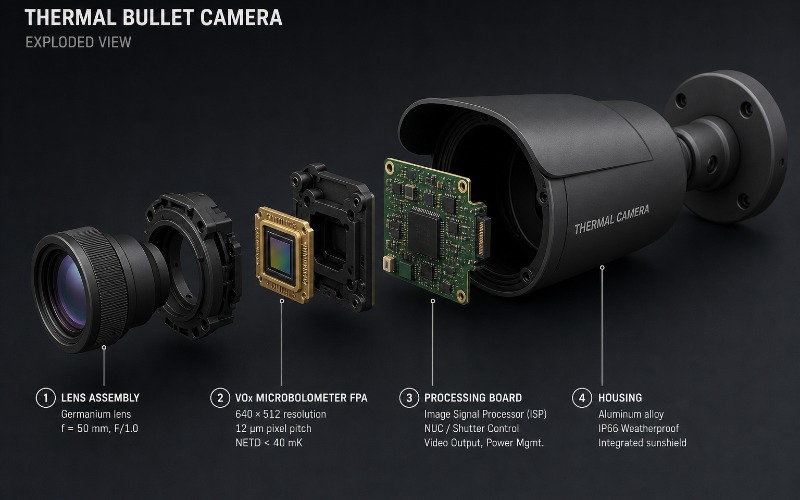
Thermal bullet cameras are defined by their cylindrical or bullet-shaped housing that houses a thermal imaging core, lens, and processing board. Unlike dome cameras, the bullet form factor offers directional aiming and superior heat dissipation, making it ideal for long-range linear perimeters such as fences, pipelines, and borders. The core component is the thermal detector focal plane array (FPA), which converts infrared radiation into electrical signals. Two primary technologies dominate the market: uncooled VOx microbolometers and cooled InSb or MCT detectors. Understanding their trade-offs is essential for procurement.
Key Parameters for Procurement
Before comparing types, establish the key performance indicators (KPIs) that drive procurement decisions in security applications:
- NETD (Noise Equivalent Temperature Difference): Measures thermal sensitivity. Lower is better; uncooled systems target <30 mK, cooled <15 mK.
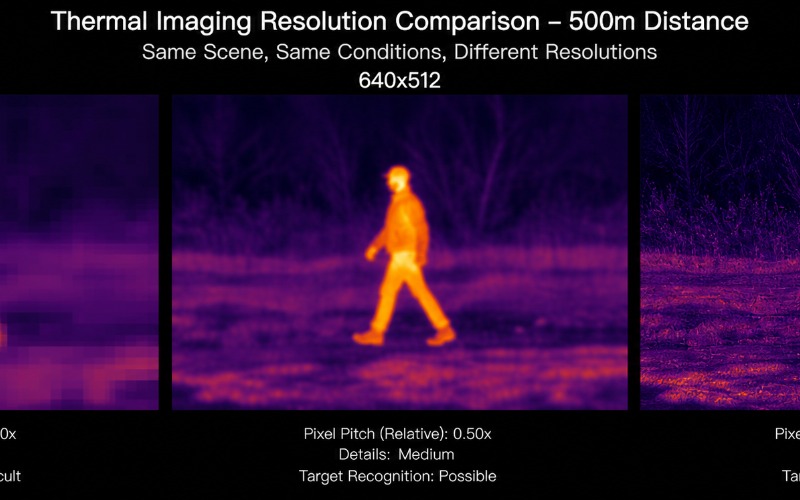
- Detector Pixel Pitch: 12 μm allows higher resolution in the same optical format vs 17 μm. Smaller pitch increases detection range for a given lens.
- Resolution (FPA Pixels): 320×256 is entry-level; 640×512 is standard; 1280×1024 offers high-definition thermal video.
- Focal Length & F-number: Longer lens gives narrower field of view but longer detection range. Lower F-number (e.g., F/1.0) improves light collection and NETD.
- Johnson Criteria Ranges: Standardize detection (2 pixels), recognition (8 pixels), identification (14 pixels) for a given target (typically 1.8 m × 0.5m human).
- Environmental Specifications: Operating temperature range, IP rating, shock/vibration, corrosion resistance, and icing mitigation.
- Video Output & Analytics: Analog (CVBS) is legacy; modern cameras output H.264/H.265 IP streams with ONVIF compliance and edge-based alarm rules.
Comparison of Thermal Detector Types
The most fundamental differentiator among thermal bullet cameras is the detector technology. The table below compares uncooled VOx microbolometers and cooled InSb focal plane arrays for security applications.
| Parameter | Uncooled VOx Microbolometer | Cooled InSb FPA |
|---|---|---|
| Typical Pixel Pitch | 12–17 μm | 10–15 μm |
| NETD (typical) | 20–30 mK | <15 mK |
| Wavelength Band | 8–14 μm (LWIR) | 3–5 μm (MWIR) |
| Cooling Requirement | None (thermally stabilized) | Stirling cycle cooler (3–7 W continuous) |
| Power Consumption | 1.5–3 W (without heater) | 10–15 W steady state |
| Warm-up Time | <5 s | 5–7 minutes |
| Typical Resolution Range | 320×256 to 1280×1024 | 320×256 to 640×512 |
| Relative Cost Factor | 1x (baseline) | 5–10x |
| Best Use Case | General perimeter, entry points, coastal | Long-range identification, border, maritime |
For most security installations, uncooled VOx microbolometers provide the best balance of performance, cost, and reliability. Cooled sensors are reserved for applications requiring detection of small targets beyond 5 km or where atmospheric transmission in MWIR is advantageous.
Resolution and Optical Configuration
Resolution directly affects the camera’s ability to detect and classify objects at distance. A 640×512 VOx detector with 12 μm pixel pitch and a 50 mm f/1.0 lens can detect a human-sized target (1.8 m × 0.5 m) at approximately 1,200 m, recognize at 300 m, and identify at 170 m (using Johnson criteria). Doubling the lens focal length to 100 mm roughly doubles these ranges but halves the field of view. Procurement officers should match resolution and lens to the required standoff distance and coverage width using validated range calculators.
Environmental and Mechanical Design
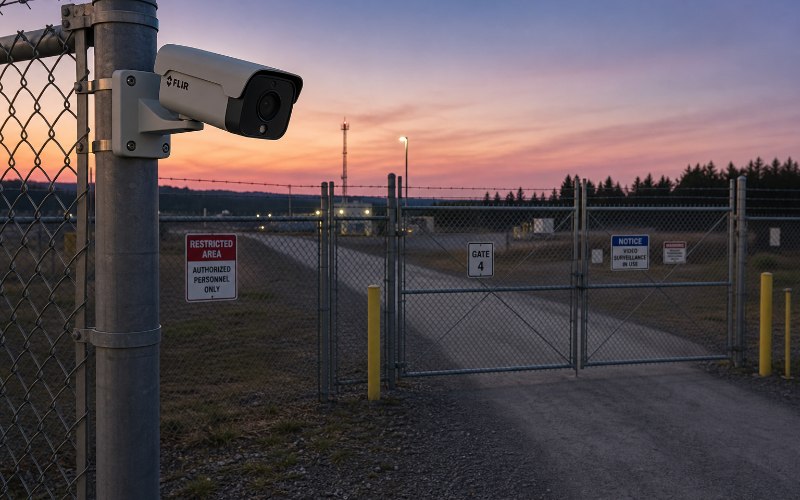
Security thermal bullet cameras must survive outdoor environments. Minimum criteria:
- IP66/IP67 rating for dust and water ingress. NEMA 4X adds corrosion protection for coastal areas.
- Operating temperature range –40°C to +65°C with solar load. Heated windows and internal thermal management (TEC) for the FPA are essential.
- Icing prevention: Built-in window heater or wiper for condensation/frost.
- Vibration and shock compliance to MIL-STD-810G or IEC 60068 for transportation and mounting stability.
- Sun shroud to reduce solar heat load and minimize false alarms from temperature gradients.
Housing materials matter: marine-grade aluminum (6061-T6, hard-coat anodized) or stainless steel for corrosive environments. Optical windows must be coated anti-reflective germanium (for LWIR) or sapphire (for MWIR) to maximize transmission.
Integration and Video Analytics
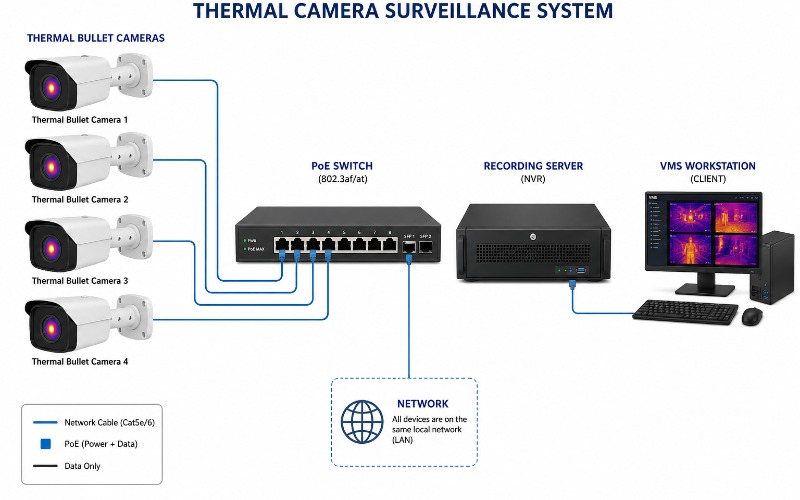
Modern thermal bullet cameras are IP-based with ONVIF Profile T (video) and Profile G (recording) support. They stream H.265 encoded video at full resolution and frame rate (typically 50/60 fps). Edge-based video analytics – such as tripwire, loitering detection, and human/vehicle classification – reduce false alarms and offload processing from central systems. Cameras with built-in Artificial Intelligence (AI) cores can run deep-learning models for distinguishing humans, animals, and vehicles. Ensure the camera supports open protocols for integration with major VMS platforms (e.g., Genetec, Milestone, Bosch) and includes secure boot, HTTPS, and 802.1X authentication.
Frequently Asked Questions
What NETD value should I specify for perimeter security?
For general perimeter surveillance, an NETD ≤30 mK is sufficient. For long-range identification ( >2 km) or in high-humidity environments, specify ≤20 mK. Cooled detectors with NETD <15 mK are reserved for specialty applications where every mK counts.
Can thermal bullet cameras be used in coastal environments?
Yes, but require NEMA 4X rated housings made from 316 stainless steel or marine-grade aluminum with powder coating. Additionally, optical windows must have anti-corrosion coatings (e.g., DLC on germanium). Integrated wipers and desiccant systems help manage salt spray and humidity.
What is the difference between LWIR and MWIR for bullet cameras?
Long-wave infrared (8–14 μm) is used by uncooled microbolometers, performs better in humid and dusty conditions. Mid-wave infrared (3–5 μm) is used by cooled detectors, offering higher contrast and better performance through atmospheric windows for distant targets. MWIR also has higher frame rate capability (up to 1 kHz) for capturing fast-moving objects.
Conclusion
Choosing the right thermal bullet camera for security requires systematic evaluation of detector technology, resolution, optics, and environmental robustness. For most applications, uncooled VOx microbolometers with 640×512 resolution and a 50–75 mm lens offer the best cost-performance ratio. Cooled cameras are reserved for extreme range or adverse atmospheric conditions. Always validate performance using Johnson criteria range tables and insist on ONVIF compliance and edge analytics for future-proof integration.
To discuss your specific procurement requirements and access technical datasheets, contact our engineering team at Moneypro Gimbal.