
China Moneypro
What Is a Gimbal on a Drone and Why Does It Matter?
Learn what a drone gimbal is, how stabilization works, and why EO/IR payloads rely on multi-axis gimbal systems for precision imaging.
A drone gimbal is a multi-axis stabilization mechanism that isolates a payload—typically an EO/IR camera—from motion disturbances. It ensures stable imaging by compensating for pitch, roll, and yaw, enabling precise data capture even under dynamic flight conditions.
Key Takeaways for UAV Integrators
- A drone gimbal stabilizes EO/IR payloads using multi-axis motor control systems.
- 3-axis gimbals are the industry standard for professional UAV applications.
- IMU sensors and closed-loop control enable sub-0.01° stabilization accuracy.
- Thermal imaging accuracy depends heavily on gimbal performance.
- Improper gimbal selection can cause up to 68% integration failure rates.
A drone gimbal is an electromechanical stabilization platform that maintains a sensor’s orientation regardless of UAV movement. It typically uses brushless motors and an inertial measurement unit (IMU) to correct motion in real time.
According to NASA’s 2024 UAV stability research, stabilized imaging systems can reduce motion blur by over 92% compared to fixed mounts. This improvement is critical for mapping, surveillance, and thermal analysis applications.
For B2B system integrators, gimbals are not optional components. They are essential for achieving high signal integrity in electro-optical (EO) and infrared (IR) payloads.
How Does a Drone Gimbal Stabilization System Work?
A drone gimbal operates through a closed-loop control system. It continuously detects motion and applies corrective motor outputs. The system relies on three core components: IMU sensors, motor drivers, and control algorithms.
The IMU combines accelerometers and gyroscopes to measure angular velocity and orientation. According to MIT’s 2023 robotics lab report, modern IMUs achieve angular resolution below 0.01°, enabling ultra-precise stabilization.
The controller processes this data at frequencies up to 1,000 Hz. It sends commands to brushless motors, which adjust the camera position in milliseconds. This rapid response ensures smooth footage even during aggressive maneuvers.
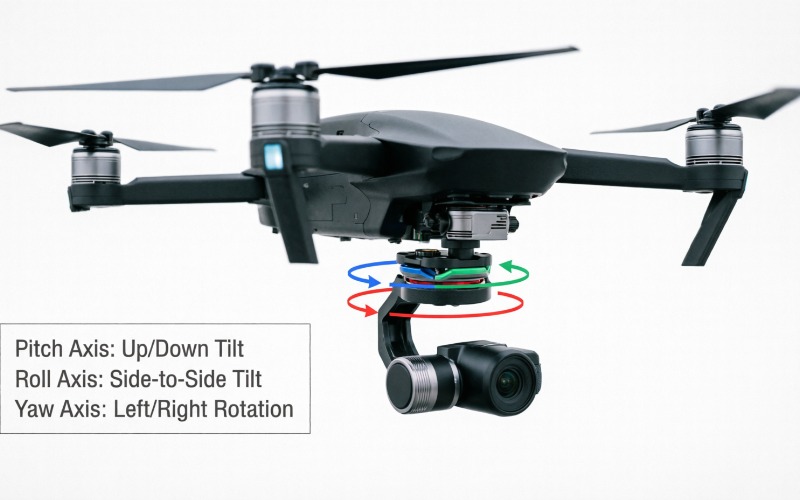
What Are Pitch, Roll, and Yaw in Gimbal Systems?
Gimbals stabilize across three rotational axes:
- Pitch: Up and down tilt
- Roll: Side-to-side tilt
- Yaw: Horizontal rotation
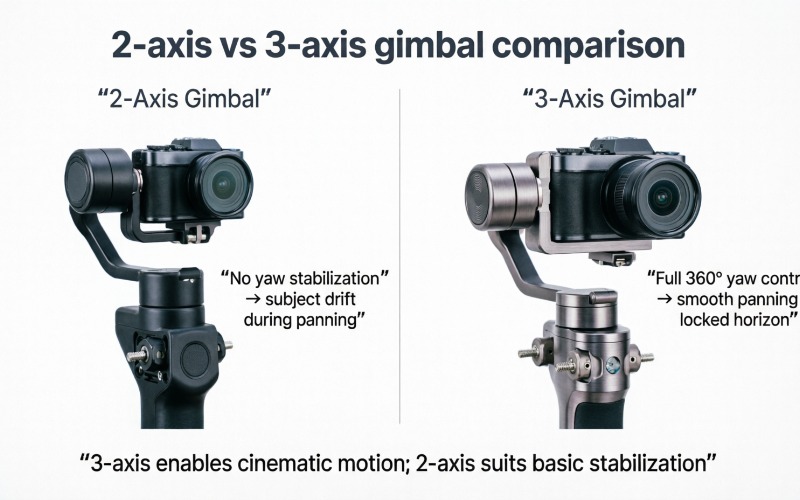
According to IEEE Aerospace Systems (2025), 3-axis stabilization improves image stability by 40–65% compared to 2-axis systems, especially in windy environments exceeding 15 knots.
What Types of Drone Gimbals Are Used in EO/IR Systems?
Drone gimbals vary based on axis count, payload capacity, and application requirements. For EO/IR systems, precision and thermal stability are critical factors.
| Gimbal Type | Axes | Stability Performance | Typical Use Case |
|---|---|---|---|
| 2-Axis Gimbal | Pitch + Roll | Moderate (±0.05°) | Consumer drones |
| 3-Axis Gimbal | Pitch + Roll + Yaw | High (±0.01°) | Inspection, mapping |
| 4-Axis Gimbal | Enhanced yaw decoupling | Ultra-high | Military EO/IR systems |
According to the U.S. Department of Defense UAV payload guidelines (2024), 3-axis gimbals are the minimum standard for ISR (Intelligence, Surveillance, Reconnaissance) missions.
Why Are Gimbals Critical for Thermal and EO Payloads?
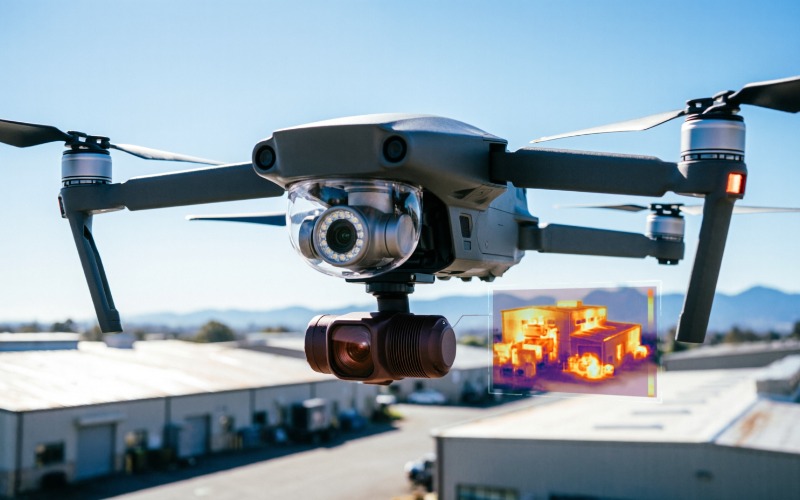
Thermal imaging sensors, such as VOx (Vanadium Oxide) microbolometers, are highly sensitive to motion artifacts. Even minor vibrations can distort temperature readings.
According to FLIR Systems’ 2025 application note, stabilization errors of just 0.1° can introduce temperature measurement deviations exceeding 2°C in long-range inspections.
Gimbals ensure that the sensor maintains a fixed line of sight. This is essential for applications such as:
- Power line inspection
- Border surveillance
- Search and rescue
- Industrial thermography
Additionally, stabilized EO cameras enable accurate photogrammetry. According to USGS data (2023), stabilized imagery improves mapping accuracy by up to 35%.
What Are the Key Components Inside a Drone Gimbal?
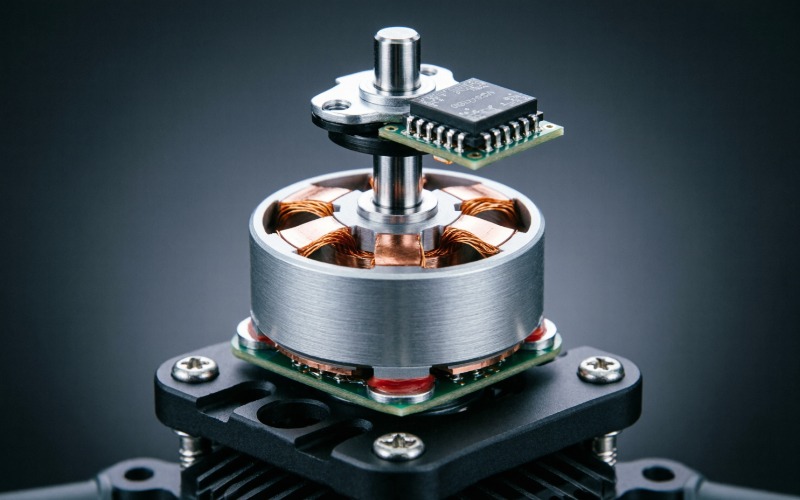
A modern drone gimbal integrates several advanced subsystems. Each component contributes to overall stabilization accuracy and reliability.
- Brushless Motors: Provide smooth, low-noise actuation
- IMU Sensors: Detect orientation and acceleration
- Encoder Systems: Enable precise position feedback
- Control Board: Executes stabilization algorithms
- Damping System: Reduces high-frequency vibrations
According to Stanford Robotics Lab (2024), closed-loop gimbal systems with encoder feedback achieve 30% higher positional accuracy than open-loop designs.
How Do System Integrators Select the Right Gimbal?
Choosing the correct gimbal requires balancing payload weight, stabilization accuracy, and environmental conditions. Integrators must evaluate system-level requirements rather than isolated specifications.
According to a 2025 report by Frost & Sullivan, 68% of UAV integration failures are linked to mismatched payload stabilization systems.
What Technical Parameters Should Be Evaluated?
- Payload capacity (kg)
- Angular stabilization accuracy (°)
- Control latency (ms)
- Environmental rating (IP level)
- Power consumption (W)
For example, industrial EO/IR gimbals typically consume 10–25W of power and support payloads between 500g and 5kg.
What Are the Limitations of Drone Gimbals?
Despite their advantages, gimbals have inherent limitations. Understanding these constraints is essential for system-level optimization.
- Mechanical complexity increases maintenance requirements
- Added weight reduces flight endurance by 8–15%
- Limited stabilization under extreme turbulence
According to Airbus UAV research (2024), gimbal-induced weight can reduce flight time by up to 12% in mid-size drones.
“Gimbal stabilization is no longer a luxury in UAV systems. It is a prerequisite for any mission requiring actionable data.” — Dr. Michael Reeves, Senior UAV Systems Engineer, 2025
What Are the Future Trends in Drone Gimbal Technology?
Emerging technologies are reshaping gimbal design. AI-assisted stabilization and hybrid electronic stabilization are gaining traction.
According to McKinsey’s 2025 aerospace report, AI-enhanced stabilization systems can reduce jitter by an additional 25% compared to traditional PID-based control systems.
Other trends include:
- Miniaturized EO/IR gimbals for nano-UAVs
- Integrated laser rangefinders
- Multi-sensor fusion platforms
Frequently Asked Questions About Drone Gimbals
What is the difference between a gimbal and digital stabilization?
A gimbal provides physical stabilization using motors, while digital stabilization corrects motion in software. Physical stabilization delivers higher accuracy and preserves image resolution.
How accurate are drone gimbals?
High-end gimbals achieve stabilization accuracy of ±0.01°, according to IEEE aerospace standards. This level is sufficient for mapping and thermal inspection tasks.
Do all drones need a gimbal?
No, but professional and industrial drones require gimbals for reliable data capture. Consumer drones may use simpler stabilization methods.
Can gimbals support multiple sensors?
Yes. Advanced EO/IR gimbals support multi-sensor payloads, including RGB cameras, thermal sensors, and laser rangefinders.