
China Moneypro
Understanding Atmospheric Transmission Windows in EO/IR Systems
Learn about atmospheric transmission windows in EO/IR systems, including their significance, types, and role in system design.
Key Takeaways
- Atmospheric transmission windows are critical for EO/IR system performance.
- They define the wavelengths through which optical and infrared signals pass through the atmosphere.
- Understanding these windows is essential for optimizing sensor designs in various environmental conditions.
- Different transmission windows serve unique applications, from thermal imaging to laser communication.
- System integrators must consider transmission window characteristics when selecting optical components and designing systems.
What Are Atmospheric Transmission Windows?
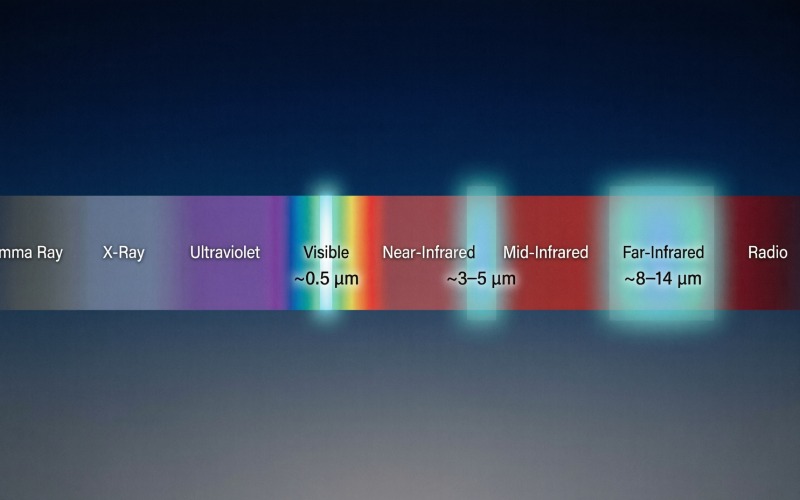
Atmospheric transmission windows refer to specific ranges of wavelengths in the electromagnetic spectrum where the atmosphere allows light, including infrared (IR) radiation and optical signals, to pass through with minimal attenuation. These windows are crucial for a variety of technologies, such as electro-optical (EO) and infrared (IR) systems, which rely on the transmission of light through the atmosphere to capture images or perform other functions.
In the context of EO/IR systems, understanding atmospheric transmission windows is key to optimizing sensor performance. These systems are often used in military, surveillance, and industrial applications, where clarity and precision of data acquisition are critical. In this article, we will explore the different atmospheric transmission windows, their characteristics, and how they impact EO/IR system design.
Why Atmospheric Transmission Windows Matter for EO/IR Systems
The performance of EO/IR systems heavily depends on the atmosphere’s ability to transmit electromagnetic radiation. In ideal conditions, certain wavelengths of light and infrared radiation pass through the atmosphere without significant interference. However, atmospheric conditions such as clouds, humidity, and temperature can affect transmission. Atmospheric transmission windows play a crucial role in understanding which wavelengths can be effectively used under various environmental conditions.
For EO/IR systems, these transmission windows are typically divided into different bands, each offering unique benefits and challenges. The ability to select the correct transmission window for a specific application can determine whether the system will function effectively in a given environment.
Types of Atmospheric Transmission Windows
There are several key atmospheric transmission windows that are most commonly utilized in EO/IR systems. Each of these windows is associated with specific parts of the electromagnetic spectrum:
Optical Transmission Window (0.4 to 1.4 µm)
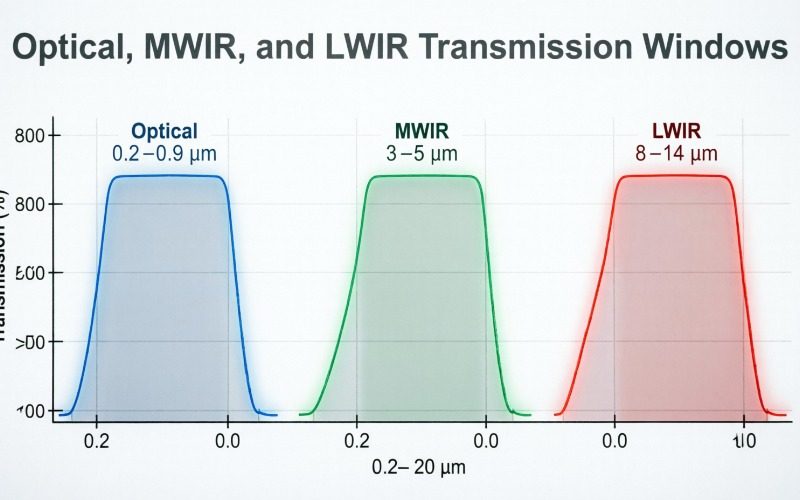
The optical transmission window covers the wavelengths between 0.4 to 1.4 micrometers (µm). This range is particularly important for visible light and near-infrared (NIR) sensors. The optical window is critical for systems that require high-resolution imaging under clear sky conditions, such as satellite imaging, night vision, and security cameras.
However, this window can be influenced by atmospheric scattering, such as Rayleigh scattering, which limits its effectiveness over long distances. For applications that require imaging over extended ranges, it may be necessary to use other transmission windows.
Mid-Wave Infrared (MWIR) Transmission Window (3 to 5 µm)
The mid-wave infrared (MWIR) window spans the range of 3 to 5 µm and is widely used for thermal imaging. MWIR systems are effective at detecting heat signatures in the environment, making them ideal for military, search and rescue, and surveillance applications. The MWIR window offers relatively low atmospheric attenuation, allowing for good performance even in conditions with moderate humidity and temperature fluctuations.
Long-Wave Infrared (LWIR) Transmission Window (8 to 12 µm)
The long-wave infrared (LWIR) window, which covers wavelengths from 8 to 12 µm, is commonly used in thermal imaging and infrared sensing. LWIR sensors are capable of detecting the thermal radiation emitted by objects, even in low-light conditions, making them valuable for surveillance and security systems.
This window has excellent transmission characteristics, especially in clear, dry conditions. However, its effectiveness can be significantly impacted by atmospheric absorption, particularly in regions with high levels of water vapor.
Far-Infrared (FIR) and Terahertz (THz) Windows (100 µm to 1 mm)
The far-infrared (FIR) and terahertz (THz) transmission windows, spanning from 100 µm to 1 mm, are primarily used for specialized applications, such as material detection and non-invasive scanning. These windows offer a higher level of penetration through dense materials, which is valuable for industrial and security purposes.
How Atmospheric Conditions Affect Transmission Windows
Atmospheric conditions significantly influence the effectiveness of transmission windows. For example, the presence of moisture, dust, or aerosols can cause scattering and absorption of electromagnetic radiation, reducing signal strength and clarity. Furthermore, the amount of water vapor in the atmosphere, temperature gradients, and other factors can cause variations in the transparency of specific transmission windows.
One of the most critical elements affecting transmission is water vapor, especially in the MWIR and LWIR bands. Water vapor can absorb infrared radiation, which limits the range of these windows. This is why systems operating in these bands need to consider the environmental conditions carefully. In contrast, the optical window is generally less affected by moisture but can suffer from scattering, especially over longer distances or in foggy conditions.
Optimizing EO/IR System Design Using Transmission Windows
System integrators must consider the characteristics of atmospheric transmission windows when designing EO/IR systems. Each window offers unique advantages and limitations depending on the application. For example, systems designed for outdoor surveillance in clear weather conditions may benefit from the optical window, while systems intended for search-and-rescue operations in foggy or cloudy conditions may rely more on MWIR or LWIR bands.
In addition to the wavelength selection, factors such as sensor sensitivity, calibration, and environmental adaptability must also be taken into account. Systems should be optimized for the specific atmospheric conditions expected in the deployment area to ensure reliability and effectiveness.
Challenges in Atmospheric Transmission for Long-Range EO/IR Systems
While atmospheric transmission windows provide critical performance parameters, challenges remain when it comes to long-range EO/IR systems. For long-range sensing, the signal degradation caused by atmospheric interference—such as scattering, absorption, and distortion—becomes more pronounced. This is particularly the case in areas with high humidity, pollution, or particulate matter in the air.
Advanced EO/IR systems often incorporate technologies such as adaptive optics, image processing, and multi-spectral fusion to mitigate these challenges. These techniques help improve image clarity and reduce the impact of atmospheric conditions on system performance.
Conclusion
Atmospheric transmission windows are a crucial factor in the design and performance of EO/IR systems. Understanding the characteristics of these windows—along with the impact of environmental conditions—is key for optimizing sensor design and system integration. By carefully selecting the appropriate transmission window, system integrators can ensure that their EO/IR systems operate effectively under various conditions, from clear skies to heavy fog or rain.
FAQ
What are atmospheric transmission windows?
Atmospheric transmission windows are specific wavelength ranges where the atmosphere allows light and infrared radiation to pass through with minimal absorption or scattering.
Why do EO/IR systems depend on transmission windows?
EO/IR systems rely on atmospheric transmission windows because they determine the ability of these systems to capture light or infrared signals through the atmosphere, which is essential for clear imaging and sensing
Which transmission window is best for thermal imaging?
The MWIR (3 to 5 µm) and LWIR (8 to 12 µm) windows are most commonly used for thermal imaging, with the MWIR offering lower attenuation under moderate atmospheric conditions.
How does water vapor affect transmission windows?
Water vapor, especially in the MWIR and LWIR ranges, can absorb infrared radiation, reducing the transmission of signals and limiting the effectiveness of these windows in humid environments.
How can system integrators optimize EO/IR system performance?
System integrators must carefully select the appropriate transmission window based on the expected environmental conditions and consider factors like sensor sensitivity, calibration, and atmospheric interference.
This is part of our Infrared & Thermal Technology section. For a complete view of all relevant knowledge about EO/IR, please visit our Knowledge Hub center.