
China Moneypro
10 Essential Specs for Handheld Thermal Imaging Camera
Master the technical specs of handheld thermal imaging tools including NETD, pixel pitch, and FPA resolution to optimize your procurement and inspection ROI.
In the high-stakes world of industrial inspection, electrical maintenance, and building diagnostics, the technical performance of handheld thermal imaging tools determines the difference between a successful preventative catch and a catastrophic system failure. As a senior optoelectronics engineer, I have seen procurement cycles fail because buyers focused on aesthetic features rather than core physics. This guide provides a deep-dive into the ten most critical technical specifications that product specifiers must evaluate to ensure superior infrared performance.
Key Takeaways
- Prioritize VOx microbolometers with NETD less than 30mK for high-contrast imaging.
- Transitioning to 12μm pixel pitch allows for more compact, high-resolution optics.
- Focal Plane Array resolution of 640 x 480 is the baseline for professional-grade diagnostics.
- Frame rates of 30Hz or higher are mandatory for handheld stability and moving targets.
- Spatial resolution or IFOV determines the safe working distance for accurate measurement.
Thermal Sensitivity NETD Defines Signal Quality
Noise Equivalent Temperature Difference (NETD) is the single most important metric for assessing the quality of a thermal sensor. It represents the smallest temperature difference the camera can detect before the signal is lost in electronic noise. In professional handheld tools, specifying a device with NETD less than 30mK at 30°C is now the industry standard for high-performance applications.
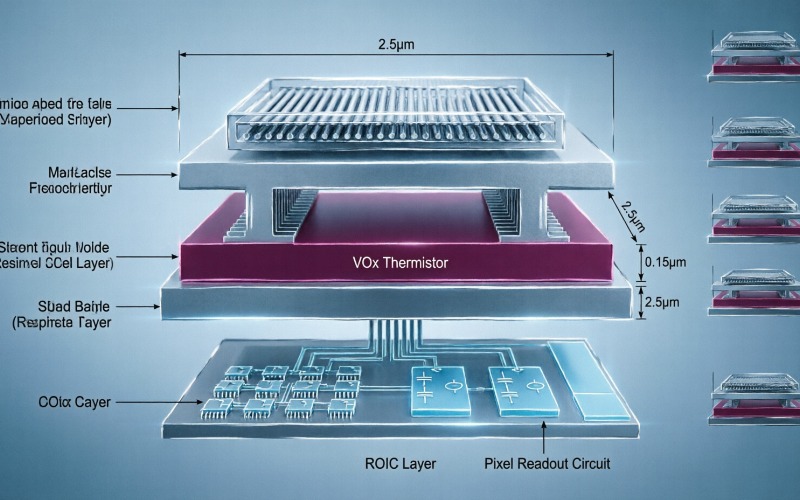
Lower NETD values result in images with significantly less “grain” or “snow,” which is particularly vital in low-contrast scenes where the target and background have similar temperatures. For instance, in building science, identifying moisture intrusion requires the ability to see differences as small as 0.03°C. A sensor with poor sensitivity will simply show a flat, featureless image. High-quality Vanadium Oxide (VOx) microbolometers consistently outperform amorphous Silicon (a-Si) sensors in thermal sensitivity, making VOx the preferred choice for specifiers seeking precision.
Infrared Resolution and Focal Plane Array Density
Infrared resolution refers to the number of individual detector pixels on the Focal Plane Array (FPA). Unlike digital cameras with millions of pixels, thermal sensors operate on a much smaller scale due to the complexity of IR-sensitive materials. For professional handheld thermal imaging cameras, a resolution of 640 x 480 (307,200 pixels) is the recommended benchmark.
Beware of “interpolated” resolutions. Some lower-end manufacturers use software algorithms to upscale a 160 x 120 sensor image to a higher resolution. This does not add actual thermal data points; it merely smooths the edges. True optical resolution is required for accurate temperature measurement of small components, such as a loose connection on a distant terminal block. When resolution increases, the camera can capture more detail at a greater distance, directly impacting the safety of the operator.
Pixel Pitch and the Shift to 12 Micrometers
Pixel pitch is the center-to-center distance between adjacent pixels on the FPA, typically measured in micrometers (μm). The industry has rapidly shifted from 17μm to 12μm technology. This reduction is not merely a matter of miniaturization; it is a fundamental shift in optical engineering.
A 12μm pixel pitch allows for a smaller sensor footprint while maintaining high resolution. This allows manufacturers to utilize smaller Germanium lenses, which are the most expensive component of a thermal camera. For the end-user, this means a lighter, more ergonomic handheld tool that offers the same Field of View (FOV) and Instantaneous Field of View (IFOV) as a much larger 17μm system. Smaller pixels also tend to have lower thermal mass, potentially leading to faster response times, though this requires sophisticated read-out integrated circuits (ROIC) to maintain low noise levels.
Field of View FOV and Spatial Resolution IFOV
Field of View (FOV) describes the horizontal and vertical extent of the scene the camera can see. A wide FOV (e.g., 42°) is excellent for close-range indoor inspections like scanning electrical panels. A narrow FOV (e.g., 12°) acts like a telephoto lens, ideal for substation inspections or power line monitoring.
However, the more critical spec for accuracy is Instantaneous Field of View (IFOV), also known as spatial resolution. Measured in milliradians (mrad), IFOV defines the smallest object a camera can resolve at a specific distance. If your target is smaller than one pixel at your working distance, the camera will “average” the target temperature with the background, leading to a massive measurement error. For high-precision handheld work, an IFOV of 1.0 mrad or lower is often required to ensure that a single pixel covers the entire area of interest on a small component.
Temperature Measurement Range and Dynamic Calibration
Handheld tools must be calibrated for specific temperature ranges. A standard industrial camera might cover -20°C to +650°C, while high-temperature models can reach +1500°C or +2000°C for kiln or furnace inspections. It is a mistake to simply buy the widest range possible.
The wider the temperature range, the lower the thermal resolution often becomes within a specific “slice” of that range. Advanced tools offer multiple range settings (e.g., -20 to 150°C and 100 to 650°C). Specifiers should look for “automatic range switching,” where the camera dynamically adjusts its internal gain to optimize the signal-to-noise ratio based on the hottest object in the scene. Accuracy is also paramount; look for ±2% or ±2°C as the minimum acceptable standard for professional diagnostics.
Frame Rate and Motion Fluidity
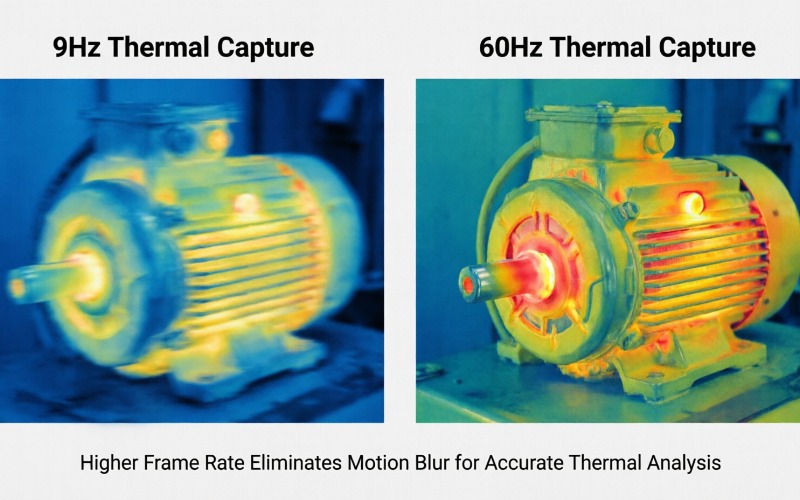
Frame rate, measured in Hertz (Hz), indicates how many times the image is refreshed per second. Standard handheld cameras usually come in 9Hz or 25Hz/30Hz/60Hz versions. The 9Hz limitation is often a result of international export controls (such as US ITAR regulations) rather than technical limitations.
For any handheld application, 30Hz or higher is essential. A 9Hz camera will produce a “choppy” image as the operator pans across a target, making it difficult to spot intermittent anomalies and causing significant eye strain. In high-speed industrial environments where the operator is moving or the target is rotating, a high frame rate is the only way to capture a blur-free, accurate thermal signature.
Spectral Range and Atmospheric Windows
Most handheld thermal cameras operate in the Long-Wave Infrared (LWIR) band, typically from 7.5μm to 14μm. This is the “atmospheric window” where the Earth’s atmosphere is most transparent to IR radiation and where objects at room temperature emit most of their energy.
However, some specialized applications require Mid-Wave Infrared (MWIR) or specific narrow-band filters. For example, detecting certain gases (Optical Gas Imaging) or looking through glass (which is opaque to LWIR) requires specific spectral tuning. For 95% of industrial handheld applications, LWIR is the correct choice, but specifiers must ensure the coating on the Germanium lens is optimized for this specific band to maximize transmission efficiency.
Image Processing Algorithms and Super Resolution
Raw data from a microbolometer is rarely what the user sees on the screen. Modern handheld tools employ sophisticated image processing. Features like “Super Resolution” use the natural micro-movements of the operator’s hand to combine multiple frames into a single image with quadruple the effective pixel count.
Additionally, look for Multi-Spectral Dynamic Imaging (MSX) or similar fusion technologies. These algorithms extract edge detail from an onboard visible-light camera and emboss it onto the thermal image. This allows the user to read labels, identify components, and understand the context of a heat signature without losing any thermal data. This is a critical productivity spec that reduces the time spent on report generation.
Ergonomics and Display Performance
A handheld tool is only as good as the user’s ability to see the data. A high-brightness, high-contrast display (at least 3.5 inches, but preferably larger) with a wide viewing angle is necessary for outdoor work under direct sunlight.
Ergonomics also play a role in technical performance. A rotating lens assembly allows the operator to keep the screen at eye level while inspecting targets at awkward angles, such as high overhead or ground-level equipment. This reduces fatigue and ensures the operator maintains a stable grip, which is essential for the sharpest possible image capture.
Connectivity and Cloud Integration
In the era of Industry 4.0, a thermal camera is a data collection node. Specifying tools with integrated Wi-Fi and Bluetooth is mandatory. This allows for the instant upload of images to cloud-based management systems, enabling remote experts to analyze data in real-time.
Furthermore, look for cameras that support the METERLiNK protocol or similar, which allows the thermal camera to pull in electrical data from a clamp meter or moisture data from a hygrometer and embed it directly into the thermal image file. This creates a comprehensive diagnostic record that is indispensable for insurance and compliance purposes.
Technical Specification Comparison Table
| Specification | Entry-Level Industrial | Professional Diagnostic | High-End Research/Utility |
|---|---|---|---|
| FPA Resolution | 160 x 120 | 320 x 240 | 640 x 480 or higher |
| Thermal Sensitivity (NETD) | <100mK | <50mK | <30mK |
| Pixel Pitch | 17μm | 17μm / 12μm | 12μm |
| Frame Rate | 9Hz | 25Hz / 30Hz | 60Hz |
| Temperature Accuracy | ±3% or ±3°C | ±2% or ±2°C | ±1% or ±1°C |
| Focus Type | Fixed | Manual / Auto | Continuous Auto Focus |
Frequently Asked Questions
What is the difference between VOx and a-Si sensors?
Vanadium Oxide (VOx) sensors typically offer higher thermal sensitivity (lower NETD) and better stability than amorphous Silicon (a-Si) sensors. VOx is the industry standard for high-end professional thermal imaging tools due to its superior signal-to-noise ratio.
Why is a 12μm pixel pitch better than 17μm?
A 12μm pixel pitch allows for a smaller sensor that can use smaller, lighter, and less expensive lenses while maintaining the same resolution. It represents the latest generation of microbolometer technology, offering better portability without sacrificing spatial resolution.
Does a higher resolution always mean a better camera?
Resolution is critical, but it must be paired with high sensitivity (NETD) and quality optics. A high-resolution camera with a high NETD will produce a grainy image, while a high-resolution camera with a poor lens will suffer from optical blurring and measurement errors.
Is 9Hz enough for industrial inspections?
While 9Hz can work for stationary objects, it is generally insufficient for professional handheld use. The lag makes it difficult to navigate complex environments and can lead to missed anomalies during a sweep. 30Hz or higher is strongly recommended.