
China Moneypro
Cooled vs Uncooled Thermal Imagers: A Complete Security Guide
Discover the definitive engineering differences between cooled vs uncooled thermal imagers. Optimize long-range security with EO/IR systems. Read more.
In the world of high-end surveillance and Aerospace & Defense, thermal imaging is not a monolithic technology. When selecting an Electro-Optical/Infrared (EO/IR) gimbal payload, the most critical decision you will face is the choice between Cooled (MWIR) and Uncooled (LWIR) sensors.
This guide breaks down the technical physics, operational performance, and total cost of ownership (TCO) to help you choose the right system for your mission-critical applications.
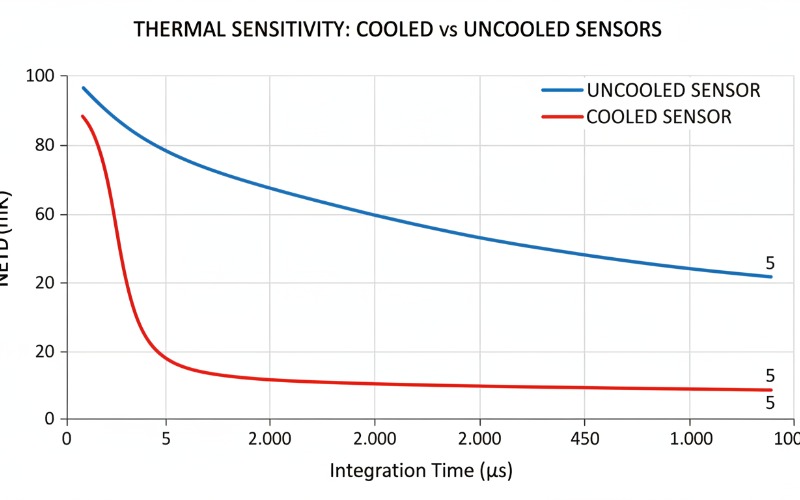
When evaluating a cooled vs uncooled thermal imager for long-range security, the primary distinction lies in operating temperature and wavelength. Cooled MWIR cameras offer superior sensitivity (NETD < 20mK) and extreme focal lengths for multi-kilometer detection, whereas uncooled LWIR microbolometers provide maintenance-free, cost-effective continuous performance for mid-range perimeter defense.
Key Takeaways
- Cooled thermal imagers utilize cryogenic coolers to reduce thermally-induced noise, offering unmatched sensitivity and multi-kilometer detection ranges.
- Uncooled thermal microbolometers operate at ambient temperatures, making them highly reliable with zero cryocooler maintenance requirements.
- For ultra-long-range border, coastal, and counter-UAS surveillance, cooled Mid-Wave Infrared (MWIR) systems consistently outperform uncooled Long-Wave Infrared (LWIR) sensors.
- Total Cost of Ownership (TCO) is significantly lower for uncooled systems, but cooled cameras remain absolutely critical for long-range threat identification and advanced EO/IR integrated payloads.
As an optoelectronics engineer and a security architect, choosing the right thermal imaging payload is the most critical decision in designing a perimeter defense or long-range threat detection system. The debate between a cooled vs uncooled thermal imager is not merely about price; it is a fundamental engineering tradeoff involving solid-state physics, atmospheric transmission, optical materials, and total lifecycle management. By understanding the core mechanics of how these infrared sensors collect, process, and display thermal signatures, security professionals can deploy the most effective surveillance architecture available. This comprehensive guide will dissect the fundamental engineering principles and practical field applications of both cooled and uncooled thermal detection systems.
The Physics of Thermal Detectors: Cooled vs Uncooled Technologies
Thermal cameras detect infrared radiation rather than visible light. However, the “infrared” spectrum is divided into two primary bands used for security:
Uncooled (LWIR – Long Wave Infrared)
- Wavelength: 8μm – 14μm.
- Sensor Type: Vanadium Oxide (VOx) or Polysilicon Microbolometers.
- How it works: The sensor measures the change in resistance as it is heated by incoming infrared radiation. It operates at ambient temperature, requiring no internal cooling system.
Cooled (MWIR – Mid-Wave Infrared)
- Wavelength: 3μm – 5μm.
- Sensor Type: InSb (Indium Antimonide) or MCT (Mercury Cadmium Telluride).
- How it works: The sensor is integrated with a Stirling Cryocooler, which drops the detector temperature to approximately 77 Kelvin (-196°C). This eliminates “thermal noise,” allowing the sensor to be incredibly sensitive to minute temperature differences.
Cooled thermal cameras are predominantly photon detectors. Built from semiconductor materials like Indium Antimonide (InSb), Mercury Cadmium Telluride (HgCdTe or MCT), or Type-II Superlattices (T2SL), these sensors directly convert incoming infrared photons into a measurable electronic signal. Because room-temperature heat generates a massive amount of thermal noise that would completely drown out the infrared signals from distant objects, these detectors must be cryogenically cooled. Integrated Stirling cycle cryocoolers reduce the sensor temperature to approximately 77 Kelvin (-196°C). This extreme reduction in thermal noise results in a Noise Equivalent Temperature Difference (NETD) of less than 20 millikelvins (mK), providing an astoundingly crisp, high-contrast image even at extreme distances.
Conversely, uncooled thermal imagers utilize thermal detectors, predominantly Vanadium Oxide (VOx) or Amorphous Silicon (a-Si) microbolometers. When infrared radiation strikes an uncooled microbolometer, the physical material absorbs the energy, causing a minute fluctuation in its electrical resistance. This change in resistance is subsequently measured and converted into an image. Because they do not rely on direct photon counting, microbolometers can operate efficiently at room temperature. While modern VOx uncooled microbolometers have seen incredible advancements—achieving NETDs in the range of 30 to 50 mK—they fundamentally cannot match the sheer sensitivity and rapid integration times of their cryogenically cooled counterparts.
Learn more about cooled vs uncooled infrared detectors.
Why Cooled MWIR Wins at Long Range
Due to the shorter wavelength (3-5μm), MWIR light experiences less diffraction. This allows engineers to use smaller pixel pitches (e.g., 10μm or 12μm) and achieve higher magnification with smaller lenses compared to LWIR. For a Coastal Surveillance mission, a Cooled MWIR camera can detect a small boat at 15km, whereas an Uncooled system would require a massive, impractical lens to achieve half that distance.
Technical Specification Matrix: Cooled vs Uncooled Systems
When engineering an integrated electro-optical (EO/IR) platform, strict adherence to technical specifications is required. Below is a comprehensive engineering comparison matrix highlighting the distinct capabilities of both systems.
| Engineering Specification | Cooled Thermal Imager (MWIR) | Uncooled Thermal Imager (LWIR) |
|---|---|---|
| Detector Architecture | Photon Detector (InSb, MCT, T2SL) | Thermal Detector (VOx, a-Si Microbolometer) |
| Wavelength Spectrum | 3 to 5 μm (Mid-Wave Infrared) | 8 to 14 μm (Long-Wave Infrared) |
| Thermal Sensitivity (NETD) | Typically < 20 mK | Typically 30 mK to 50 mK |
| Operating Temperature | Cryogenically Cooled (~77K) | Ambient / Room Temperature |
| Cooling Mechanism | Integrated Stirling Cryocooler | Thermoelectric Cooler (TEC) or TEC-less |
| Mean Time Between Failures (MTBF) | 10,000 – 15,000 hours (Cooler Rebuild) | > 50,000 hours (Virtually Maintenance-Free) |
| Optimal Surveillance Range | Ultra-Long Range (10km to 25km+) | Short to Mid-Range (1km to 5km) |
| Lens Compatibility | Continuous Optical Zoom (Large Focal Lengths) | Athermalized Fixed or Moderate Zoom Lenses |
Evaluating Optical Range and Performance in Security Applications
In the realm of long-range security architectures, optical performance is quantified using Johnson’s Criteria, which defines the probability of Detection, Recognition, and Identification (DRI). A cooled vs uncooled thermal imager assessment must inherently focus on these DRI metrics to ensure the system meets operational requirements. Cooled MWIR systems operate in the 3 to 5 micron wavelength band. Because the wavelength is shorter compared to the 8 to 14 micron band used by uncooled LWIR systems, optical designers can achieve significantly longer focal lengths using smaller, lighter lens assemblies. A 1000mm continuous zoom lens on a cooled MWIR camera is a standard deployable asset for coastal and border security, allowing operators to identify small vessels or individual human threats at ranges exceeding 15 kilometers.
Uncooled LWIR cameras struggle to achieve matching focal lengths without adopting impractically large and prohibitively expensive Germanium optics. Furthermore, because uncooled sensors require a larger pixel pitch to maintain sensitivity, capturing long-range detail becomes exponentially more difficult. For mid-range perimeter security, such as monitoring a 3-kilometer fenceline around a critical infrastructure facility, a high-resolution VOx uncooled thermal imager is completely sufficient and highly cost-effective.
In my two decades of engineering and deploying integrated EO/IR systems for high-value asset protection, I have witnessed this limitation firsthand. During a specialized coastal defense deployment in Southeast Asia, the facility had initially installed premium uncooled LWIR microbolometers. However, the heavy maritime humidity and dense coastal fog effectively choked the 8-14 micron transmission window. The uncooled systems could barely detect incoming skiffs past 2 kilometers. By swapping the payload to a T2SL cooled MWIR system equipped with a 600mm continuous zoom lens, we cut through the atmospheric moisture efficiently. The cooled thermal imager shifted our detection range to 12 kilometers and allowed for positive target identification at 5 kilometers, profoundly altering the security posture of the installation.
When to Choose Uncooled (LWIR)
Uncooled systems are the “workhorses” of tactical and industrial security.
- Perimeter Security: Protecting 500m to 2km boundaries around power plants or warehouses.
- Tactical UAVs: Short-range ISR (Intelligence, Surveillance, Reconnaissance) where weight and battery life are critical.
- Fire Detection: Identifying hotspots in high-temperature industrial environments.
When to Choose Cooled (MWIR)
Cooled systems are high-precision instruments for strategic assets.
- Border & Coastal Patrol: Detecting human intruders or vessels at extreme distances (10km+).
- C-UAS (Counter-Drone): Tracking small, fast-moving drones against a cold sky background.
- Maritime Environments: MWIR performs significantly better than LWIR in high-humidity conditions (fog/sea mist) due to the specific “atmospheric window” of the 3-5μm band.
Atmospheric Transmission Windows and Environmental Constraints
Choosing between a cooled vs uncooled thermal imager also requires an in-depth understanding of atmospheric attenuation. The Earth’s atmosphere absorbs, scatters, and refracts infrared energy depending on the specific environmental conditions and the wavelength in use. Cooled sensors generally operate in the Mid-Wave Infrared (MWIR) band. This spectral window is exceptionally proficient at penetrating high humidity, dense marine fog, and heavy precipitation. For coastal surveillance, shipborne EO/IR turrets, and maritime search and rescue operations, the MWIR band is universally preferred.
Conversely, uncooled sensors operate predominantly in the Long-Wave Infrared (LWIR) band. The LWIR band excels in penetrating battlefield smoke, heavy dust, and light haze. Moreover, terrestrial objects at ambient temperatures peak in their thermal emission within the 8 to 14 micron range, making uncooled LWIR cameras incredibly effective for short-range human detection, industrial monitoring, and ground-based perimeter defense in dry environments. To further your understanding of how atmospheric scattering affects optical sensors, SPIE Digital Library provides outstanding peer-reviewed literature on infrared physics.
Cost-to-Performance Ratio and Total Cost of Ownership (TCO)
While optical superiority firmly belongs to the cooled thermal imager, the Total Cost of Ownership (TCO) narrative dramatically favors the uncooled thermal imager. The inclusion of a Stirling cryocooler introduces a highly complex, mechanical moving part into the camera payload. Continuous operation of the cryocooler results in mechanical wear; therefore, cooled thermal cameras require a costly cooler rebuild or replacement every 10,000 to 15,000 operational hours. Consequently, operating a cooled thermal camera 24/7/365 necessitates an ongoing maintenance budget and planned downtime.
Uncooled VOx and a-Si microbolometers are solid-state devices with absolutely zero moving parts for thermal regulation. They boast an impressive Mean Time Between Failures (MTBF) exceeding 50,000 hours. An uncooled camera can be mounted on a mast, connected to a power source and video management system, and effectively ignored for a decade. This maintenance-free lifecycle makes uncooled thermal cameras the undisputed champion for large-scale, mass-deployment perimeter security networks where hundreds of cameras are required. To optimize your network, consider evaluating specialized VOx microbolometer solutions engineered for harsh environments.
Counter-UAS and Advanced Threat Detection Architectures
The rapid proliferation of Unmanned Aerial Systems (UAS) and drone technology has forced a paradigm shift in long-range security. Small, battery-operated commercial drones present a minuscule thermal signature and a highly reduced Radar Cross Section (RCS). Detecting these threats requires extremely fast integration times and unmatched thermal sensitivity. Cooled thermal imagers are practically mandatory for dedicated Counter-UAS (C-UAS) systems. Because photon detectors operate at such high speeds, they can effectively freeze the motion of fast-moving aerial targets, allowing automated video analytics and AI-driven tracking algorithms to lock onto the drone accurately. Uncooled cameras, with their slower thermal response times, often suffer from motion blur when tracking rapid aerial targets, reducing the effectiveness of the overall integrated EO/IR payload.
Making the Strategic Choice for Long-Range Security Architectures
The definitive answer to the cooled vs uncooled thermal imager debate is dictated entirely by your operational parameters. If your mission demands identifying a vehicle at 15 kilometers, detecting low-flying drones, or securing a maritime border heavily obscured by marine humidity, the upfront investment and ongoing maintenance of a cooled MWIR thermal camera are non-negotiable. It is the gold standard for long-range, high-fidelity thermal surveillance.
However, if your objective is to establish an impenetrable electronic perimeter around a 5-kilometer critical infrastructure facility, a solar farm, or an airport boundary, deploying an array of uncooled LWIR thermal cameras will yield a significantly higher Return on Investment (ROI). The uncooled architecture provides continuous, automated, and maintenance-free threat detection that easily integrates into modern VMS platforms without inflating operational expenditures.
Action-Oriented Closure: Elevate Your Perimeter Defense
Selecting the optimal thermal sensor requires a deep analysis of your local atmospheric conditions, required DRI ranges, and available lifecycle budgets. Do not leave your critical infrastructure vulnerable to misapplied optical technology.
Choosing between Cooled and Uncooled thermal imaging is a balance of Distance vs. Budget.
- Select Uncooled LWIR if your mission is short-range (<3km), requires “instant-on” capability, and has a limited budget for long-term maintenance.
- Select Cooled MWIR if your mission requires maximum DRI (10km+), high-speed target tracking, or operates in humid/maritime environments.
At China Moneypro, we specialize in integrating both Cooled and Uncooled sensors into high-stability, multi-axis gyro-stabilized gimbals. Our engineering team can help you calculate the exact DRI requirements for your specific AO (Area of Operations).
Frequently Asked Questions
What is the maximum detection range of a cooled thermal imager?
A high-performance cooled MWIR thermal imager paired with a continuous optical zoom lens (e.g., 1000mm or 1200mm) can detect large objects, such as naval vessels or aircraft, at ranges exceeding 25 kilometers. Human detection is frequently achievable at ranges between 10 to 15 kilometers, heavily dependent on atmospheric conditions and the specific NETD of the sensor array.
How often does a cryocooler need maintenance?
Modern rotary and linear Stirling cryocoolers typically have an operational lifespan ranging from 10,000 to 15,000 hours. For a camera running continuously (24/7/365), this translates to approximately 14 to 20 months of operation before the cooler requires a factory rebuild, vacuum re-pressurization, or complete replacement.
Can uncooled thermal cameras be used for drone detection?
While uncooled LWIR thermal cameras can detect drones at very short ranges, they are generally not recommended as the primary optical payload for Counter-UAS missions. Their slower integration times can lead to target blurring, and their limited focal lengths restrict early warning detection capabilities compared to high-speed MWIR photon detectors.
Why are cooled cameras primarily MWIR instead of LWIR?
While cooled LWIR systems do exist (often utilizing MCT or QWIP detectors), cooled systems predominantly utilize the Mid-Wave Infrared (3-5 micron) band because MWIR sensors offer excellent thermal contrast and superior transmission through high-humidity environments. Additionally, the shorter wavelength of MWIR allows engineers to design smaller, lighter, and more powerful continuous zoom lenses, which are essential for long-range surveillance applications.