
China Moneypro
Thermal Imager: Complete Guide for EO/IR Systems
Master the integration of a thermal imager in EO/IR systems. Explore VOx microbolometers, cooled MWIR detectors, SWaP-C optimization, and PID control.
A thermal imager in EO/IR systems is an advanced optoelectronic sensor designed to detect mid-wave (MWIR) or long-wave (LWIR) infrared radiation. Modern platforms rely on either cooled InSb/MCT detectors for extreme long-range acquisition or uncooled VOx microbolometers to optimize Size, Weight, Power, and Cost (SWaP-C).
Key Takeaways
- Uncooled VOx microbolometers dominate tactical SWaP-C limited platforms due to their high reliability and lower power consumption.
- Cooled MWIR sensors utilizing Indium Antimonide (InSb) or Mercury Cadmium Telluride (MCT) architectures provide superior stand-off ranges and higher sensitivity.
- Noise Equivalent Temperature Difference (NETD) and focal plane pixel pitch dictate the absolute thermal imager performance and Johnson’s Criteria probabilities.
- Advanced thermal imaging payloads require robust continuous zoom germanium optics, real-time image processing, and meticulous athermalization.
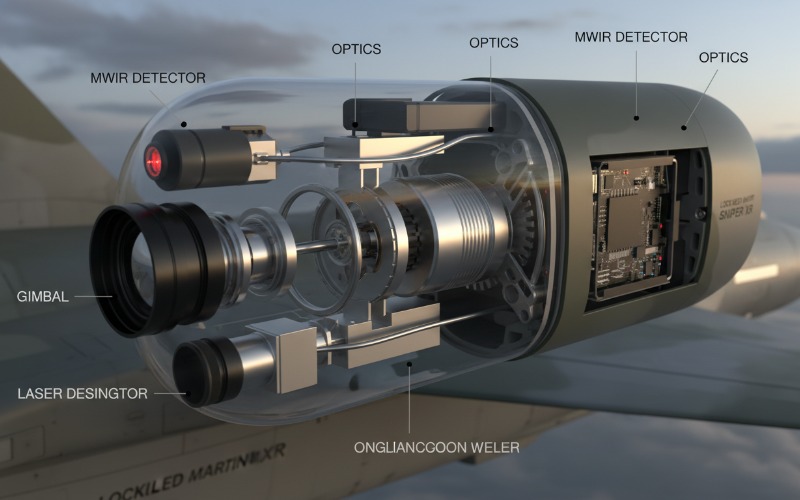
A high-performance thermal imager forms the structural backbone of modern integrated Electro-Optical/Infrared (EO/IR systems). For systems engineers and defense contractors, understanding the intricate mechanical, optical, and algorithmic dependencies of infrared technology is non-negotiable. Designing an airborne gimbal, naval targeting pod, or highly mobile ground combat vehicle requires meticulously matching the specific thermal imager architecture to the operational theater parameters. In this comprehensive engineering guide, we will decompose the critical technologies, specifications, and integration challenges associated with military-grade infrared thermal imaging systems.
Core Thermal Imager Detector Architectures
When engineering an EO/IR payload, the foundational decision involves selecting the appropriate detector technology. The spectrum of thermal imaging broadly divides into two operational categories: uncooled and cooled architectures. Each presents unique advantages and distinct engineering compromises.
Uncooled VOx Microbolometer Technology
Uncooled thermal imagers predominantly rely on VOx microbolometers operating in the Long-Wave Infrared (LWIR) spectrum, typically covering the 8 to 14-micron wavelength band. Unlike photonic detectors, microbolometers function via thermal resistance variations. When incoming infrared radiation strikes the microbolometer’s pixel array, the Vanadium Oxide material absorbs the heat, causing a precise change in electrical resistance. Consequently, an integrated Read-Out Integrated Circuit (ROIC) translates these minute resistance shifts into a digital video stream.
The engineering appeal of uncooled systems lies fundamentally in their solid-state nature. Because they lack a mechanical cryocooler, uncooled thermal imagers possess virtually unlimited operational lifespans. Furthermore, they drastically reduce power consumption, making them the superior choice for dismounted troops, battery-operated Unmanned Aerial Vehicles (UAVs), and autonomous perimeter defense networks. The primary trade-off, however, resides in detection range and absolute thermal sensitivity when compared to their cooled counterparts.
Cooled MWIR and LWIR Detectors
Conversely, a cooled thermal imager operates on photonic detection principles, largely within the Mid-Wave Infrared (MWIR) 3 to 5-micron band. These optoelectronic sensors rely on advanced semiconductor materials such as Indium Antimonide (InSb), Mercury Cadmium Telluride (MCT), or Type-II Superlattices (T2SL). To prevent the detector’s own thermal energy from blinding the highly sensitive focal plane, the sensor must be cryogenically cooled to approximately 77 Kelvin. Therefore, engineers integrate Stirling cycle rotary or linear coolers directly into the sensor package.
This extreme cooling delivers unprecedented Noise Equivalent Temperature Difference (NETD) metrics and enables ultra-fast integration times, effectively freezing fast-moving targets without motion blur. Consequently, cooled architectures are mandatory for long-range target acquisition, missile warning systems, and advanced aerial combat operations. The penalties for this performance include significant increases in physical footprint, power draw, monetary cost, and the ongoing maintenance requirements of the mechanical cryocooler assemblies.
| Technical Specification | Uncooled VOx (LWIR) | Cooled InSb/MCT (MWIR) |
|---|---|---|
| Operational Wavelength | 8 to 14 microns | 3 to 5 microns |
| Operating Temperature | Ambient (Usually TEC-less) | ~77K (Cryocooled) |
| NETD Sensitivity | Typically < 40mK | Typically < 15mK |
| System SWaP-C | Low / Highly Optimized | High Power / Heavy / Expensive |
| Optimal Application Matrix | Dismounted troops, small UAVs | Long-range targeting, maritime patrol |
Critical Specifications Dictating System Performance
Selecting a thermal imager demands rigorous quantitative analysis. Defense contractors cannot rely on superficial marketing metrics; they must evaluate the exact physics driving the sensor. Two of the most critical specifications are NETD and FPA resolution parameters.
Noise Equivalent Temperature Difference (NETD)
NETD represents the absolute thermal sensitivity of the system. It defines the smallest temperature difference the thermal imager can distinguish from the background noise. Measured in milliKelvins (mK), a lower NETD value denotes superior performance. For instance, a tactical uncooled VOx sensor might advertise an NETD of 35mK at f/1.0, while a cooled sensor might achieve less than 15mK. A lower NETD drastically enhances the imager’s ability to operate in degraded visual environments (DVE) such as dense fog, heavy rain, or high humidity, where thermal contrast is severely attenuated.
Focal Plane Array (FPA) Resolution and Pixel Pitch
The physical geometry of the Focal Plane Array directly governs spatial resolution. Pixel pitch refers to the physical distance between the centers of two adjacent pixels, measured in micrometers (microns). Over the past decade, the industry has aggressively reduced pixel pitch from 17 microns down to 12 microns, and currently pushing into 8-micron territories for uncooled systems. Furthermore, reducing the pixel pitch allows engineers to either increase the total resolution (e.g., migrating from 640×512 to 1280×1024 High Definition) without expanding the detector’s physical footprint, or drastically shrink the entire payload while maintaining legacy resolutions.
Crucially, pixel pitch impacts optics. A smaller pixel pitch allows a thermal imager to achieve a narrower Field of View (FOV) and greater magnification using a significantly smaller, lighter objective lens. This is a primary driver in SWaP-C (Size, Weight, Power, and Cost) optimization strategies across modern defense acquisitions.
First-Person Experience: Airborne Gimbal Integration
During a recent integration of a multi-sensor payload on a high-altitude tactical UAV, I encountered severe thermal drift within the uncooled thermal imager module. The dynamic environmental temperature variations during rapid ascent caused the localized focal plane array to deviate significantly from its factory calibration curves. This manifested as aggressive fixed-pattern noise across the video feed, jeopardizing target tracking.
To solve this critical failure, I spearheaded the implementation of an advanced shutterless Non-Uniformity Correction (NUC) algorithm utilizing localized scene-based reference points. Furthermore, we engineered a customized Proportional-Integral-Derivative (PID) control loop directly interfacing with the microbolometer’s underlying substrate heater. This hands-on, algorithmically driven PID adjustment stabilized the thermal equilibrium, eliminated the spatial noise completely, and preserved our strict SWaP-C margins. Ultimately, this approach saved the project from necessitating heavier, mechanized shutter assemblies and cost-prohibitive hardware redesigns.
Advanced Optical Subsystems and Lens Athermalization
The raw performance of a thermal imager is entirely bottlenecked by its optical front-end. Unlike visible spectrum cameras that utilize standard silica glass, thermal infrared wavelengths cannot penetrate conventional glass. Instead, engineers must specify exotic materials such as germanium lens assemblies, Zinc Selenide (ZnSe), or specialized Chalcogenide glasses. Germanium is the undisputed standard for LWIR due to its high refractive index, though it suffers from significant weight and extreme temperature sensitivity.
As germanium’s temperature shifts, its refractive index changes dynamically, causing the thermal imager to spontaneously lose focus. To combat this, precision lens designers employ mechanical or passive athermalization techniques. Passive athermalization involves combining multiple infrared materials with opposing thermal expansion coefficients, effectively canceling out the focus drift. Furthermore, high-end EO/IR systems utilize Continuous Zoom (CZ) optical layouts, allowing operators to seamlessly transition from wide situational awareness fields of view down to highly magnified targeting focal lengths without losing spatial tracking.
Digital Video Processing and FPGA Architectures
Capturing raw analog resistance shifts is only the initial step. Generating a tactical-grade video stream demands formidable backend processing, typically executed via custom Field Programmable Gate Arrays (FPGAs) or integrated System-on-Chip (SoC) architectures. The analog signals are digitized through ultra-low noise Analog-to-Digital Converters (ADCs).
Once digitized, the FPGA executes intensive image processing pipelines. This includes 2-point Non-Uniformity Correction (NUC) to eliminate pixel-to-pixel response deviations. Following NUC, advanced algorithms like Contrast Limited Adaptive Histogram Equalization (CLAHE) compress the massive 14-bit dynamic range of the thermal scene into a visually distinguishable 8-bit stream optimized for human monitors. Additionally, modern thermal imagers utilize edge-enhancement filters, local area processing, and dead-pixel replacement matrices to guarantee flawless video outputs even in highly chaotic thermal environments.
Addressing SWaP-C in Tactical Defense Programs
Within the defense sector, SWaP-C constraints dictate the viability of every thermal imager integration. Minimizing Size, Weight, and Power while controlling Cost requires holistic systems engineering. Modern advancements utilize Wafer-Level Packaging (WLP) to vacuum-seal microbolometers directly on the silicon wafer during semiconductor fabrication, bypassing bulky metal or ceramic packages. Consequently, this innovation enables the production of thermal imaging cores smaller than a conventional sugar cube.
Furthermore, transitioning from discrete FPGA architectures to Application-Specific Integrated Circuits (ASICs) drastically slashes power consumption. Engineers continuously balance these variables, ensuring that a drone payload remains light enough to guarantee extensive loiter times without sacrificing the identification ranges established by Johnson’s Criteria. According to standards backed by DARPA research, maintaining high thermal sensitivity while halving the battery payload fundamentally shifts the tactical advantage.
Integration Protocols and Digital Video Interfaces
Integrating the thermal imager into the broader EO/IR mission computer requires robust, high-bandwidth data interfaces. Legacy analog interfaces like RS-170 or NTSC/PAL are entirely obsolete in high-definition digital systems. Today, defense engineers rely on uncompressed digital standards. Camera Link and CoaXPress offer massive bandwidth for raw, 14-bit radiometric data essential for secondary machine vision processing and autonomous target recognition (ATR).
Alternatively, GigE Vision is heavily favored for distributed vehicle architectures, allowing standard Ethernet infrastructure to transport thermal video alongside command telemetry. For highly miniaturized airborne payloads, the MIPI CSI-2 interface has crossed over from the mobile phone industry, providing tremendous data throughput with absolutely minimal power and pin-count requirements. Navigating these protocols correctly ensures zero latency between the imager’s capture and the operator’s display.
Environmental Qualifications and MIL-STD Reliability
A thermal imager operating within defense EO/IR systems must survive brutal environmental extremes. Engineering specifications demand rigorous adherence to MIL-STD-810G and MIL-STD-461 testing protocols. The imager must endure extreme shock and random vibration profiles mirroring tracked combat vehicles or rotary-wing aircraft operations.
Additionally, the enclosures undergo explosive decompression testing, salt fog immersion, and aggressive thermal cycling from -40°C to +71°C. To achieve this, engineers rely on hermetic sealing, specialized conformal coatings on the PCB layouts, and ruggedized internal chassis structures. Any failure in the thermal imager’s reliability immediately blinds the host platform, making meticulous mechanical engineering just as critical as the underlying optoelectronics. Extensive resources on ruggedization can be found through authorized platforms like the SPIE Digital Library.
Frequently Asked Questions
How does pixel pitch affect thermal imager detection range?
A smaller pixel pitch allows engineers to fit more pixels onto a given focal plane area. Consequently, this increases the spatial resolution and puts more pixels on target at longer distances, directly improving Detection, Recognition, and Identification (DRI) ranges according to Johnson’s Criteria without requiring larger, heavier optics.
What is the difference between MWIR and LWIR in high humidity environments?
Mid-Wave Infrared (MWIR) typically performs better in high humidity and marine environments because water vapor absorbs less infrared energy in the 3-5 micron band compared to the Long-Wave Infrared (LWIR) 8-14 micron band. Therefore, defense contractors prefer MWIR for long-range naval and coastal surveillance.
How often does a cooled thermal imager require cryocooler maintenance?
Cooled thermal imagers utilize Stirling cycle cryocoolers which have moving parts and degraded helium seals over time. Typically, a high-quality linear cryocooler requires factory servicing or replacement every 10,000 to 20,000 operating hours, making Mean Time Between Failures (MTBF) a critical specification for continuous monitoring applications.
Can a thermal imager see through glass?
No, standard thermal imagers cannot see through conventional silica glass because standard glass reflects and absorbs infrared radiation in the MWIR and LWIR spectrums. Instead, thermal imaging lenses must be manufactured from materials transparent to infrared, such as Germanium, Chalcogenide glass, or Zinc Selenide.
Conclusion and Engineering Next Steps
Successfully integrating a thermal imager into highly complex EO/IR systems is a definitive test of advanced engineering. Whether manipulating PID control loops to stabilize uncooled microbolometers or integrating ultra-sensitive cooled MWIR sensors for aerospace defense, maintaining a firm grasp on the underlying physics is essential. Optoelectronics continues to advance rapidly, pushing the boundaries of what is possible within strict tactical SWaP-C constraints.
If you are actively engineering a multi-sensor payload or require deep-dive analysis on sensor matching, do not leave your integration to chance. Download my comprehensive Integration Checklist for EO/IR Systems, or Schedule my Equipment Consultation to architect your exact thermal payload specifications today.