
China Moneypro
Choosing VOx Resolution for Handheld Infrared Cameras
Expert guide on selecting VOx resolution for handheld IR cameras. Optimize IFOV, NETD, and spatial resolution for professional thermal imaging inspections.
In the rapidly evolving landscape of thermal imaging technology, selecting the appropriate resolution for a Vanadium Oxide (VOx) uncooled microbolometer is the most critical decision for any technical buyer or lead engineer. Handheld infrared cameras have transitioned from low-resolution diagnostic tools to high-precision analytical instruments capable of identifying thermal anomalies with surgical accuracy. This deep-dive technical guide explores the engineering nuances of Focal Plane Array (FPA) resolution and how to align sensor specifications with specific industrial application requirements.
Key Takeaways
- Higher VOx resolution directly translates to superior Instantaneous Field of View (IFOV) and target identification.
- The transition from 17μm to 12μm pixel pitch allows for more compact handheld designs without sacrificing spatial resolution.
- NETD values below 30mK are essential for high-contrast thermal imaging in low-gradient environments.
- Resolution choice should be dictated by the smallest target size and the maximum safe inspection distance.
- The optical system must be matched to the sensor resolution to avoid diffraction-limited performance bottlenecks.
VOx Microbolometer Technology Fundamentals
Vanadium Oxide (VOx) remains the industry standard for uncooled thermal detectors. Unlike amorphous Silicon (a-Si), VOx offers a higher Temperature Coefficient of Resistance (TCR), which results in a higher Signal-to-Noise Ratio (SNR) and better thermal sensitivity. When we discuss resolution in the context of a Focal Plane Array, we are referring to the number of individual detector elements, or pixels, on the sensor surface. For handheld IR cameras, this resolution determines the density of data points captured in a single frame.
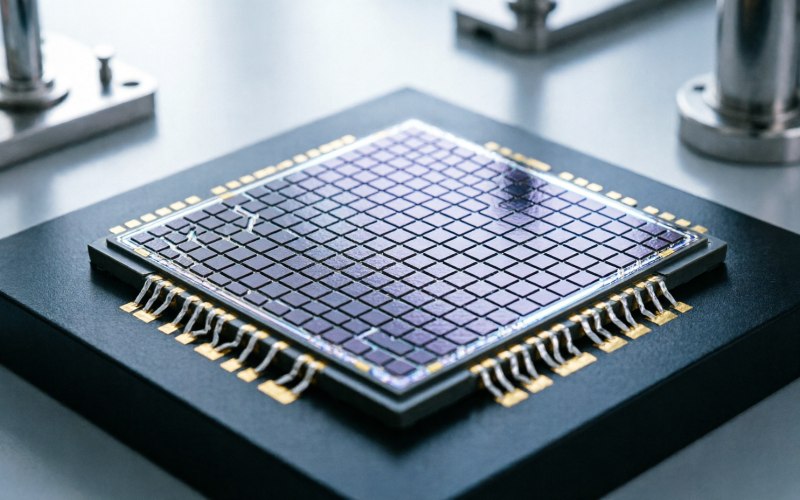
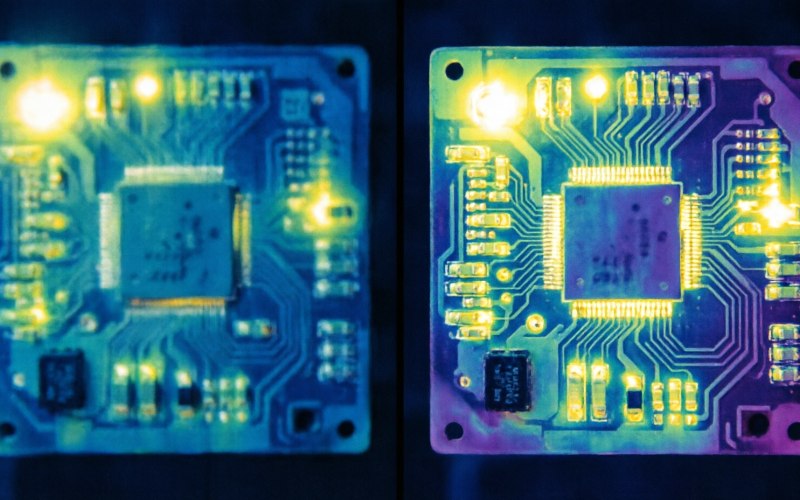
The resolution of the FPA is the primary driver of spatial resolution. Spatial resolution defines the smallest detail that can be seen by the camera at a given distance. In engineering terms, this is often expressed through the Instantaneous Field of View (IFOV). A higher resolution sensor with a 640×512 matrix provides significantly more pixels on target than a 160×120 entry-level sensor, allowing for more precise temperature measurements of small components like electrical connectors or PCB traces from a safe distance.
The Impact of Pixel Pitch on Handheld Design
The physical size of each pixel, known as pixel pitch, has seen a significant reduction from 25μm to 17μm, and now to the current industry leading 12μm pixel pitch. This reduction is vital for handheld IR cameras. A smaller pixel pitch allows for a higher resolution sensor to be integrated into a smaller physical package. More importantly, it permits the use of smaller, lighter germanium lenses to achieve the same optical magnification and field of view.
However, as pixel size decreases, the amount of infrared energy each pixel can collect also decreases. This is where the excellence of VOx material becomes apparent. By maintaining a high fill factor and utilizing advanced MEMS fabrication techniques, modern 12μm VOx sensors can achieve an NETD <30mK, ensuring that the reduction in pixel size does not lead to a noisier image. For the technical buyer, a 12μm 640×512 sensor is often the optimal balance between portability and high-definition thermal performance.
Comparing Common Thermal Resolutions
Choosing the right resolution requires an understanding of the trade-offs between cost, processing power, and thermal detail. Below is a comparison of the most common VOx resolutions found in professional handheld systems.
| Resolution | Total Pixels | Best Use Case | IFOV Capability |
|---|---|---|---|
| 160 x 120 | 19,200 | Basic HVAC, Home Inspection | Low |
| 384 x 288 | 110,592 | Industrial Maintenance, Electrical | Medium |
| 640 x 512 | 327,680 | High-End Predictive Maintenance | High |
| 1024 x 768 | 786,432 | Research and Development, Long Range | Ultra-High |
Spatial Resolution and Measurement Accuracy
A common misconception in thermography is that image resolution is only about ‘looking pretty.’ In reality, resolution is the foundation of measurement accuracy. To obtain an accurate temperature reading, the target must fully cover at least a 3×3 pixel area on the sensor (the measurement spot size). If the target is smaller than the IFOV of a single pixel, the camera will average the target temperature with the background temperature, leading to a significant measurement error known as the ‘slit-response’ effect.
For example, if you are inspecting an overhead power line connection at a distance of 10 meters, a 160×120 resolution camera might have an IFOV that is larger than the connector itself. In this scenario, even if the connector is overheating, the camera might report a safe temperature because of pixel averaging. Upgrading to a 640×512 VOx sensor reduces the IFOV, ensuring that more pixels fall on the target, thereby providing an accurate and potentially life-saving temperature reading.
Thermal Sensitivity and NETD Considerations
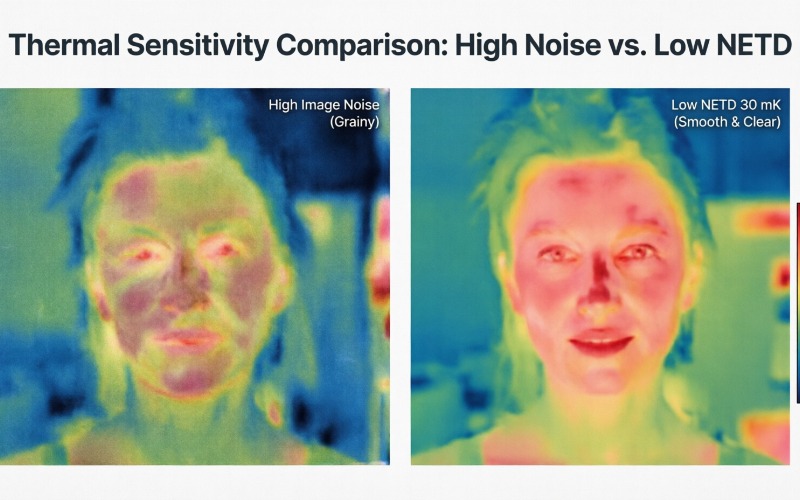
While resolution dictates spatial detail, Noise Equivalent Temperature Difference (NETD) dictates thermal detail. NETD is a measure of the smallest temperature difference the camera can resolve. It is typically expressed in milliKelvins (mK). In professional-grade handheld cameras, a VOx sensor with an NETD <30mK is highly desirable.
Low NETD is particularly critical in applications with low thermal contrast, such as moisture detection in building envelopes or identifying composite delamination in aerospace components. When combined with high resolution, a low NETD sensor produces a clean, sharp image where subtle thermal bridges and moisture patterns become clearly visible against the background noise. As a senior engineer, I always recommend prioritizing sensors that offer both high resolution and low NETD for comprehensive diagnostic reliability.
Optical Matching and the Modulation Transfer Function
The performance of a high-resolution VOx sensor is only as good as the lens sitting in front of it. The Modulation Transfer Function (MTF) of the lens must be capable of resolving the spatial frequencies permitted by the pixel pitch. Using a low-quality lens on a 1024×768 sensor results in ’empty magnification,’ where the image is large but blurry because the lens cannot focus the IR energy onto the small 12μm pixels accurately.
When selecting a handheld IR camera, ensure the manufacturer has specified the lens system’s performance. High-quality germanium lenses with low F-numbers (e.g., f/1.0 or f/1.1) are necessary to maximize the energy reaching the FPA. This ensures that the high resolution you are paying for actually translates into improved image quality and measurement precision in the field.
Economic Analysis of Resolution Upgrades
For many B2B buyers, the decision comes down to Return on Investment (ROI). While a 640×512 resolution camera carries a higher upfront cost than a 384×288 model, the efficiency gains in the field are substantial. High-resolution cameras allow thermographers to scan larger areas more quickly and from greater distances, reducing the time spent on-site and minimizing the need for ladders or scaffolding.
Furthermore, high-resolution imagery is much easier to interpret for non-technical stakeholders. When presenting a report to a plant manager or a client, a clear, high-definition thermal image showing a specific failing component is far more persuasive than a pixelated blob. In professional services, the ability to provide definitive, high-authority reports justifies the investment in premium VOx resolution.
Future Trends in Handheld Thermal Imaging
The future of handheld thermal imaging lies in the integration of AI-driven Super Resolution (SR) and multi-spectral fusion. Super Resolution algorithms take multiple frames and combine them to create an image with higher effective resolution than the native FPA. However, these algorithms are not a substitute for high-quality native VOx resolution; they are an enhancement. Native resolution remains the baseline for all subsequent image processing and analytics.
We are also seeing a move toward ‘dual-sensor’ systems that combine high-resolution VOx thermal sensors with ultra-high-definition visible light cameras. Techniques like Multi-Spectral Dynamic Imaging (MSX) or thermal fusion overlay the edges from the visible image onto the thermal image, providing structural context that helps in identifying the exact location of thermal anomalies.
Frequently Asked Questions
What is the most versatile resolution for industrial electrical inspections?
A 384×288 resolution is generally considered the minimum professional standard, but 640×512 is the preferred choice for versatility. It provides enough detail for small component inspection while offering a wide enough field of view for scanning large switchgear panels.
How does pixel pitch affect the distance I can stand from a target?
Smaller pixel pitch (like 12μm) combined with high resolution reduces the IFOV. This means you can stand further away from a target while still maintaining enough pixels on the target to ensure an accurate temperature measurement.
Is VOx better than a-Si for handheld cameras?
Yes, for most professional applications. VOx sensors typically offer better thermal sensitivity (lower NETD) and more stable performance across a wider range of operating temperatures compared to amorphous Silicon (a-Si) sensors.
Can I use software to increase my camera resolution?
While Super Resolution software can improve the visual clarity of an image, it does not change the physical limitations of the FPA. Native resolution is still the primary factor in determining measurement accuracy and the minimum detectable target size.
Does a higher resolution camera always have better sensitivity?
Not necessarily. Resolution and sensitivity (NETD) are separate specs. You can have a high-resolution camera with poor sensitivity. However, premium VOx sensors often combine high resolution with excellent NETD (<30mK) for optimal performance.