
China Moneypro
Top Long-Range Handheld Infrared Cameras for Security
Deep-dive technical guide on selecting long-range handheld infrared cameras for border security. Compare VOx detectors, 12μm pixel pitch, and cooled MWIR systems.
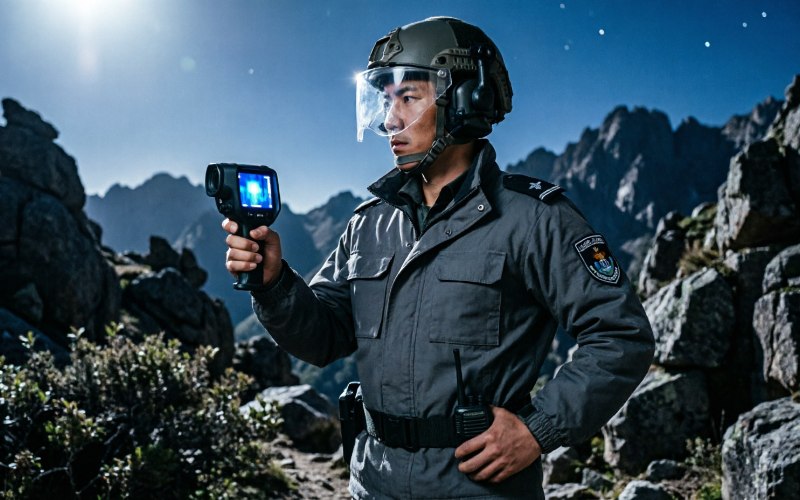
Border security operations represent one of the most demanding environments for electro-optical infrared (EO/IR) technology. To maintain situational awareness across vast perimeters and remote terrains, border control agencies require high-performance long-range handheld infrared cameras that provide clear, actionable intelligence under any lighting or weather condition. The effectiveness of these systems depends on the underlying detector technology, the precision of the optical system, and the sophisticated image processing algorithms that translate thermal energy into high-contrast visual data.
Key Takeaways for Border Security Procurement
- Vanadium Oxide VOx microbolometers provide superior thermal sensitivity and image stability compared to amorphous silicon alternatives.
- A 12μm pixel pitch enables higher resolution and longer detection ranges with more compact lens assemblies.
- Cooled MWIR systems are essential for ultra-long-range detection exceeding five kilometers in high-humidity environments.
- Thermal sensitivity measured as NETD below 30mK is critical for distinguishing human targets against complex background clutter.
- Ruggedization and SWaP optimization ensure operational reliability during extended dismounted patrols in harsh climates.
Critical Sensor Technologies for Long Range Detection
At the heart of every long-range handheld infrared camera is the Focal Plane Array (FPA). For border security, the choice often falls between uncooled Long-Wave Infrared (LWIR) and cooled Mid-Wave Infrared (MWIR) technologies. Each serves a specific operational requirement based on range, sensitivity, and maintenance cycles.
Vanadium Oxide VOx Microbolometers for Uncooled Performance
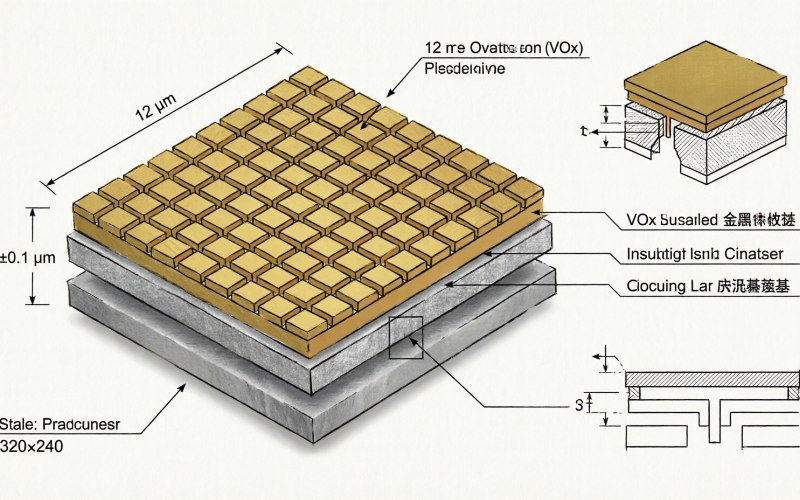
The Vanadium Oxide (VOx) microbolometer is the industry standard for high-performance uncooled handheld devices. Unlike amorphous silicon (a-Si) sensors, VOx materials offer a higher Temperature Coefficient of Resistance (TCR), which directly translates to better thermal sensitivity. For border control agents, this means the ability to see smaller temperature differences, such as a human hidden behind sparse vegetation at distances over one kilometer. These sensors operate without a cryogenic cooler, making them lighter, quieter, and ready for instant use without a cool-down period.
Advantages of 12μm Pixel Pitch in Modern Systems
The transition from 17μm to 12μm pixel pitch is a significant leap in infrared engineering. By reducing the pixel size, manufacturers can fit more pixels on the same sensor area or reduce the overall footprint of the detector. More importantly, a 12μm pixel pitch allows for a longer focal length within the same physical lens size, effectively increasing the magnification and range. This enables a handheld device to achieve the detection, recognition, and identification (DRI) distances previously reserved for much larger, vehicle-mounted systems.
Comparative Analysis of Handheld Infrared Technologies
When evaluating hardware for border defense, engineers must compare the trade-offs between cooling technologies and spectral bands. While LWIR is dominant for general surveillance, MWIR cooled cameras are the gold standard for long-range target identification.
| Technical Specification | Standard LWIR Handheld | High-End VOx 12μm | Cooled MWIR Handheld |
|---|---|---|---|
| Detector Material | a-Si Microbolometer | VOx Microbolometer | InSb or HgCdTe |
| NETD Sensitivity | <50mK | <30mK | <20mK |
| Spectral Range | 8-14μm | 8-12μm | 3-5μm |
| Human Detection Range | 1,200m | 2,400m | 6,000m+ |
| Operational Lifespan | Unlimited | Unlimited | ~10,000 hours (Cooler) |
Optical Excellence and Focal Length Requirements
The lens system is the most physically significant part of a long-range camera. To detect a human at 3 kilometers, a handheld LWIR camera typically requires a focal length of at least 100mm. Advanced systems utilize Continuous Optical Zoom (COZ) or Multi-Field of View (MFOV) lenses. MFOV systems allow an operator to use a wide field of view for initial detection and then rapidly switch to a narrow field of view for target identification.
Modern handheld units for border security often feature germanium lenses with high-performance anti-reflective coatings. These coatings are essential for maximizing transmission in the infrared spectrum, especially since germanium is naturally reflective. For long-range applications, Diamond-Like Carbon (DLC) coatings are often applied to the external lens element to protect against the abrasive effects of sand and wind common in border environments.
The Role of Thermal Sensitivity and NETD
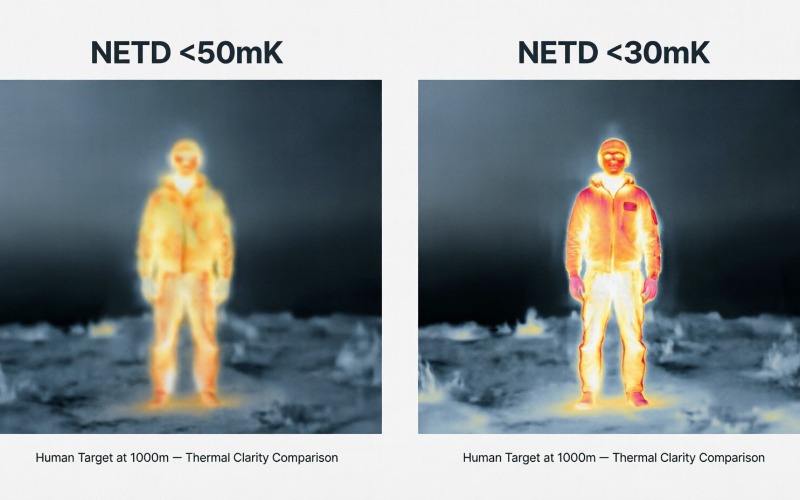
Noise Equivalent Temperature Difference (NETD) is the primary metric for thermal sensitivity. It represents the smallest temperature difference a camera can detect. In border security, where targets may have a very similar thermal signature to the background—such as a person in a desert at noon—a lower NETD is paramount. High-end handhelds now routinely achieve NETD values of less than 30mK. When combined with advanced Non-Uniformity Correction (NUC) algorithms, these sensors produce extremely clean images with minimal graininess, allowing AI-based detection software to function with much higher accuracy.
Integration of Multi Sensor Systems
A long-range handheld camera is rarely just a thermal imager today. To meet the needs of border control agencies, these devices have evolved into multi-sensor systems. The integration of a Laser Range Finder (LRF), Digital Magnetic Compass (DMC), and Global Positioning System (GPS) allows the operator to not only see a target but to acquire its exact coordinates instantly. This data is critical for directing response teams or articulating the threat level to a central command post.
Furthermore, the inclusion of a high-definition visible light sensor allows for a “fused” image. Image fusion overlays the thermal data onto the visible light image, providing the operator with both the heat signature and the color/textural details of the target. This significantly reduces the cognitive load on the operator and speeds up the identification process in complex urban or maritime border environments.
Environmental Durability and SWaP Considerations
Size, Weight, and Power (SWaP) are the limiting factors for dismounted border patrol agents. A camera that is too heavy will be left in the vehicle. Engineering breakthroughs in electronics have allowed for the miniaturization of signal processing boards, reducing weight without sacrificing power. Modern units are typically IP67 rated, meaning they are completely dust-tight and can withstand immersion in water. They must also meet MIL-STD-810G standards for shock, vibration, and extreme temperature operation.
Frequently Asked Questions Regarding Long Range Thermal Cameras
What is the maximum detection range for a handheld thermal camera
Detection ranges vary based on sensor type. High-performance uncooled VOx systems can detect a vehicle at 6 to 8 kilometers, while cooled MWIR handhelds can extend this to over 15 kilometers under ideal atmospheric conditions.
Why is VOx preferred over amorphous silicon for security
Vanadium Oxide VOx sensors offer higher thermal sensitivity and lower noise levels, which results in a clearer image at longer ranges and better performance in low-contrast environments compared to amorphous silicon.
Does pixel pitch affect the image resolution of the camera
Yes, a smaller pixel pitch like 12μm allows for more pixels on a smaller sensor area, enabling higher resolution and greater detail without significantly increasing the size of the camera or the optics.
What is the importance of NETD in border surveillance
NETD measures sensitivity to temperature differences. A lower NETD, typically below 30mK, is essential for identifying targets that are nearly the same temperature as their surroundings, which is common in many border terrains.
Are cooled thermal cameras better than uncooled for handheld use
Cooled cameras offer superior range and sensitivity but are heavier, more expensive, and require more maintenance due to the cryogenic cooler. They are best reserved for ultra-long-range identification tasks.