
China Moneypro
Best Thermal Imager Core for Long-Range Security
Discover the best thermal imager core for long-range security. Explore high-resolution VOx thermal imagers, PID control, and DRI optimization. Read now!
When engineering border patrol surveillance networks, integrators face a relentless demand for uncompromising detection capabilities. Identifying the best thermal imager core for long-range security dictates the overall success of tactical operations in harsh, unpredictable environments. Advanced electro-optical systems require thermal cores that deliver exceptional sensitivity, unyielding reliability, and optimized Size, Weight, Power, and Cost (SWaP-C).
For long-range border security, the best thermal imager core is a high-resolution 12µm or 10µm pitch Vanadium Oxide (VOx) uncooled microbolometer paired with continuous optical zoom lenses. These systems deliver superior DRI (Detection, Recognition, Identification) metrics, exceptional SWaP-C optimization, and reliable 24/7 target acquisition in extreme environments.
Key Takeaways
- Vanadium Oxide (VOx) uncooled microbolometers provide superior thermal contrast and lower noise compared to amorphous silicon (a-Si) alternatives.
- Smaller pixel pitches (12µm and 10µm) allow for longer focal length optics without increasing the physical footprint, drastically improving DRI metrics.
- NETD (Noise Equivalent Temperature Difference) ratings below 30mK are non-negotiable for distinguishing human targets during thermal crossover periods.
- Integrating advanced PID control loops in rotary pan-tilt mounts maximizes image stability at maximum optical zoom.
- Continuous optical zoom lenses are critical for maintaining situational awareness while transitioning from wide-area detection to narrow-field identification.
Evaluating High-Resolution VOx Thermal Imagers
The foundational component of any long-range surveillance platform is the infrared detector. For border patrol applications, uncooled Long-Wave Infrared (LWIR) detectors operating in the 8-14µm spectral band are the industry standard. Specifically, VOx uncooled microbolometers have emerged as the dominant technology. VOx materials possess a highly favorable Temperature Coefficient of Resistance (TCR), which translates directly to enhanced thermal sensitivity. Furthermore, VOx sensors exhibit significantly lower 1/f noise than competing technologies, ensuring crisp, high-contrast imagery even when scanning homogenous desert landscapes.
The Impact of Pixel Pitch on Optical Design
One of the most critical specifications when selecting the best thermal imager core is the pixel pitch. Historically, 17µm pixel pitches were the standard. However, the industry has aggressively transitioned to 12µm and even 10µm architectures. Consequently, smaller pixels yield a higher spatial resolution for a given sensor area. This mathematical relationship means integrators can achieve the same Instantaneous Field of View (IFOV) using a smaller, lighter lens. Alternatively, by utilizing the same size optic on a 10µm core as one would on a 17µm core, the effective detection range increases dramatically. This scaling is the secret to achieving massive DRI capabilities while strictly maintaining SWaP-C constraints on tactical masts.
Noise Equivalent Temperature Difference (NETD)
NETD represents the smallest temperature difference a thermal camera can detect. For long-range border security, pushing this metric below 40mK—ideally sub-30mK at f/1.0—is imperative. When scanning for human smugglers or covert vehicles over distances exceeding 5 kilometers, atmospheric attenuation drastically degrades the thermal signal reaching the sensor. Therefore, a highly sensitive core with a low NETD will register faint thermal signatures that a less capable sensor would lose entirely in the background noise floor.
Technical Specification Matrix
To illustrate the performance tiers of modern thermal cores, the following matrix compares standard industry configurations utilized in high-tier integrated electro-optical (EO/IR) systems.
| Specification | Legacy Uncooled (17µm) | Advanced VOx Uncooled (12µm) | Next-Gen VOx Uncooled (10µm) |
|---|---|---|---|
| Spectral Band | LWIR (8-14µm) | LWIR (8-14µm) | LWIR (8-14µm) |
| NETD (at f/1.0) | < 50 mK | < 35 mK | < 30 mK |
| Resolution | 640 x 512 | 1280 x 1024 (HD) | 1280 x 1024 (HD) |
| Optics Weight (for 10km Detection) | High (Requires massive Germanium) | Medium (Optimized SWaP-C) | Low (Highly optimized SWaP-C) |
| Maintenance Cycle | Near Zero | Near Zero | Near Zero |
Mastering DRI Standards in Border Environments
System integrators must validate their thermal core selection against Johnson’s Criteria, the universal standard for DRI (Detection, Recognition, and Identification). Detection requires a minimum of 1.5 pixels across the critical dimension of a target. Recognition, distinguishing a human from an animal, requires at least 6 pixels. Identification, discerning specific equipment or intent, mandates 12 pixels or more. A high-resolution HD (1280×1024) 10µm thermal core provides a dense pixel array that exponentially increases the number of pixels on target at extreme ranges. As a result, border patrol operators can elevate their operational tempo by making faster, more accurate decisions from centralized command posts.
Continuous Optical Zoom Lenses vs Fixed Field of View
Pairing the best thermal imager core with the right optics is essential. Fixed field of view lenses, or dual-field of view (DFOV) systems, force operators to temporarily lose situational awareness during lens switching. Conversely, continuous optical zoom (CZ) lenses, such as a 25-225mm or 50-500mm focal length configuration, allow operators to seamlessly track a moving target. The mechanical precision required to maintain focus during a long-range zoom sweep relies heavily on advanced thermal imaging modules processing real-time autofocus algorithms.
Atmospheric Challenges in Electro-Optical Systems
Long-range security is fundamentally a battle against the atmosphere. Absolute humidity, fog, dust, and heat shimmer all contribute to signal degradation. The LWIR band naturally penetrates smoke and dust far better than the Mid-Wave Infrared (MWIR) or visible spectrums. However, absolute humidity remains a challenge. The Beer-Lambert law dictates that thermal radiation decreases exponentially with distance through an absorbing medium. High-resolution VOx thermal imagers combat this by leveraging aggressive Digital Detail Enhancement (DDE) algorithms and 3D Digital Noise Reduction (3D DNR). These proprietary edge-computing algorithms enhance localized contrast, pulling human targets out of the thermal background even during heavy precipitation.
The Diurnal Cycle and Thermal Crossover
Twice a day, environments experience thermal crossover. This occurs when the ambient temperature of the background exactly matches the surface temperature of the target, resulting in zero thermal contrast. Integrators must rely on the superior NETD of the VOx core to detect minute emissivity differences during these critical windows. A sensor with a 50mK NETD might render the screen entirely gray, whereas a high-end 30mK sensor will still detect the faint outline of tactical clothing against desert sand.
Field Experience: Integrating VOx at the Southern Border
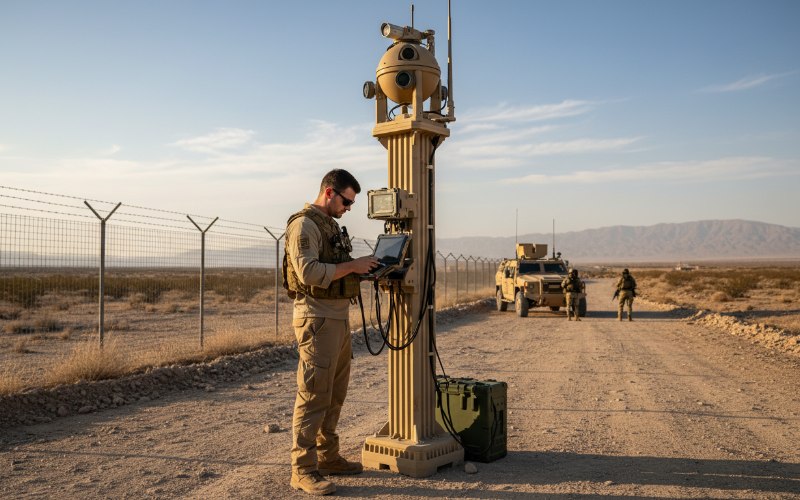
During my deployment optimizing multi-sensor tactical masts along the southern border, the theoretical limits of electro-optical engineering collided with harsh operational realities. We were tasked with upgrading legacy 17µm VGA systems that frequently failed to provide adequate recognition capabilities past 3 kilometers. The operators were experiencing severe eye strain trying to differentiate coyotes from human smugglers through intense atmospheric heat shimmer.
Optimizing Gimbal Stabilization
I spearheaded the integration of a new 12µm HD VOx thermal core combined with a 75-300mm continuous zoom lens. Immediately, the raw video feed was a drastic improvement, but we encountered a new challenge: micro-vibrations from the mast at maximum optical zoom. To mitigate this, I completely recalibrated the PID control loops on the rotary pan-tilt unit. By fine-tuning the proportional, integral, and derivative gains, we dampened the wind-induced oscillations. The result was rock-solid, stabilized imagery at 300mm focal lengths, pushing our positive human identification range past 5 kilometers. It was a definitive demonstration of why the core itself is only half the equation; mechanical integration and stabilization are equally vital.
System Architecture and SWaP-C Optimization
Modern border patrol programs demand agility. Heavy, cooled MWIR systems require cryogenic coolers that consume substantial power and have strict Mean Time Between Failure (MTBF) lifespans—often requiring expensive overhauls every 10,000 hours. This is an operational bottleneck for remote autonomous towers. Uncooled VOx thermal cores eliminate the cryogenic cooler. Consequently, they consume less than 2 watts of power, operate silently, and boast an MTBF of over 10 years. For more comprehensive standards on thermal imaging deployments, integrators often reference guidelines from the Department of Homeland Security (DHS) S&T and research papers within the SPIE Digital Library.
Edge Computing and AI Integration
The next frontier in identifying the best thermal imager core involves on-board edge computing. Modern cores output 14-bit raw digital video directly into AI processing units. By feeding uncompressed, high-contrast VOx data into convolutional neural networks, border security systems can autonomously classify targets, drastically reducing the cognitive load on human operators. Because the VOx sensor provides such a clean, low-noise image, the AI inference engines suffer far fewer false positives compared to integrating AI with noisy, legacy a-Si sensors.
Conclusion and Strategic Next Steps
Selecting the best thermal imager core for long-range security is an exercise in balancing uncompromising DRI requirements with stringent SWaP-C limitations. High-resolution, small-pitch VOx uncooled microbolometers represent the pinnacle of this balance. They provide the thermal sensitivity necessary to defeat crossover events, the spatial resolution required for extreme long-range identification, and the rugged reliability demanded by unblinking border surveillance operations. To achieve dominance in your next EO/IR integration project, ensure your architecture leverages the definitive advantages of 12µm or 10µm VOx technology.
If you are engineering a multi-sensor payload and need definitive guidance on matching high-resolution thermal cores with optimized continuous zoom optics, do not leave your system performance to chance. Schedule my Equipment Consultation today to evaluate your specific tactical requirements.
Frequently Asked Questions
What makes VOx better than a-Si for long-range security thermal imagers?
Vanadium Oxide (VOx) possesses a superior Temperature Coefficient of Resistance and significantly lower 1/f noise compared to amorphous silicon (a-Si). This results in a much higher thermal sensitivity and cleaner imagery, which is critical when detecting long-range targets through atmospheric interference and heat shimmer common in border security applications.
How does pixel pitch affect the best thermal imager core performance?
Pixel pitch directly determines the required size of the optical lens to achieve a specific field of view. A smaller pixel pitch, such as 10µm, allows system integrators to achieve greater DRI (Detection, Recognition, Identification) ranges using smaller, lighter lenses. This drastically improves the Size, Weight, Power, and Cost (SWaP-C) profile of the entire tactical system.
What is thermal crossover and how do high-resolution cores overcome it?
Thermal crossover is a twice-daily phenomenon where the background environment temperature matches the target’s surface temperature, resulting in zero thermal contrast. High-resolution VOx thermal cores overcome this by utilizing extreme sensitivity (NETD < 30mK) and advanced Digital Detail Enhancement algorithms to detect microscopic temperature deviations, keeping the target visible.
Why are uncooled thermal cores preferred over cooled cores for remote border masts?
Uncooled thermal cores do not rely on mechanical cryogenic coolers. This eliminates the need for expensive routine maintenance, drastically lowers power consumption (under 2 watts), and extends the operational lifespan (MTBF) of the system beyond 10 years. This reliability makes uncooled VOx cores the strategic choice for remote, off-grid border security installations.