

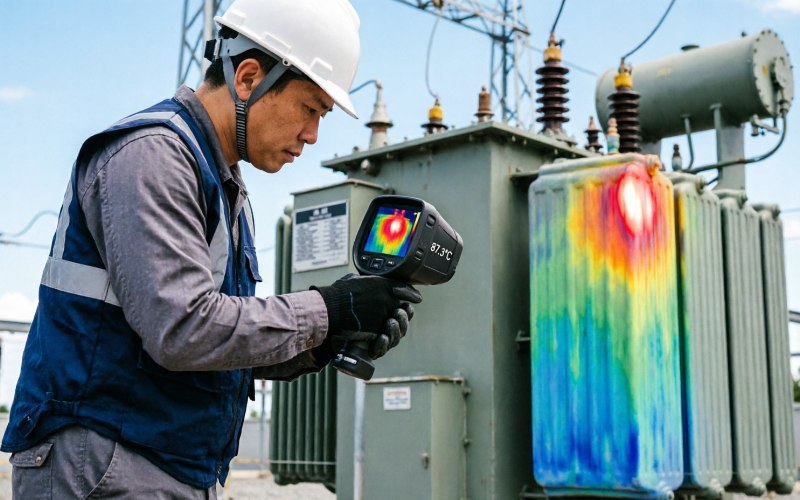
In the competitive landscape of industrial thermography, procurement officers and engineering leads often find themselves navigating a sea of technical specifications. Among these, Thermal Sensitivity, professionally known as Noise Equivalent Temperature Difference (NETD), stands as the most critical indicator of a handheld thermal imaging camera’s performance. For high-stakes applications such as electrical grid inspection, building envelope analysis, or chemical process monitoring, understanding the nuances of NETD is the difference between identifying a catastrophic failure and missing it entirely.
Key Takeaways
- NETD measures the smallest temperature difference a thermal camera can detect amidst electronic noise.
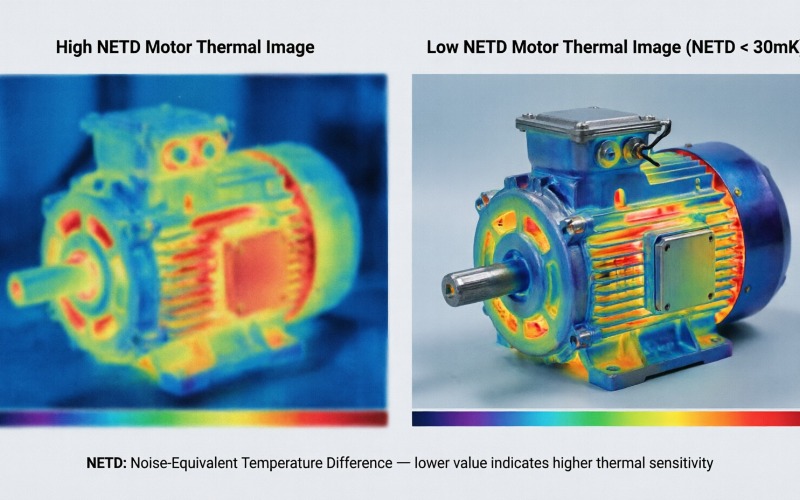
- Lower values in millikelvins (mK) indicate superior sensitivity and better image clarity.
- Industry-leading handheld thermal imaging cameraS now feature NETD ratings below 30mK for high-fidelity diagnostics.
- Procurement decisions should prioritize NETD over resolution when subtle thermal gradients are critical.
- Sensor material and lens f-number significantly impact the effective thermal sensitivity of the system.
Defining Thermal Sensitivity in Modern Thermography
Thermal Sensitivity represents the signal-to-noise ratio of an infrared detector. In simpler terms, it defines the smallest temperature change that the infrared sensor can distinguish from its own internal electronic noise. When a handheld thermal imaging camera scans a scene, the sensor—typically a Focal Plane Array (FPA)—is bombarded by long-wave infrared radiation. However, the electronics within the device generate their own thermal “hum.” NETD is the value where the thermal signal from the object is equal to the noise of the camera.
This metric is expressed in millikelvins (mK). A camera with a sensitivity of 50mK can detect temperature differences as small as 0.05°C. In the world of high-end optoelectronics, a lower number is always better. A device rated at 30mK is significantly more capable than one rated at 100mK, particularly when observing targets with low thermal contrast, such as moisture intrusion in a wall or early-stage bearing wear in a motor.
The Engineering Physics Behind Noise Equivalent Temperature Difference
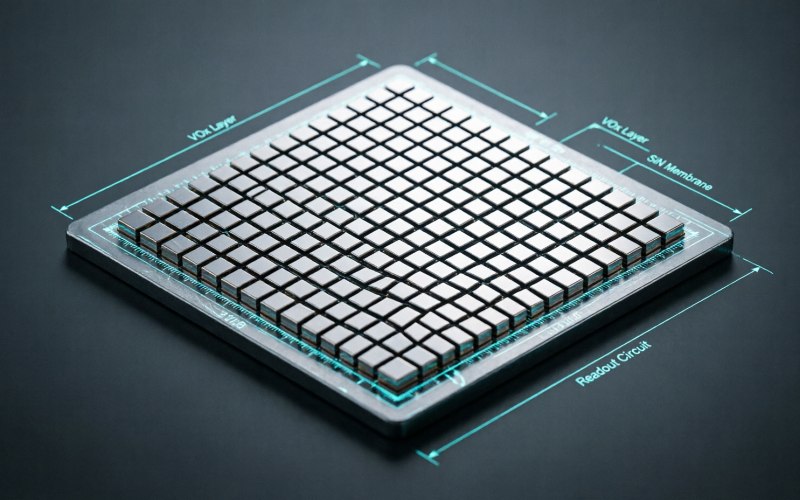
To truly grasp NETD, one must look at the VOx uncooled microbolometer. Vanadium Oxide (VOx) is the industry standard for high-performance handheld thermal imaging cameras due to its superior Temperature Coefficient of Resistance (TCR). When infrared radiation hits a VOx pixel, its electrical resistance changes. The camera’s processor measures this change to calculate temperature.
The noise component of NETD arises from several sources within the detector architecture. Johnson noise (thermal agitation of electrons), Shot noise, and 1/f noise all contribute to the “graininess” seen in poor quality thermal images. For a Procurement Officer, it is vital to understand that NETD is not just a sensor spec; it is a system-level spec. It is affected by the detector’s pixel pitch (commonly 12μm in modern high-end units), the efficiency of the readout integrated circuit (ROIC), and the aperture of the Germanium lens.
Critical Factors Influencing handheld thermal imaging cameras Sensitivity
Several hardware variables dictate the final NETD value delivered to the user. When comparing data sheets, these variables must be scrutinized to ensure an apples-to-apples comparison.
The Impact of Lens Aperture and F-Number
The lens is the gateway for infrared energy. A lens with a lower f-number (e.g., f/1.0) allows more radiation to reach the sensor than an f/1.4 lens. Because NETD is measured as a system, a manufacturer might achieve a 40mK rating simply by using a very expensive, fast lens on a mediocre sensor. Conversely, a high-quality sensor paired with a restrictive lens will show degraded sensitivity. Always check the f-number at which the NETD was tested.
Measurement Temperature Standards
NETD is temperature-dependent. The industry standard is to measure sensitivity at a target temperature of 30°C. Some manufacturers may attempt to inflate their specs by measuring at higher target temperatures where the signal is stronger, thus making the NETD value appear lower (better) than it would be in real-world, room-temperature conditions. Always verify that the specification is quoted at 30°C or 25°C.
Technical Comparison of NETD Performance Tiers
| Sensitivity Tier | NETD Value | Visual Quality | Typical Applications |
|---|---|---|---|
| Professional Elite | <30mK | Crystal clear, no grain | R&D, Medical, Subsurface leak detection |
| High-End Industrial | 30mK – 50mK | Very smooth, high detail | Electrical predictive maintenance, HVAC |
| Standard Commercial | 50mK – 80mK | Visible noise in low contrast | General home inspection, DIY tools |
| Entry Level | >100mK | Grainy, “snowy” image | Basic temperature spotting, non-critical use |
Why Procurement Must Prioritize Sensitivity Over Resolution
A common mistake in B2B procurement is over-indexing on spatial resolution (e.g., 640×480) while ignoring thermal sensitivity. While resolution determines how many pixels are in the image, NETD determines the quality of the data within each pixel. A 320×240 camera with 30mK sensitivity will often produce a more useful diagnostic image than a 640×480 camera with 100mK sensitivity.
In low-contrast scenes—such as identifying a moisture plume behind a cool tile wall—the 100mK camera will show a screen full of “snow” or electronic noise, masking the subtle temperature difference of the moisture. The 30mK camera will clearly delineate the damp area, even if it has fewer pixels. For professional thermographers, the ability to see the thermal gradient is more important than the sharpness of the edges.
The Economic Value of High Sensitivity Handheld Tools
From a Return on Investment (ROI) perspective, high-sensitivity tools (<40mK) reduce the probability of false negatives. In electrical utility inspections, an aging splice or connector may only be 1°C warmer than the surrounding wire in its early stages of failure. A tool with poor NETD will miss this delta, leading to unplanned downtime and potentially millions in lost revenue or repair costs. By investing in superior optoelectronics, organizations shift from reactive to proactive maintenance with a much higher degree of confidence.
Future Trends in Handheld Thermal Sensitivity
The frontier of handheld IR technology is moving toward the 20mK threshold. This is being driven by the shift from 17μm to 12μm pixel pitch, allowing for more pixels on smaller dies without sacrificing thermal mass. Furthermore, Advanced Intelligent Noise Reduction algorithms are now being embedded directly into the FPGA of handheld units. These algorithms use temporal filtering to average out noise in real-time, effectively “boosting” the perceived sensitivity of the hardware. However, for the most accurate thermography, raw hardware sensitivity remains the gold standard.
Conclusion
For procurement professionals, the technical specification of Thermal Sensitivity NETD is the most reliable metric for judging the quality of a handheld thermal imaging camera. By selecting devices with a VOx microbolometer and an NETD of <40mK, organizations ensure their technical teams have the sensitivity required to detect the invisible signs of failure before they manifest as costly disasters. In the world of infrared, sensitivity is clarity.
Frequently Asked Questions
NETD stands for Noise Equivalent Temperature Difference. It is a measure of the minimum temperature difference a thermal camera can distinguish from its own internal noise.
A lower NETD value, measured in millikelvins (mK), means the camera is more sensitive. This allows it to produce clearer images with less noise, making it easier to see small temperature differences in critical applications.
Pixel pitch refers to the distance between the centers of two pixels. While smaller pixel pitches (like 12μm) allow for smaller devices, they require more advanced engineering to maintain high sensitivity because each pixel has less surface area to capture infrared energy.
Yes, 50mK is considered a high-standard for professional industrial use. However, for specialized tasks like medical thermography or advanced building science, 30mK or lower is preferred.