
China Moneypro
White Phosphor vs Green Phosphor in Night Vision Technology
Compare White Phosphor vs Green Phosphor night vision performance. Discover why elite operators choose P45 white phosphor for reduced eye strain and higher contrast.
This article is part of our Night Vision Technology section. For a complete overview, visit our Knowledge Hub guide.
The evolution of night vision technology has reached a critical juncture in the debate between P45 white phosphor and P43 green phosphor. For decades, green phosphor dominated the optoelectronics landscape due to the human eye’s peak sensitivity to green light. However, modern battlefield requirements and advancements in image intensifier tube (IIT) manufacturing have shifted the standard toward white phosphor.
This technical analysis compares White Phosphor vs Green Phosphor technology, examining the underlying physics, physiological impacts on the operator, and performance metrics defined by Signal-to-Noise Ratio (SNR) and Figure of Merit (FOM).
Key Takeaways
- Contrast Superiority: White Phosphor (P45) offers higher contrast levels, allowing for faster object recognition and better depth perception in low-contrast environments.
- Eye Fatigue Reduction: Operators report significantly less eye strain during prolonged use with white phosphor due to the activation of rods and cones that process grayscale more naturally than monochromatic green.
- Evolutionary Sensitivity: While the human eye is most sensitive to green (555nm), the brain processes black and white shapes faster for threat identification.
- Cost Implications: P45 white phosphor tubes often command a premium due to high demand from Tier 1 military units and slightly lower manufacturing yields compared to mature P43 processes.
The Physics of Image Intensifier Phosphor Screens
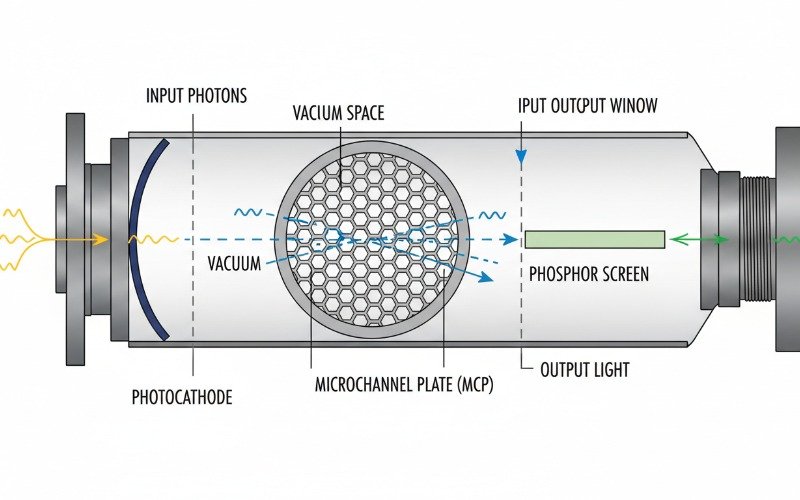
To understand the performance differences, one must analyze the final stage of an Image Intensifier Tube. Photons enter the objective lens, strike the photocathode (typically Gallium Arsenide in Gen 3 tubes), and are converted into electrons. These electrons pass through the Microchannel Plate (MCP), where they are multiplied thousands of times. Finally, this avalanche of electrons strikes the phosphor screen.
The phosphor screen converts the kinetic energy of the electrons back into visible light photons. The chemical composition of this screen dictates the color and decay time of the image.
P43 Green Phosphor Composition
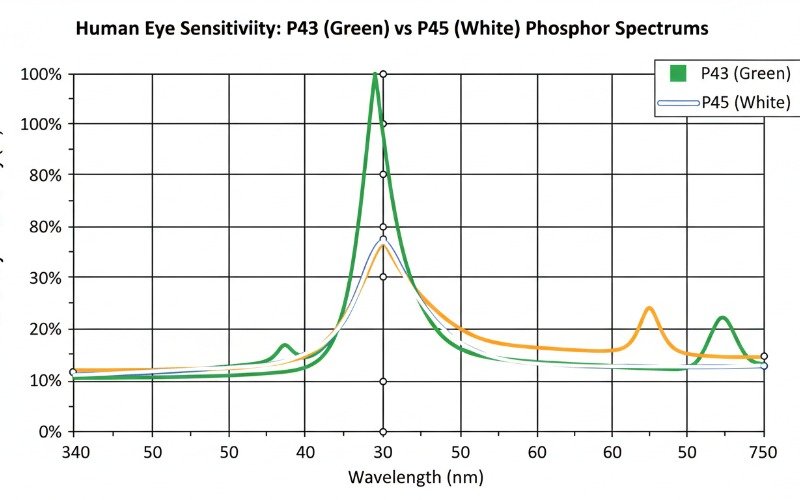
P43, or Gadolinium Oxysulfide (Gd2O2S:Tb), produces a peak emission at approximately 545 nanometers. This wavelength aligns closely with the peak sensitivity of the human eye in photopic (daytime) conditions. The choice of P43 was historically engineering-driven to maximize apparent brightness per unit of power input.
P45 White Phosphor Composition
P45 typically utilizes similar host materials but employs different activators to produce a broad-spectrum emission that appears black and white (often with a slight blueish tint). Unlike the monochromatic spike of P43, P45 provides a visual experience closer to the natural grayscale vision humans utilize in low-light scotopic conditions.
Analyzing the Optical Performance of P45 White Phosphor
The shift toward White Phosphor is not merely aesthetic. It is backed by improved engagement times and target discrimination capabilities. The primary advantage lies in the interaction between the image and the visual cortex.
Contrast and Object Recognition
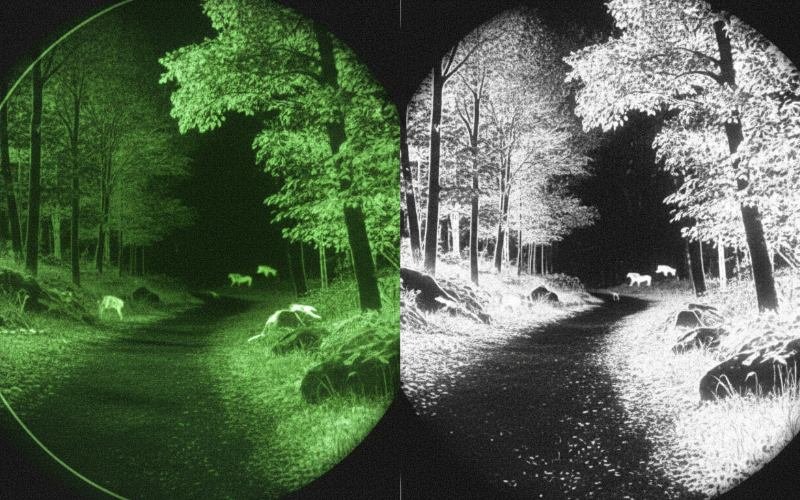
High contrast is critical for separating a target from the background. In a dense forest environment, a P43 green phosphor image renders foliage, ground, and targets in various shades of green. The human eye can distinguish many shades of green, but the lack of true contrast can cause “visual washing,” where distinct objects blend together.
White Phosphor creates distinct separation between dark shadows and bright highlights. This grayscale presentation leverages the brain’s natural ability to interpret shadows for depth perception. When scanning a sector, the stark difference between black and white allows the operator to identify silhouettes faster than interpreting monochromatic gradients.
Physiological Factors and Eye Fatigue
One of the most cited reasons for the migration to White Phosphor in aviation and special operations is the reduction of ocular fatigue. Night vision devices are often worn for 6 to 8 hours continuously during missions.
The Rod and Cone Response
Constant exposure to intense green light overstimulates specific cone receptors in the retina. When the operator removes the NVGs, they often experience a strong “pink hues” afterimage, known as the complimentary color effect. This indicates cone saturation.
White Phosphor produces a more neutral image that engages both rods and cones more evenly. Users report significantly less eye strain and headaches after long-duration sorties. Furthermore, the transition from NVG-aided vision to unaided dark adaptation is generally smoother with P45 tubes, as the eye has not been oversaturated by a single wavelength.
Technical Specifications Comparison P43 vs P45
While the phosphor screen changes the color, the underlying metrics of the tube remain the primary indicators of performance. A low-spec white phosphor tube will still be outperformed by a high-spec green phosphor tube.
| Parameter | Green Phosphor (P43) | White Phosphor (P45) |
|---|---|---|
| Emission Color | Monochromatic Green (545nm) | Grayscale / Blueish-White |
| Decay Time | Medium-Short | Medium-Short (Similar to P43) |
| Eye Sensitivity | High (Peak Human Sensitivity) | Moderate (Natural Contrast) |
| Contrast Sensitivity | Standard | High (Enhanced Depth) |
| Fatigue Factor | Moderate to High (Long duration) | Low (Long duration) |
| Cost Basis | Standard | Premium (+10% to +20%) |
Manufacturing and Market Dynamics
The optoelectronics industry produces white phosphor tubes, such as L3Harris Unfilmed WP or Elbit Systems Thin-Filmed WP, using slightly different doping processes. Historically, yield rates for white phosphor were lower, contributing to higher costs. Strict cosmetic standards mean that black spots (blemishes) are more noticeable on a white screen than on a green screen, leading to a higher rejection rate during quality control for premium aviation-grade tubes.
Currently, the market trend is overwhelmingly favoring White Phosphor. Major military contracts, including the US Marine Corps Squad Binocular Night Vision Goggle (SBNVG) and various aviation contracts, mandate P45 screens. This mass adoption is slowly closing the price gap, though a premium for “Clean” white phosphor screens remains.
Scenarios Favoring Green Phosphor
Despite the dominance of white phosphor, P43 Green Phosphor retains specific advantages. The human eye can detect lower levels of light in the green spectrum than any other color. In extremely low light conditions with zero supplemental IR illumination, a high-FOM green tube may provide a slightly brighter perceived image to the user.
Furthermore, legacy compatibility is a factor. Units operating with mixed inventory may prefer to keep all devices uniform to ensure team cohesion and consistent signaling. For budget-conscious agencies or civilian enthusiasts, the secondary market for green phosphor offers exceptional value, providing high-performance Gen 3 capabilities at a fraction of the cost of modern WP systems.
Final Recommendation for Procurement
When selecting between White Phosphor vs Green Phosphor, the decision often comes down to budget versus endurance requirements. For short-duration observation or static security, Green Phosphor remains a highly effective and cost-efficient solution. Its ability to render detail is proven through decades of combat history.
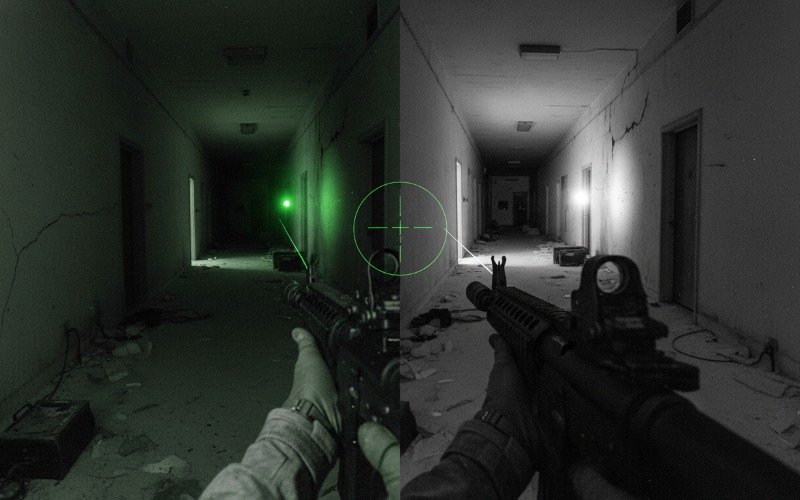
However, for dynamic operations involving Close Quarters Battle (CQB), high-speed driving, or prolonged wear, White Phosphor is the objective technical superior. The enhancement in reaction time, depth perception, and reduced cognitive load justifies the additional investment. In the modern electro-optical landscape, P45 is the standard for elite performance.
Frequently Asked Questions
Is White Phosphor brighter than Green Phosphor?
Does White Phosphor degrade faster than Green Phosphor?
Why is White Phosphor more expensive?
Can I change my Green Phosphor tube to White Phosphor?
Get more information about Night Vision Technology:
Gen 1 vs Gen 2 vs Gen 3 Night Vision Technology Guide
What Is Night VisionTechnology: Image Intensification vs Thermal Imaging