
China Moneypro
What Is Thermal Imaging?
Explore thermal imaging physics, VOx microbolometers, and NETD metrics. A technical guide for integrators optimizing SWaP-C in UAV and security systems.
Executive Summary: The Engineering Behind Infrared Sensing
- Core Physics: Thermal imaging detects infrared radiation (IR) emitted by objects based on their emissivity and temperature, functioning independently of visible light.
- Detector Technology: VOx (Vanadium Oxide) uncooled microbolometers dominate the commercial market due to superior TCR (Temperature Coefficient of Resistance) and SWaP-C optimization compared to a-Si.
- Critical KPIs: NETD (Noise Equivalent Temperature Difference) values <40mK are essential for distinguishing low-contrast targets in adverse weather.
- Integration Trends: The shift from 17μm to 12μm pixel pitch enables smaller optics and lighter payloads for UAV and handheld applications.
For system integrators and defense contractors, understanding what is thermal imaging goes far beyond basic heat detection. It involves mastering the physics of the Long-Wave Infrared (LWIR) spectrum, evaluating detector materials, and optimizing the optomechanical signal path. This guide provides a deep technical dive into the architecture of modern infrared systems, from Focal Plane Arrays (FPAs) to image processing algorithms.
Physics of Infrared Radiation: Planck’s Law and Atmospheric Transmission
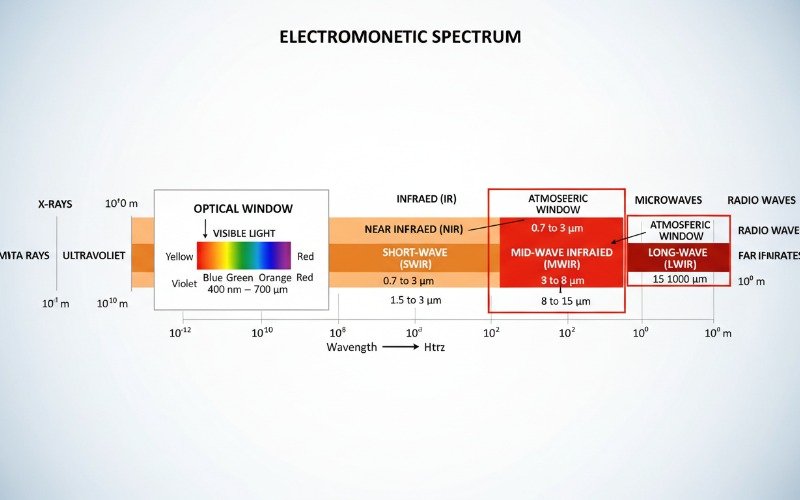
At its core, thermal imaging relies on the fact that all matter above absolute zero (0 Kelvin) emits electromagnetic radiation. This phenomenon is governed by Planck’s Law, which describes the spectral density of electromagnetic radiation emitted by a black body in thermal equilibrium. For terrestrial temperatures (-20°C to +50°C), peak emission occurs in the infrared spectrum, specifically around 10μm.
Effective thermal imaging requires operating within specific atmospheric transmission windows where infrared radiation is not heavily absorbed by water vapor and carbon dioxide:
- MWIR (Mid-Wave Infrared): 3μm – 5μm. Primarily used in cooled detectors for high-contrast, long-range capabilities in high-humidity environments.
- LWIR (Long-Wave Infrared): 8μm – 14μm. The standard for uncooled microbolometers. This band offers superior penetration through smoke, dust, and fog, making it ideal for battlefield situational awareness and industrial thermography.
Detector Architecture: VOx vs. a-Si Microbolometers
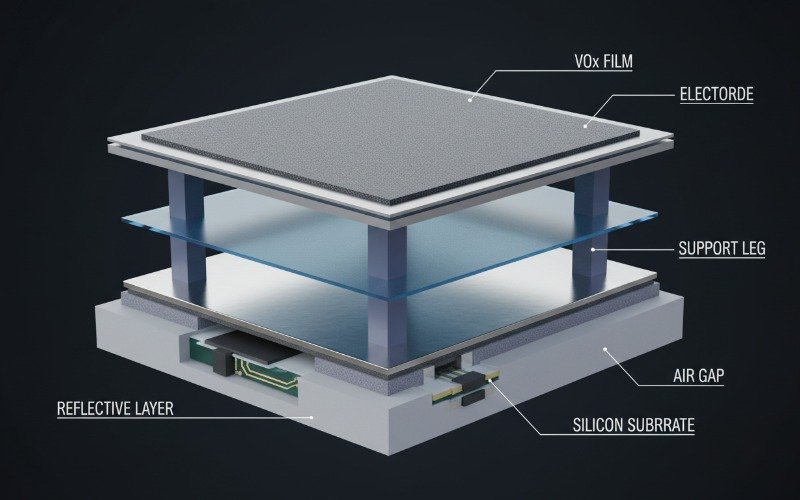
The heart of any uncooled thermal imaging module is the microbolometer. This MEMS (Micro-Electro-Mechanical System) device changes electrical resistance when struck by infrared radiation. Two primary materials dominate the market: Vanadium Oxide (VOx) and Amorphous Silicon (a-Si).
Vanadium Oxide (VOx) Superiority
For high-performance applications, VOx is the material of choice. It exhibits a higher Temperature Coefficient of Resistance (TCR)—typically around 2-3% per Kelvin—compared to a-Si. A higher TCR means the detector is more sensitive to minute temperature changes, resulting in a better signal-to-noise ratio. This material property is directly responsible for achieving NETD values below 40mK (and increasingly <30mK in premium cores).
Amorphous Silicon (a-Si) Characteristics
While a-Si is easier to manufacture using standard CMOS processes, it generally suffers from higher 1/f noise and lower TCR. It is often relegated to lower-cost, entry-level thermal cameras where extreme sensitivity is not the primary requirement.
Critical Performance Metrics for System Integrators
When selecting a thermal module for integration into a UAV gimbal or a security PTZ system, three technical specifications define the system’s operational envelope: NETD, Pixel Pitch, and Resolution.
NETD (Noise Equivalent Temperature Difference)
NETD represents the thermal sensitivity of the detector. It is the temperature difference required to produce a signal equal to the system’s temporal noise. Measured in millikelvins (mK), a lower number indicates higher sensitivity.
- <30mK: High-end scientific and defense grade. Essential for low-contrast scenes (e.g., detecting a target against a background of similar temperature in rain).
- <50mK: Standard for quality industrial and security applications.
- >100mK: Low-cost consumer grade, often producing grainy images in low thermal contrast conditions.
The Transition to 12μm Pixel Pitch
The industry is rapidly shifting from 17μm to 12μm pixel pitch architectures. A smaller pixel pitch allows more pixels to be packed onto the same size wafer, or strictly speaking, the same resolution FPA to be smaller. For integrators, 12μm offers significant SWaP (Size, Weight, and Power) advantages. A 12μm sensor requires a lens with a shorter focal length to achieve the same Field of View (FOV) and Detection/Recognition/Identification (DRI) range as a 17μm sensor. Smaller lenses mean lighter payloads—critical for battery life in electric UAVs.
Comparing Detector Technologies: Cooled vs. Uncooled
Selecting between cooled and uncooled detectors determines the cost, maintenance, and capability of the integrated system. The following table breaks down the engineering trade-offs.
| Feature | Uncooled Microbolometer (LWIR) | Cooled Photodetector (MWIR) |
|---|---|---|
| Operating Principle | Thermal sensor changes resistance; operates at ambient temp. | Photonic quantum effect; sensor cryo-cooled to ~77K. |
| Sensitivity (NETD) | Typically 30mK – 50mK | Extreme sensitivity: <20mK – 25mK |
| Spectral Range | 7.5μm – 13.5μm | 3μm – 5μm |
| SWaP-C | Low weight, low power, solid state reliability. | Heavy, high power draw due to Stirling cooler mechanism. |
| Maintenance | Zero maintenance (MTBF > 10,000 hrs). | Cooler requires service/replacement every 10k-20k hours. |
| Typical Application | UAVs, Handheld Scopes, Security Cameras, Automotive. | Long-range Border Defense, Gas Detection (OGI), Missile Guidance. |
Optics and Materials: Why Glass Fails
Standard silicate glass is opaque to LWIR radiation. Therefore, thermal imaging requires exotic optical materials. Germanium (Ge) is the most common lens material due to its high refractive index (approx. 4.0), allowing for lenses with high optical power and low curvature. However, Germanium is heavy and expensive.
For SWaP-constrained systems, engineers often utilize Chalcogenide glass. While it has a lower refractive index than Germanium, it can be molded, reducing manufacturing costs and allowing for complex aspheric shapes that correct aberrations in a single element. All thermal lenses must be coated with DLC (Diamond-Like Carbon) or High-Durability AR (Anti-Reflective) coatings to withstand harsh environmental exposure.
Integration and Image Processing Pipelines
Raw data from a microbolometer is rarely usable without sophisticated image processing. The sensor exhibits non-uniformity because each pixel responds slightly differently to temperature. System integrators must rely on the thermal core’s internal processing pipeline.
Non-Uniformity Correction (NUC)
NUC is the process of normalizing the pixel response. Most uncooled cores use a mechanical shutter that periodically closes to present a uniform temperature surface to the sensor. The system calculates offset coefficients to calibrate the image. “Shutterless” NUC algorithms are gaining traction for military applications where the freeze-frame caused by a shutter calibration is unacceptable.
Digital Detail Enhancement (DDE)
Because thermal scenes often have high dynamic range (e.g., a hot engine against a cold sky), 14-bit raw data must be compressed to 8-bit video for display without losing detail. Algorithms like CLAHE (Contrast Limited Adaptive Histogram Equalization) and proprietary DDE are used to enhance edge contrast and maximize information density for the operator.
Frequently Asked Questions
What is the difference between thermal imaging and night vision?
Why is NETD important for industrial inspections?
Can thermal cameras see through glass?
Radiometry is the ability of the thermal camera to measure the absolute temperature of a specific pixel or region of interest (ROI). While all thermal cameras detect heat, only radiometric cores are calibrated to output precise temperature data (e.g., +/- 2°C accuracy) used for industrial measurement or fire detection.What is radiometry in thermal imaging?