
China Moneypro
What Is Infrared (IR) Technology?
Explore infrared technology fundamentals for system integrators. Detailed analysis of VOx sensors, SWIR/MWIR/LWIR bands, and thermal module integration.
Key Takeaways: Infrared Technology Fundamentals
- Spectral Definition: Infrared radiation spans the electromagnetic spectrum from approximately 700 nm to 1 mm, divided into Near-IR, SWIR, MWIR, and LWIR bands critical for specific industrial and defense applications.
- Detector Types: The market is bifurcated into cooled detectors (InSb, MCT) for high-sensitivity long-range applications and uncooled microbolometers (VOx, a-Si) for SWaP-optimized commercial systems.
- Integration Metrics: Success in EO/IR system design relies on optimizing NETD (<30mK), pixel pitch (12μm vs 17μm), and frame rates (30Hz/60Hz) relative to optics size.
- Future Trends: The shift toward smaller pixel pitches (10μm and below) allows for reduced lens sizing, driving down total system cost (SWaP-C) for UAV and handheld integration.
Infrared technology constitutes the backbone of modern non-contact thermal sensing and night vision capabilities. For system integrators and Original Equipment Manufacturers (OEMs), understanding the nuances of infrared radiation—specifically within the context of Focal Plane Arrays (FPAs) and optoelectronics—is essential for designing competitive surveillance, radiometric, and machine vision systems.
Unlike visible light imaging, which relies on reflected photons, thermal infrared imaging detects emitted radiation based on the blackbody radiation principles defined by Planck’s Law. This article provides a comprehensive technical breakdown of infrared technology, focusing on uncooled VOx microbolometers, spectral band selection, and integration parameters for high-performance B2B applications.
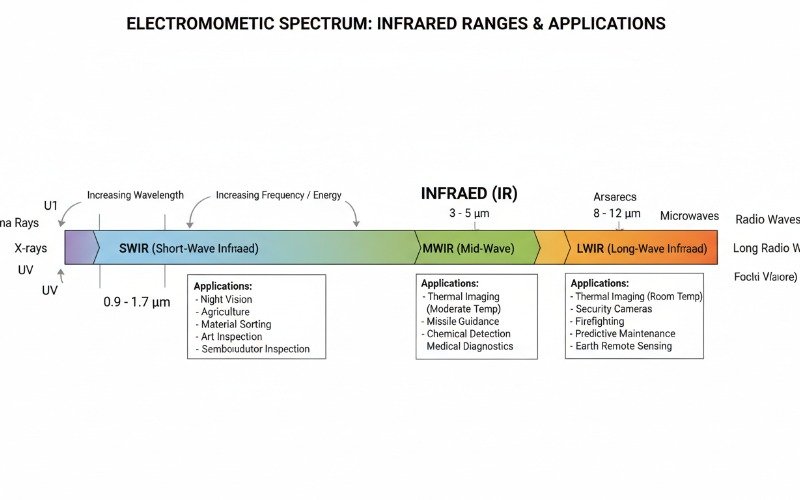
Defining the Infrared Spectrum for Industrial Use
Infrared (IR) radiation sits between the visible spectrum and microwave radiation. For optoelectronic engineers, the spectrum is categorized based on atmospheric transmission windows and detector material sensitivities.
Short-Wave Infrared (SWIR): 0.9μm – 1.7μm
SWIR sensors, typically utilizing Indium Gallium Arsenide (InGaAs) material, operate closer to the visible spectrum. Unlike thermal IR, SWIR relies largely on reflected light (similar to visible cameras) but can penetrate fog, smoke, and haze better than visible sensors. Key applications include semiconductor wafer inspection and laser spot tracking.
Mid-Wave Infrared (MWIR): 3μm – 5μm
MWIR is the domain of cooled detectors. This band offers high thermal contrast and is less affected by humidity than LWIR, making it the standard for long-range coastal surveillance and missile seeking technologies. However, MWIR systems require cryogenic cooling to reduce thermal noise, impacting Size, Weight, and Power (SWaP).
Long-Wave Infrared (LWIR): 7.5μm – 13.5μm
LWIR is the primary band for uncooled thermal imaging. This range aligns with the peak emission of terrestrial objects (people, vehicles, wildlife) at roughly 300K. LWIR sensors, primarily VOx microbolometers, are dominant in commercial security, UAV payloads, and automotive night vision due to their operation at ambient temperatures.
Core Detector Technologies: Cooled vs Uncooled
The choice between cooled and uncooled architectures dictates the system’s cost, maintenance lifecycle, and integration complexity. Understanding the underlying physics of the detector is crucial for selecting the right thermal core for your integration project.
Uncooled Microbolometers (VOx vs a-Si)
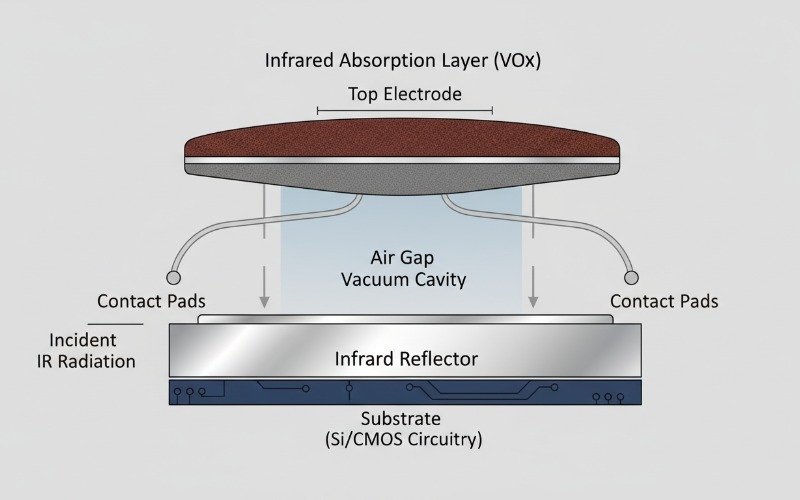
Uncooled detectors do not require cryogenic cooling. They use a microbolometer array where each pixel acts as a resistor that changes resistance when heated by IR radiation. This change is read by a Readout Integrated Circuit (ROIC).
- Vanadium Oxide (VOx): VOx is the industry standard for high-performance commercial and defense applications. It offers a higher Temperature Coefficient of Resistance (TCR) and lower 1/f noise compared to amorphous silicon, resulting in superior sensitivity (NETD) and image stability.
- Amorphous Silicon (a-Si): Historically cheaper to manufacture due to silicon compatibility, a-Si generally suffers from lower sensitivity and “burn-in” artifacts. However, modern manufacturing techniques are narrowing the gap.
Cooled Photodetectors (MCT and InSb)
Cooled detectors utilize quantum physics (photon detection) rather than thermal physics (heat detection). Materials like Mercury Cadmium Telluride (MCT) and Indium Antimonide (InSb) generate electron-hole pairs when struck by photons. These sensors must be cooled to roughly 77K (using Stirling cycle coolers) to prevent dark current from overwhelming the signal. They offer unmatched frame rates and sensitivity but come with a high SWaP penalty.
Technical Comparison: Cooled vs. Uncooled Sensors
The following table outlines the critical performance differences relevant to system integrators deciding between module types.
| Feature | Uncooled (VOx Microbolometer) | Cooled (MCT / InSb) |
|---|---|---|
| Spectral Band | LWIR (7.5 – 13.5 μm) | MWIR (3 – 5 μm) / LWIR |
| Sensitivity (NETD) | <30mK to <50mK | <15mK to <25mK |
| Response Time | Thermal time constant (~10-12ms) | Microseconds (Photon detection) |
| SWaP-C | Low Weight, Low Power, Low Cost | High Weight, High Power, High Cost |
| MTBF | >10 years (solid state) | ~10,000 – 20,000 hours (cooler wear) |
| Primary Use Case | UAVs, Security, Thermography, Auto | Long-range Defense, R&D, Gas Detection |
Critical Specs for System Integration
When selecting a thermal module for integration into a gimbal, security camera, or handheld scope, four primary specifications drive performance:
1. NETD (Noise Equivalent Temperature Difference)
NETD measures the thermal sensitivity of the detector. It represents the smallest temperature difference the sensor can distinguish from the noise floor. A lower value is better. High-end VOx sensors achieve an NETD of <30mK or even <20mK. In low-contrast scenes—such as a person standing in front of a tree line at night where temperatures are equilibrated—a low NETD is critical for target recognition.
2. Pixel Pitch and Optical Sizing
Pixel pitch refers to the distance between the centers of two adjacent pixels, measured in microns (μm). The industry has migrated from 25μm to 17μm, and now to 12μm and 10μm standards.
- The 12μm Advantage: Smaller pixels allow for the same resolution (e.g., 640×512) on a smaller chip. This reduction in sensor size enables the use of focal length lenses that are physically smaller and lighter while maintaining the same field of view (FOV) and zoom capabilities. This is vital for drone payloads where gram-level weight savings increase flight time.
3. Resolution formats (Array Size)
Common resolutions include QVGA (384×288), VGA (640×512), and XGA (1024×768) or SXGA (1280×1024). For most industrial and security applications, VGA (640×512) represents the sweet spot between cost and performance, providing sufficient detail for AI analytics and object classification.
Integration Challenges: SWaP-C and Interfaces
Integrating infrared technology requires careful consideration of the “SWaP-C” factor: Size, Weight, Power, and Cost.
Mechanical and Electrical Interface
Modern infrared detectors are supplied as OEM modules (cores). Integrators must interface with these cores via standard protocols.
- Video Output: Analog (CVBS) is legacy but low latency. Digital outputs like BT.656, CameraLink, MIPI CSI-2, and USB 3.0 are preferred for modern systems to access raw 14-bit radiometric data essential for temperature measurement and post-processing.
- Power Consumption: Uncooled cores typically consume <1.5W. Effective thermal management (heat sinking) is required not just to prevent overheating, but to maintain the FPA temperature stability, which ensures the accuracy of the Non-Uniformity Correction (NUC) algorithms.
NUC and Shutterless Operation
Microbolometers drift over time due to ambient temperature changes. A mechanical shutter typically fires periodically to recalibrate the sensor (NUC). For tactical applications where the “freeze” caused by the shutter is unacceptable, “shutterless” algorithms utilize scene-based NUC to maintain image uniformity without mechanical interruption.
Industrial and Defense Applications
The versatility of infrared technology spans multiple high-value verticals. Each sector leverages specific aspects of the electromagnetic spectrum.
UAV Payloads and Aerial Reconnaissance
Drones equipped with radiometric LWIR cameras are revolutionizing solar farm inspection, power line monitoring, and search and rescue (SAR). The migration to 12μm sensors has allowed for dual-sensor payloads (EO/IR) that fit within the weight classes of small commercial quadcopters.
Automated Process Control
In Machine Vision, IR cameras monitor critical temperatures in glass manufacturing, metallurgy, and plastic injection molding. Radiometric accuracy (typically ±2°C or ±2%) is paramount here. High-speed uncooled cameras can now capture fast-moving conveyor belts to detect thermal anomalies before packaging.
Perimeter Security and Border Defense
Unlike visible cameras dependent on external lighting or star-light, thermal cameras require zero light. Analytics software integrated with thermal security cameras can detect human intrusion at distances exceeding 1km, reducing false alarms caused by shadows, headlights, or vegetation movement.
Frequently Asked Questions
What is the difference between active and passive infrared?
Why is Germanium used for thermal lenses?
Can infrared cameras see through walls?