
China Moneypro
What Is an EO/IR System and How It Works
Discover the engineering behind EO/IR systems. Learn about electro-optical sensors, thermal imaging fusion, and stabilization for defense and industrial use.
This article is part of our EO Technology section. For a complete overview, visit our Knowledge Hub guide.
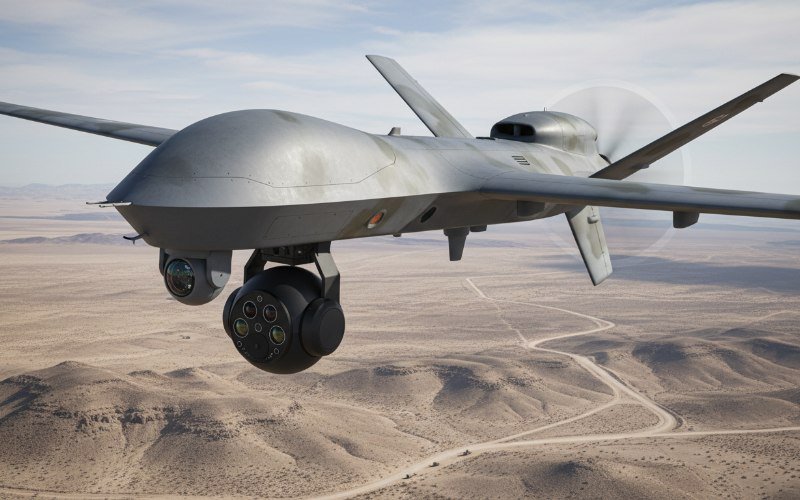
Modern surveillance and defense operations rely heavily on the ability to see beyond the capabilities of the human eye. An EO/IR system represents the pinnacle of this optical technology. These sophisticated integrated units combine Electro-Optical (EO) sensors with Infrared (IR) detectors to provide comprehensive situational awareness day or night. From unmanned aerial vehicles (UAVs) to maritime border security, EO/IR payloads act as the eyes of complex mission systems.
Understanding these systems requires a deep dive into optoelectronics, sensor fusion, and precision stabilization. This guide explores the engineering principles, core components, and critical performance metrics that define high-end EO/IR technology.
Key Takeaways on Electro Optical Infrared Systems
- Dual Spectrum Capability combines visible light cameras for daytime detail with thermal sensors for night vision.
- Sensor Fusion allows operators to overlay thermal signatures onto visual feeds for superior target identification.
- Precision Stabilization using multi-axis gimbals ensures steady imagery even on high-vibration platforms like drones or helicopters.
- Diverse Applications span across search and rescue, perimeter security, fire control systems, and industrial inspection.
- Advanced Metrics like NETD (Noise Equivalent Temperature Difference) and DRI (Detection, Recognition, Identification) define system performance.
Defining the EO/IR System Architecture
An EO/IR system is an integrated assembly of sensors that capture electromagnetic radiation across different wavelengths. The term stands for Electro-Optical and Infrared. While “Electro-Optical” typically refers to sensors operating in the visible and near-infrared (NIR) spectrum, “Infrared” refers to thermal imaging sensors that detect heat radiation in the Mid-Wave Infrared (MWIR) or Long-Wave Infrared (LWIR) bands.
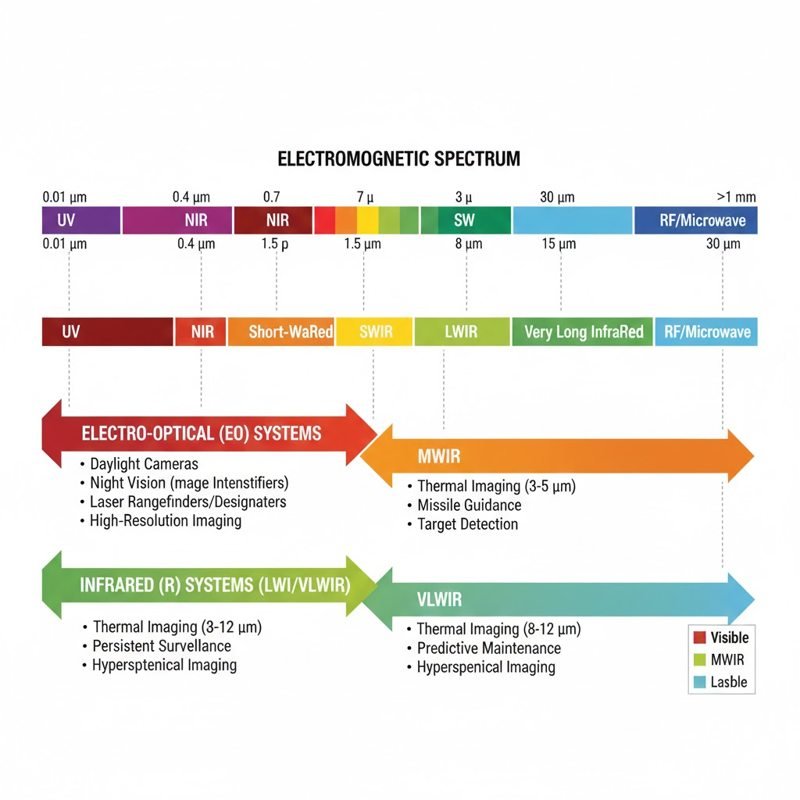
These systems are rarely just cameras. They are complex payloads often housed within a spherical turret or gimbal. This housing contains the optical bench, the sensors, laser range finders, and the stabilization electronics required to maintain a clear line of sight while the platform moves.
Core Components of Integrated EO/IR Turrets
The efficacy of an EO/IR payload depends on the quality and integration of its sub-systems. Engineers design these units to balance weight, power consumption, and optical performance.
Visible Light Cameras
The EO component usually consists of a high-definition daylight camera. Modern systems utilize CMOS sensors with high pixel counts to provide distinct advantages during daylight operations. These cameras often feature powerful optical zoom lenses, allowing operators to identify license plates or facial features from kilometers away. Low-light CMOS sensors extend this capability into twilight conditions before the system switches to infrared modes.
Infrared Thermal Imagers
The IR component is the heart of 24/7 operations. It detects thermal energy radiated by objects rather than reflected light. There are two primary categories used in these systems.
- Cooled MWIR Detectors operate in the 3-5 micrometer range. They require a cryogenic cooler to reduce sensor noise, offering extreme sensitivity and long-range performance suitable for high-altitude or maritime environments.
- Uncooled LWIR Detectors operate in the 8-14 micrometer range. Typically using VOx microbolometers, these are lighter, more reliable, and require less maintenance, making them ideal for smaller UAVs and short-to-medium range surveillance.
Laser Modules
To enhance utility, manufacturers often integrate laser systems. A Laser Range Finder (LRF) pulses a laser beam to calculate the exact distance to a target. Laser Illuminators or Pointers operate in the near-infrared spectrum, invisible to the naked eye but visible to night vision goggles (NVG), allowing ground forces to coordinate with air support silently.
Stabilization and Gimbal Technology
An EO/IR system is useless if the image shakes uncontrollably. Stabilization is the engineering feat that keeps the video smooth. High-performance gimbals utilize 2-axis or 4-axis stabilization systems equipped with fiber-optic gyroscopes (FOG) or MEMS gyroscopes.
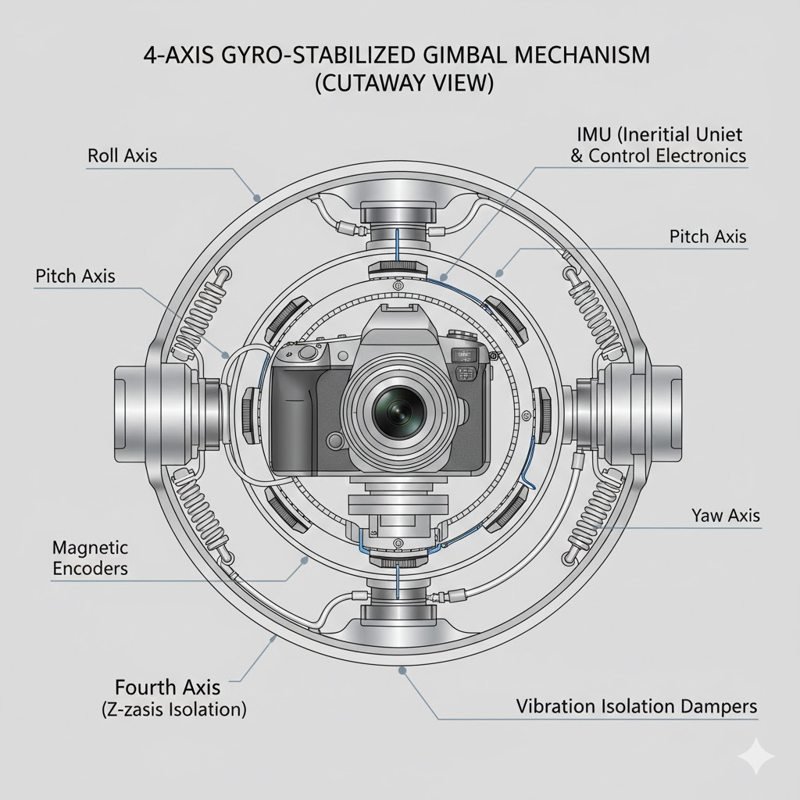
The stabilization performance is measured in microradians. A lower number indicates better stability. Top-tier systems achieve stabilization better than 5 microradians, meaning they can maintain a lock on a target kilometers away even if the aircraft carrying them is vibrating or banking sharply.
Understanding Sensor Fusion
One of the most significant advancements in modern EO/IR technology is sensor fusion. Historically, operators had to switch between the daylight camera and the thermal view. Sensor fusion algorithms now blend these two video streams in real-time.
This process overlays thermal hot spots onto the high-contrast visual image. For example, a camouflaged soldier in a forest might be invisible to the daylight camera but glows brightly in thermal. Fusion technology highlights this heat signature on the visual display, providing immediate context and faster target acquisition. This capability significantly reduces cognitive load for operators during critical missions.
Cooled versus Uncooled System Comparison
Selecting the right EO/IR system often comes down to choosing between cooled and uncooled infrared technologies. The following table outlines the technical trade-offs involved in this engineering decision.
| Feature | Cooled MWIR Systems | Uncooled LWIR Systems |
|---|---|---|
| Wavelength | 3μm – 5μm (Mid-Wave) | 8μm – 14μm (Long-Wave) |
| Sensitivity (NETD) | High (<25mK typical) | Moderate (<40mK typical) |
| Range Performance | Long Range (10km+) | Short to Medium Range (1-5km) |
| Size and Weight | Heavier, requires cooling engine | Compact, lightweight |
| Maintenance | Cooler requires service (MTTF limits) | Solid state, low maintenance |
| Cost | High | Moderate to Low |
| Best Application | Border defense, high-altitude ISR | Commercial drones, handheld sights |
Get more information about Uncooled vs Cooled Infrared Detectors Technical Comparison
Cooled vs Uncooled Infrared Detectors
Applications Across Industries
While defense remains the primary driver for EO/IR innovation, the technology has permeated various civilian and industrial sectors. The versatility of multi-spectral imaging solves problems that visible cameras alone cannot address.
Maritime Search and Rescue
In maritime environments, finding a person overboard at night is nearly impossible with spotlights alone. Thermal sensors detect the head of a swimmer against the cold ocean surface instantly. EO/IR systems mounted on coast guard vessels utilize contrast enhancement algorithms to make these subtle temperature differences pop out on the screen.
More details about Maritime Surveillance with EO/IR and Multi-Sensor Perception
Infrastructure Inspection
Power line and pipeline inspections utilize airborne EO/IR payloads. The thermal channel identifies overheating components in electrical grids or leaks in pipelines that cause temperature anomalies in the surrounding soil. High-resolution EO cameras simultaneously capture detailed images of the physical structure to check for rust or damage.
Future Technology Trends in Optoelectronics
The future of EO/IR systems lies in edge computing and Artificial Intelligence (AI). Traditional systems transmit raw video to an operator who must interpret the data. Next-generation systems incorporate AI processors directly into the turret.
These “smart” turrets perform Automatic Target Recognition (ATR) on the fly. They can classify vehicles, track multiple moving targets simultaneously, and even filter out false alarms caused by animals or moving foliage. As pixel pitches decrease—now reaching 10μm and smaller for uncooled sensors—systems are becoming smaller and more powerful, allowing sophisticated EO/IR capabilities to be deployed on micro-drones and handheld devices.
Frequently Asked Questions on EO/IR Systems
Below are common technical questions regarding Electro-Optical and Infrared systems.
What is the difference between EO and IR sensors?
What does DRI mean in thermal imaging?
Why is a gimbal necessary for EO/IR systems?
What is NETD and why does it matter?