
China Moneypro
What Is a Thermal Imaging Module and How It Works
Discover the engineering behind thermal imaging modules. We explore VOx microbolometers, NETD sensitivity, and uncooled infrared detector integration.
This article is part of our Infrared & Thermal Technology section. For a complete overview, visit our Knowledge Hub guide.
Thermal imaging modules function as the fundamental core of modern infrared systems. These sophisticated electro-optical components translate invisible heat signatures into visible images for analysis. From industrial predictive maintenance to automotive night vision, the thermal imaging module serves as the critical interface between the physical world of thermodynamics and digital signal processing.
Engineers and system integrators often refer to these units as camera cores. They contain the infrared detector, readout electronics, and often the image processing algorithms required to produce a usable video stream. Understanding the architecture of these modules is essential for selecting the right component for UAVs, security systems, or handheld thermography devices.
Key Takeaways
- Core Functionality: A thermal imaging module converts Long-Wave Infrared (LWIR) radiation into electronic signals using a microbolometer array.
- VOx Standard: Vanadium Oxide (VOx) is the dominant material for uncooled detectors due to its superior high thermal coefficient of resistance.
- Critical Metrics: NETD (thermal sensitivity) and pixel pitch define the performance and physical size of the module.
- Integration: Modules output raw or processed data via interfaces like MIPI, USB, or Camera Link for downstream application use.
The Anatomy of an Infrared Detector
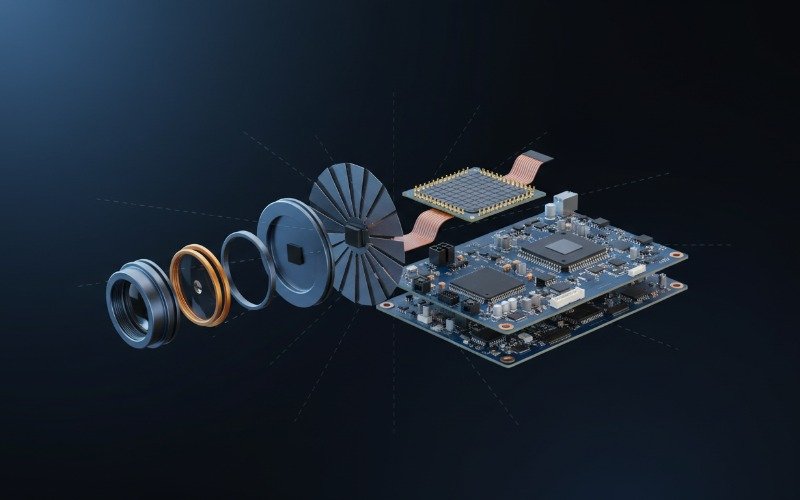
At the heart of every uncooled thermal imaging module lies the Focal Plane Array (FPA). Unlike visible light cameras that use silicon-based CMOS sensors to detect photons, thermal modules utilize microbolometers. These sensors are designed to detect electromagnetic radiation in the 8 to 14 micrometer (μm) spectral range, known as the Long-Wave Infrared (LWIR) band.
The FPA consists of thousands of microscopic pixels. Each pixel is a suspended membrane that absorbs infrared energy. As the pixel absorbs heat, its temperature rises, causing a change in its electrical resistance. This change is read by the Readout Integrated Circuit (ROIC), which sits directly beneath the pixel array. The ROIC converts these minute resistance changes into electrical voltage signals that the module’s processor can interpret as temperature data.
Vanadium Oxide vs Amorphous Silicon
The material used to construct the microbolometer pixels defines the module’s performance. Two primary materials dominate the uncooled market.
Vanadium Oxide (VOx) offers a high Temperature Coefficient of Resistance (TCR) and lower noise profiles. This results in clearer images and better thermal sensitivity. VOx is widely regarded as the gold standard for high-performance commercial and defense applications.
Amorphous Silicon (a-Si) is an alternative material used in some detectors. While typically easier to manufacture in standard silicon foundries, it generally exhibits lower sensitivity compared to VOx. However, for cost-constrained applications where extreme precision is not mandatory, a-Si remains a viable option.
Understanding Technical Specifications
Selecting the correct thermal imaging module requires a deep understanding of specific engineering metrics. These values determine the clarity of the image and the distance at which the system can detect targets.
NETD and Thermal Sensitivity
Noise Equivalent Temperature Difference (NETD) is the primary figure of merit for thermal detector sensitivity. It measures the smallest temperature difference the detector can distinguish from the noise floor. NETD is expressed in millikelvins (mK).
A lower NETD value indicates superior performance. Standard industrial modules typically offer an NETD of <50mK. High-end modules utilized in security and scientific research push this boundary to <30mK or even <20mK, allowing the sensor to visualize extremely subtle thermal contrasts in low-contrast scenes, such as a person standing against a warm background.
Pixel Pitch and Resolution
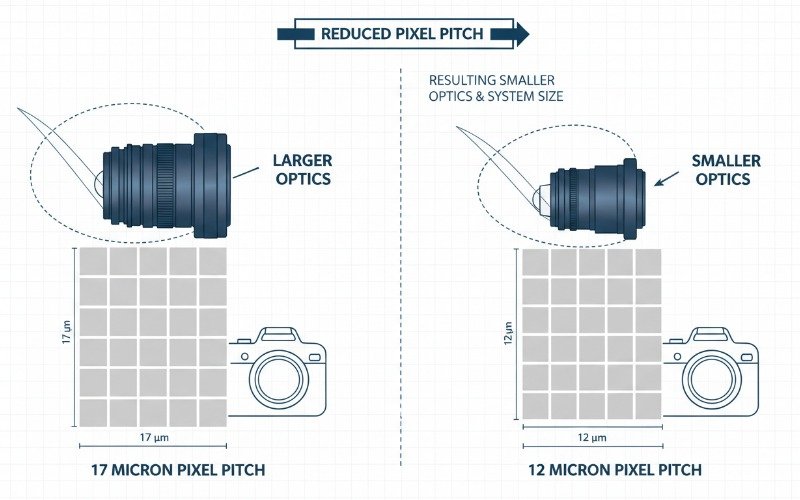
Pixel pitch refers to the distance between the center of one pixel and the center of the next, measured in micrometers (μm). The industry has trended toward smaller pixel pitches to reduce the physical size of the detector and the required optics.
Historically, 25μm and 17μm were standard. Today, 12μm is the mainstream standard for VOx detectors, with 10μm and 8μm technologies emerging for ultra-compact applications. Smaller pixels allow for higher resolution arrays (such as 640×512 or 1280×1024) to fit into smaller form factors, significantly reducing the Size, Weight, and Power (SWaP) of the final product.
Integration Interfaces
The utility of a thermal imaging module depends heavily on how easily it integrates into larger systems. Engineers must consider video output formats and communication protocols.
| Interface Type | Description | Typical Application |
|---|---|---|
| MIPI CSI-2 | High-speed serial interface widely used in mobile and embedded electronics. | Drones, Smartphones, Compact IoT devices |
| USB 3.0 / UVC | Plug-and-play digital interface for easy connection to PCs. | Lab testing, Medical devices, Handheld scopes |
| Camera Link | Robust high-bandwidth standard for industrial vision. | Automated factory inspection, Machine vision |
| CMOS Parallel | Direct raw data access for custom FPGA processing. | Custom OEM integration, Advanced defense systems |
Optics and Lens Materials
Standard glass acts as a mirror to infrared radiation. Therefore, thermal imaging modules require specialized lenses made from materials transparent to LWIR wavelengths. Germanium (Ge) is the most common material due to its high refractive index, though it is heavy and expensive. Chalcogenide glass is increasingly used as a cost-effective, moldable alternative suitable for mass production.
The lens assembly is often coated with Hard Carbon (DLC) or Anti-Reflective (AR) coatings to maximize transmission and protect the soft lens material from environmental damage.
Applications in Modern Industry
The versatility of the thermal imaging module has pushed it beyond military use into widespread commercial sectors.
Automotive Advanced Driver Assistance Systems
Thermal modules provide ADAS with the ability to detect pedestrians and wildlife in total darkness or through heavy fog—scenarios where visual cameras and LiDAR may fail. Automotive-grade modules must meet stringent shock and temperature qualifications.
Industrial Predictive Maintenance
Fixed thermal cores monitor critical infrastructure such as electrical substations and mechanical bearings. By detecting heat anomalies before a failure occurs, these systems prevent costly downtime and catastrophic equipment damage.
Frequently Asked Questions
Below are authoritative answers to common technical inquiries regarding thermal imaging modules.
Can thermal imaging modules see through glass windows?
What is the difference between cooled and uncooled modules?
How does frame rate affect thermal module performance?
What does shutterless non uniformity correction mean?