
China Moneypro
What is a Gimbal Payload
Discover the engineering behind gimbal payload systems. Learn about stabilization, EO/IR sensors, and how these modules empower UAVs and autonomous vehicles.
This article is part of our Systems & Payloads section. For a complete overview, visit our Knowledge Hub guide.
Modern autonomous systems rely on sophisticated vision technologies to perceive the world. Whether attached to a high-altitude drone, a marine vessel, or a ground robot, the sensor array responsible for capturing data is known as the gimbal payload. While the term is often used interchangeably with “camera,” a professional-grade gimbal payload is a complex integration of optics, mechanics, and stabilization algorithms designed to operate in dynamic environments.
Understanding the distinction between the stabilization mechanism and the sensor payload itself is critical for engineers and procurement specialists. The payload defines the mission capability, determining whether a system can see through fog, measure distances with laser precision, or map terrain in 3D. This guide explores the architecture, sensor types, and engineering principles that define high-performance gimbal payloads.
Key Takeaways
- Payload Definition: The payload refers to the active sensors (cameras, lasers, radars) carried by the gimbal, distinct from the motorized stabilization unit.
- Stabilization Necessity: Gimbals counteract vibration and movement using gyroscopes to ensure payload data remains usable and clear.
- Sensor Variety: Common payloads include Electro-Optical (EO) visible cameras, Infrared (IR) thermal imagers, and Laser Rangefinders (LRF).
- SWaP Constraints: Size, Weight, and Power (SWaP) are the primary engineering limitations when selecting a payload for UAVs.
The Distinction Between Gimbal and Payload
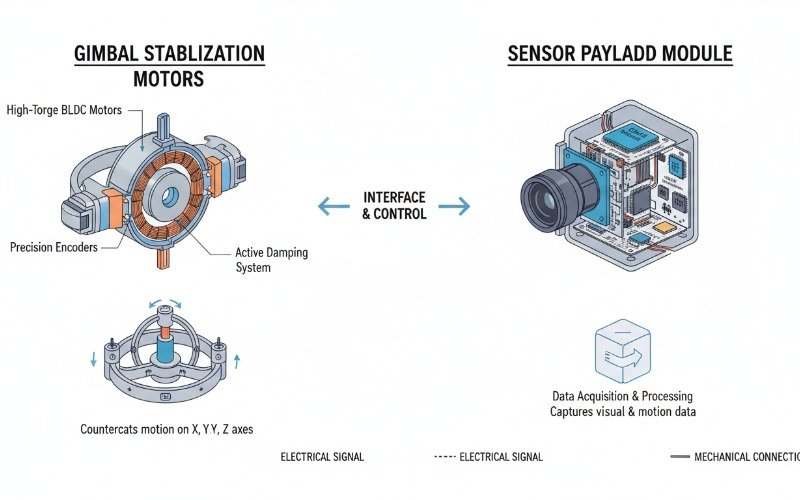
To fully grasp the technology, one must separate the carrier from the cargo. The gimbal is the electromechanical chassis. It utilizes brushless DC motors, inertial measurement units (IMUs), and advanced PID controllers to maintain a steady horizon regardless of the vehicle’s movement. Its primary job is stabilization and pointing.
The payload is the functional equipment mounted within that chassis. In the context of optoelectronics, the payload is the “eye” of the system. A high-end gimbal system is often modular, allowing operators to swap payloads depending on the mission requirements. For instance, a search and rescue mission might require a high-sensitivity thermal imager, while a standard inspection mission might only require a high-resolution zoom camera.
Core Components of a Multi Sensor Payload
Modern payloads are rarely single-purpose. Manufacturers integrate multiple sensors into a single housing to maximize utility. This convergence of technologies allows a single payload to perform daytime surveillance, nighttime tracking, and target geolocation simultaneously.
Electro Optical Sensors
The Electro-Optical (EO) sensor is the industry standard for visible light imaging. These are typically CMOS (Complementary Metal-Oxide-Semiconductor) sensors similar to those found in high-end consumer cameras but engineered for industrial resilience. Key metrics for EO payloads include optical zoom capability, shutter speed (global shutters are preferred to avoid rolling shutter artifacts), and low-light performance.
For more information about EO Technology.
Infrared Thermal Imaging Modules
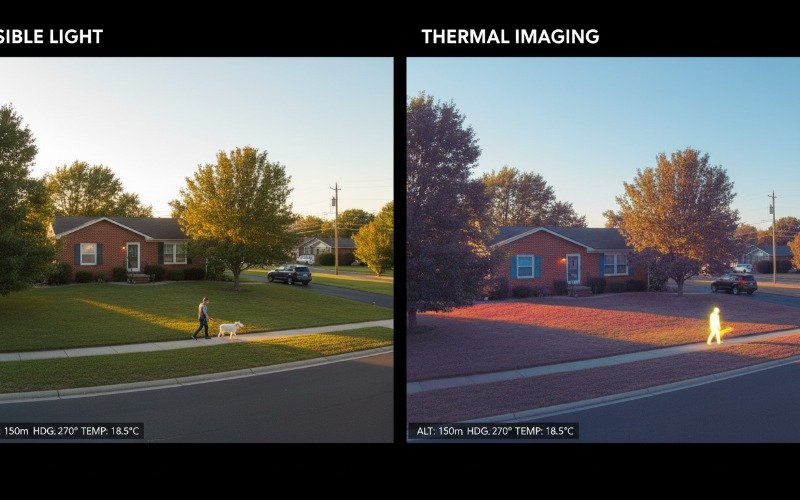
Thermal imaging represents the cornerstone of night-vision capabilities. Most commercial and industrial payloads utilize uncooled Vanadium Oxide (VOx) microbolometers. These detectors sense heat radiation rather than visible light, allowing the payload to “see” in total darkness or through smoke.
Advanced payloads may feature cooled MCT (Mercury Cadmium Telluride) detectors, which offer superior sensitivity (NETD < 20mK) for long-range surveillance, though they add significant weight and power requirements. For general use, a radiometric thermal core allows the operator to measure the temperature of specific pixels, a vital feature for inspecting power lines or solar panels.
For more information about Infrared & Thermal Imaging Knowledge.
Laser Rangefinders and Illuminators
A Laser Rangefinder (LRF) emits a laser pulse to measure the distance between the payload and the target. When combined with the gimbal’s angular position data and the drone’s GPS coordinates, the onboard computer can calculate the exact geolocation of a target. This is essential for mapping and coordination applications.
Stabilization Mechanics and Axis Control
The effectiveness of a payload depends entirely on the gimbal’s ability to isolate it from vibration. Without stabilization, the high-zoom capabilities of an EO sensor would be rendered useless by the high-frequency vibrations of drone propellers or the rocking motion of a boat.
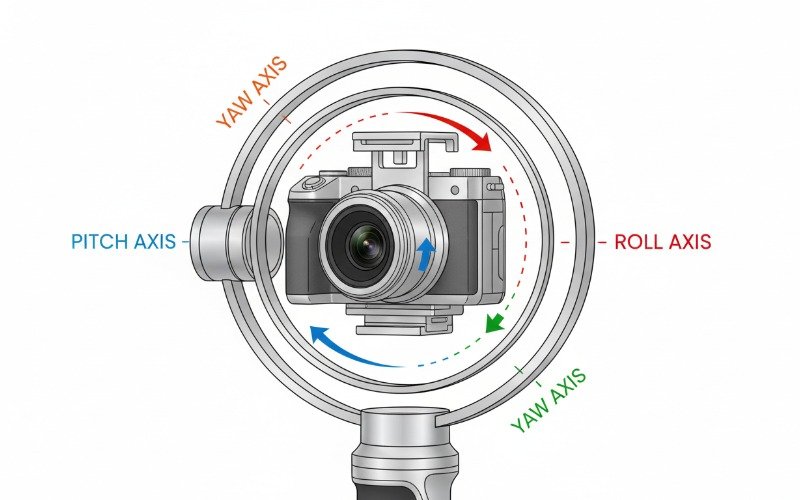
Stabilization is generally categorized by the number of axes controlled. While 2-axis systems (pitch and roll) exist, professional payloads almost exclusively use 3-axis stabilization to control Pitch (tilt), Roll (horizon), and Yaw (pan).
Micro-vibration is the enemy of image clarity. High-end gimbal payloads utilize MEMS gyroscopes to detect angular velocity changes. The system processes this data thousands of times per second, driving brushless motors to counteract the movement. Leading systems achieve stabilization accuracy of nearly 10 microradians, meaning the image remains virtually perfectly still even when the vehicle is vibrating intensely.
Technical Comparison of Payload Configurations
Selecting the correct payload requires balancing performance with physical constraints. The following table outlines common configurations found in the industry.
| Payload Type | Primary Components | Typical Application | Stabilization Demand |
|---|---|---|---|
| Single Sensor EO | 30x Optical Zoom Camera | Traffic Monitoring, Inspection | High (due to high zoom) |
| Dual Sensor EO/IR | 4K Visible + 640px Thermal | Search & Rescue, Solar Inspection | Medium |
| Tri-Sensor Pod | EO + IR + Laser Rangefinder | Tactical ISR, Surveying | High |
| LiDAR Payload | Laser Scanner + IMU | 3D Mapping, Topography | Critical (requires precise position data) |
SWaP Factors in Payload Engineering
In aerospace and robotics engineering, the acronym SWaP (Size, Weight, and Power) dictates every design decision. A heavy payload reduces the flight time of a drone or the range of an electric vehicle. Consequently, payload manufacturers strive to miniaturize components without sacrificing performance.
Recent advancements in wafer-level packaging for infrared detectors have allowed for smaller thermal cores. A 12-micron pixel pitch sensor is significantly smaller and requires smaller optics than older 17-micron sensors, resulting in a lighter overall payload. Efficient power management is also crucial; the payload must draw minimal current from the host vehicle’s battery to ensure mission longevity.
Applications Across Industries
Search and Rescue Operations
Thermal payloads are indispensable in search and rescue (SAR). A human body emits a distinct heat signature that contrasts sharply with cold water or dense foliage. A gimbal-mounted thermal camera can scan vast areas autonomously, identifying survivors even at night. The gimbal allows the camera to point directly downward (nadir) or scan the horizon while the aircraft maintains a straight flight path.
Infrastructure Inspection
High-resolution EO payloads with powerful zoom lenses allow inspectors to examine wind turbines, bridges, and cellular towers from a safe distance. The stabilization ensures that the zoom lens can focus on minute cracks or corrosion without image blur. Radiometric thermal payloads are specifically used to detect overheating components in electrical substations.
Border Security and Surveillance
For security applications, payloads often require long-range optics and object tracking capabilities. Onboard software processes the video feed in real-time, locking onto moving targets such as vehicles or personnel. The gimbal automatically rotates to keep the target in the center of the frame, a feature known as object tracking.
See what China Moneypro’s products can do in Border & Castal Surveillance.
Integration and Control Interfaces
Integrating a payload involves data transmission and control protocols. The payload must transmit high-bandwidth video data to the operator while simultaneously receiving control commands (zoom, pan, tilt, palette change).
Standard interfaces include HDMI and SDI for video output, while control data is often managed via serial protocols like UART (VISCA, Pelco-D) or Ethernet (MAVLink). Advanced payloads offer IP output, encoding video into H.264/H.265 streams that can be transmitted over long-range digital links. Seamless integration ensures that the pilot can control the payload settings directly from the flight controller without needing a secondary remote.
Future Trends in Payload Technology
The future of gimbal payloads lies in Edge AI. Rather than transmitting raw video to a ground station for analysis, payloads are increasingly equipped with powerful processors capable of onboard analytics. This allows the payload to autonomously detect objects, classify threats, and filter data, sending only relevant alerts to the operator. This reduces bandwidth requirements and increases reaction speed.
Furthermore, the fusion of multispectral data—combining thermal, visible, and hyperspectral imagery—will provide richer datasets for agriculture and environmental monitoring. As sensor resolutions increase and SWaP footprints decrease, gimbal payloads will become even more integral to the autonomous systems of tomorrow.
Frequently Asked Questions
What is the difference between a 2-axis and 3-axis gimbal payload?
Can I mount any camera on a gimbal payload?
What is a radiometric thermal payload?
How does a gimbal payload connect to a drone?
What does SWaP mean in payload technology?