
China Moneypro
Uncooled vs Cooled Infrared Detectors Technical Comparison
A technical engineering analysis comparing Uncooled Microbolometer and Cooled Photonic detector technologies. Evaluate NETD, SWaP-C, and spectral ranges.
This article is part of our Comparisons & Buying Guides section. For a complete overview, visit our Knowledge Hub guide.
Key Takeaways
- Thermal vs Photonic Physics: Uncooled detectors measure resistance changes from heat (microbolometers), while cooled detectors count photons using electron excitation (photonic).
- Sensitivity Metrics: Cooled detectors offer superior sensitivity with NETD values often below 25mK compared to 40-50mK for high-end uncooled systems.
- Spectral Ranges: Uncooled systems typically operate in the Long-Wave Infrared (LWIR) band, whereas cooled systems dominate the Mid-Wave Infrared (MWIR) spectrum.
- Lifecycle Costs: Uncooled sensors provide indefinite operation times, while cooled assemblies require cryocooler maintenance every 10,000 to 20,000 hours.
Selecting the correct infrared imaging architecture is the most critical decision in designing electro-optical systems. For procurement managers and system engineers, understanding the fundamental divergence between uncooled and cooled infrared detectors determines the success of applications ranging from scientific research to perimeter security. While both technologies convert infrared radiation into visible images, their underlying physics, cost structures, and performance envelopes differ radically.
This technical guide analyzes the engineering trade-offs between these two dominant detector types. We will examine the distinctions in sensitivity, speed, spectral response, and Size, Weight, and Power (SWaP) to provide a definitive answer on which technology suits specific mission requirements.
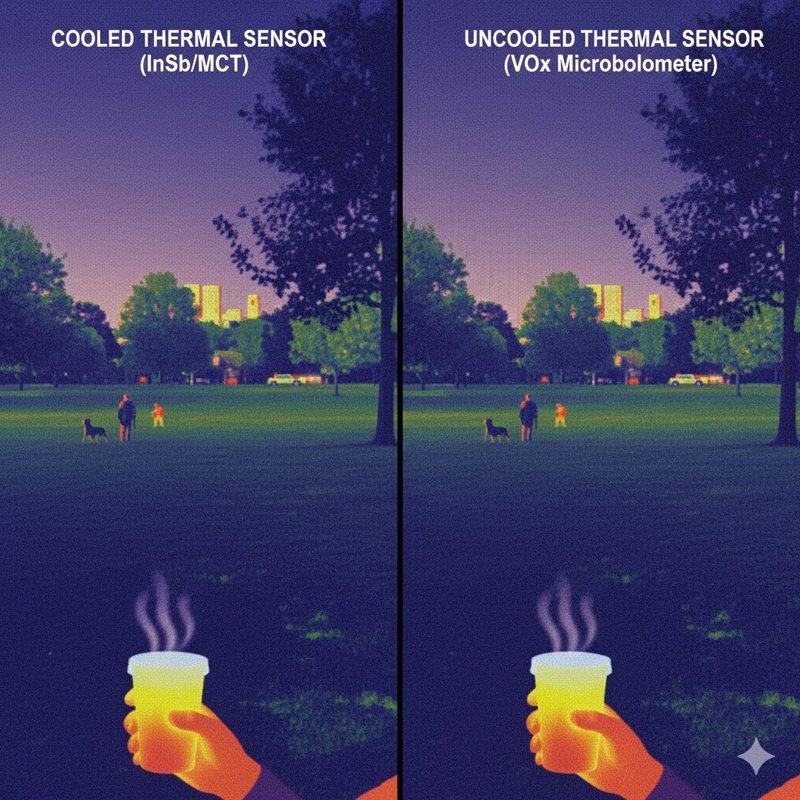
The Physics of Thermal Detection
To evaluate performance, we must first understand the detection mechanism. Infrared detectors are categorized based on how they interact with incident radiation. This fundamental difference dictates the cooling requirements and the ultimate sensitivity of the system.
Thermal Detectors (Uncooled)
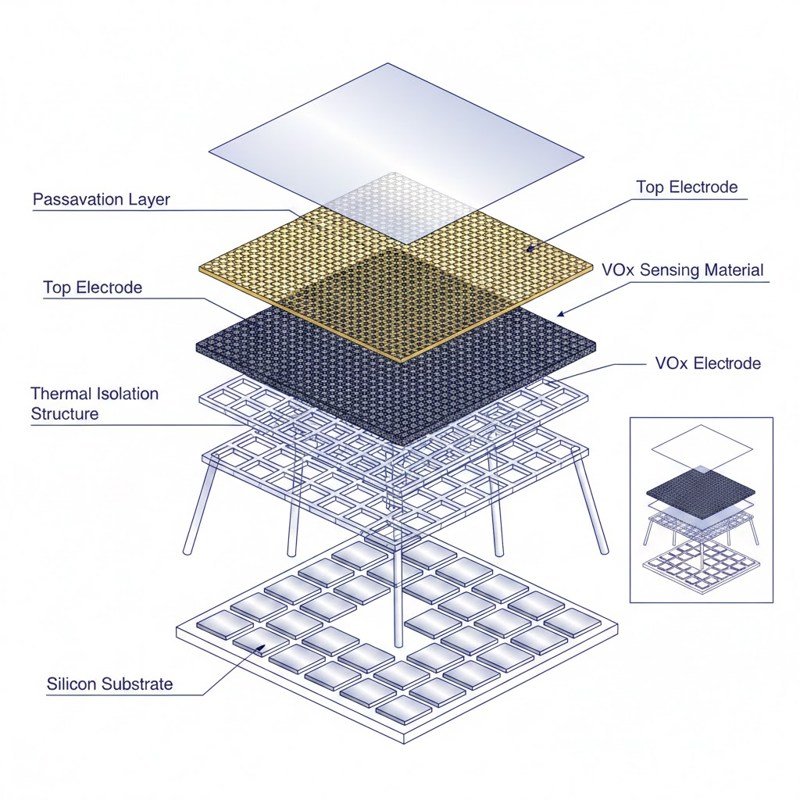
Uncooled detectors, primarily microbolometers, function as thermal sensors. They rely on the change in physical properties of a material when it absorbs infrared radiation and heats up. The most common materials used are Vanadium Oxide (VOx) or Amorphous Silicon (a-Si).
In a VOx microbolometer, the detector elements are thermally isolated from the readout integrated circuit (ROIC). When infrared energy hits a pixel, its temperature rises, causing a measurable change in electrical resistance. The ROIC reads this resistance change and converts it into a video signal. Because this process involves a physical temperature change, it has a distinct thermal time constant, which limits the frame rate and sensitivity compared to photonic detection.
Quantum Detectors (Cooled)
Cooled detectors represent a class known as photonic or quantum detectors. These sensors, often made from Indium Antimonide (InSb), Mercury Cadmium Telluride (MCT/HgCdTe), or Type-II Superlattice (T2SL) structures, operate on the principle of the photoelectric effect.
Instead of heating up, the cooled detector material absorbs photons which excite electrons from the valence band to the conduction band, generating an electric current or voltage directly. This quantum event is instantaneous. However, to prevent thermal noise (dark current) from overwhelming the signal, the sensor must be cooled to cryogenic temperatures (typically 77 Kelvin or -321°F) using an integrated Dewar assembly and a Stirling cryocooler.
Uncooled Microbolometer Technology Analysis
Uncooled technology has revolutionized the commercial thermal market by removing the heavy, expensive cooling mechanisms. Modern 12μm pixel pitch VOx sensors are now standard, pushing resolution up to HD formats (1280×1024).
Long Wave Infrared Dominance
Uncooled sensors operate almost exclusively in the Long-Wave Infrared (LWIR) band, spanning 8 to 14 micrometers. This is significant because terrestrial objects (people, vehicles, vegetation) emit peak thermal energy in this band. Furthermore, LWIR is less susceptible to scattering by smoke, dust, and aerosols compared to shorter wavelengths, making uncooled systems robust for firefighting and battlefield obscuration scenarios.
SWaP and Reliability Advantages
The absence of a cryocooler creates immense advantages in Size, Weight, and Power (SWaP). Uncooled modules can be smaller than a golf ball and consume less than 1.5 Watts. This enables integration into handheld devices, commercial drones, and weapon sights. Additionally, solid-state construction means there are no moving parts, leading to an extremely high Mean Time Between Failures (MTBF), often exceeding years of continuous operation.
Cooled Photonic Detector Technology Analysis
While uncooled sensors are convenient, cooled detectors remain the gold standard for high-performance scientific and long-range surveillance applications. The cryogenic cooling allows these sensors to achieve sensitivities that are orders of magnitude higher than microbolometers.
Mid Wave Infrared Capability
Cooled detectors are frequently designed for the Mid-Wave Infrared (MWIR) band (3-5 micrometers). The MWIR band offers higher thermal contrast than LWIR, which is critical for identifying targets against cluttered backgrounds. While atmospheric absorption is higher in MWIR over extremely long distances in humid conditions, the high contrast usually compensates for this, providing sharper images at range.
Speed and Synchronization
The quantum nature of cooled detectors allows for incredibly fast integration times (microseconds). This enables “snapshot” readout modes, effectively freezing motion. This capability is essential for tracking fast-moving projectiles, analyzing combustion processes, or capturing high-speed machinery. Uncooled sensors, with their thermal lag, typically suffer from motion blur in these high-dynamic scenarios.
Technical Performance Comparison
The following table illustrates the stark differences in performance metrics between a standard Uncooled VOx Microbolometer and a Cooled InSb Detector.
| Feature | Uncooled (VOx Microbolometer) | Cooled (InSb / MCT) |
|---|---|---|
| Operating Principle | Thermal (Resistance Change) | Quantum (Photonic Excitation) |
| Spectral Band | LWIR (7-14 μm) | MWIR (3-5 μm) or LWIR |
| NETD (Sensitivity) | <40mK to <50mK | <20mK to <25mK |
| Integration Time | Slow (Thermal Time Constant) | Fast (Microseconds) |
| Cooling Requirement | None (TEC optional) | Cryogenic (77K via Stirling Cooler) |
| Maintenance Interval | Indefinite | 10,000 – 20,000 Hours (Cooler rebuild) |
| Cost | Low to Moderate | High |
Magnification and Optical Challenges
One often overlooked distinction is the relationship between the detector and the optics. Cooled detectors have a higher F-number tolerance (often F/4 or F/5.5) compared to uncooled sensors which require fast optics (F/1.0 or F/1.2) to gather enough energy.
Because cooled sensors are so sensitive, they can operate with lenses that have smaller apertures. This allows for the design of high-magnification continuous zoom lenses that are physically manageable. Achieving a 20x optical zoom on an uncooled LWIR system would require a germanium lens of massive diameter and weight, making it impractical. Therefore, for extreme long-range surveillance (10km+), cooled MWIR systems are the only viable option due to optical physics.
Application Suitability Guide
Choosing between uncooled and cooled technologies requires mapping the technical constraints to the operational environment. Below are the primary use cases for each architecture.
When to Choose Uncooled Detectors
Uncooled microbolometers are the superior choice when reliability, cost, and portability are the driving factors. They are ideal for:
- Predictive Maintenance: Inspecting electrical panels, bearings, and insulation.
- Short-Range Security: Perimeter monitoring up to 500 meters.
- Automotive Night Vision: Driver enhancement systems requiring instant-on capability.
- Drones (UAVs): Payload weight restrictions necessitate lightweight uncooled cores.
When to Choose Cooled Detectors
Cooled systems are mandatory when the application demands extreme sensitivity, high speed, or long-range identification. They are required for:
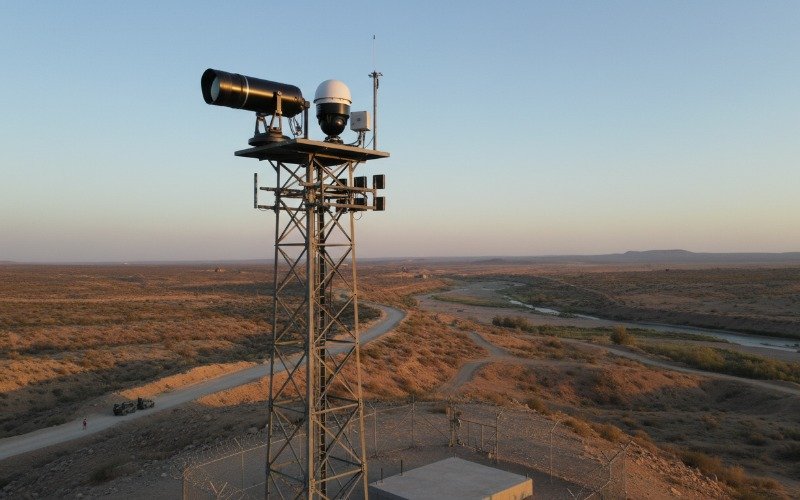
- Long-Range Border Surveillance: Identifying humans or vehicles at distances exceeding 10km. See what Moneypro’s products can do in Border & Coastal Surveillance
- Gas Detection (OGI): Detecting specific spectral absorption lines of fugitive gas leaks. Dive into Optical Gas Imaging Solution for real-time leak detection and environmental safety.
- R&D and Science: High-speed thermal analysis of ballistics or combustion.
- Coastal Surveillance: Penetrating high humidity environments where MWIR performs better.
The Cost of Ownership Reality
The acquisition cost is only one part of the equation. A cooled thermal camera can cost 5 to 10 times more than an equivalent resolution uncooled camera. However, the Total Cost of Ownership (TCO) calculation must include maintenance.
Cooled cameras utilize Stirling cryocoolers, which are mechanical pumps containing helium gas. Over time, seals wear and helium leakage occurs. Typically, a cooler will need servicing or replacement every 10,000 to 20,000 hours. This service is specialized, costly, and results in system downtime. In contrast, uncooled cameras are essentially maintenance-free solid-state devices that can run continuously for years without performance degradation.
Future Trends in Infrared Detection
The gap between these technologies is narrowing. High Operating Temperature (HOT) MWIR detectors are a recent breakthrough. These sensors operate at roughly 150 Kelvin rather than 77 Kelvin. This higher temperature requirement reduces the workload on the cryocooler, extending its life and reducing power consumption.
Simultaneously, uncooled microbolometer pixel pitches are shrinking from 12μm to 10μm and smaller, improving resolution and allowing for smaller optics. While the physics of thermal vs. quantum detection ensures a permanent distinction in sensitivity, the practical utility of uncooled sensors continues to expand into territories previously held by cooled systems.
Frequently Asked Questions
What is the main difference between cooled and uncooled thermal cameras?
Why are cooled thermal cameras more expensive?
Which thermal camera is better for long range surveillance?
What is the lifespan of an uncooled microbolometer?