
China Moneypro
Thermal Weapon Sight vs Clip-on Modules
Compare dedicated thermal weapon sights and clip-on configurations. Analyze boresight retention, collimation physics, and SWaP factors for system integrators.
System integrators and procurement officers facing the choice between a dedicated thermal weapon sight (TWS) and a clip-on thermal imager (COTI) must navigate complex trade-offs. The decision impacts optical performance, weight distribution, logistical footprints, and total cost of ownership. This analysis dissects the electro-optical architecture, collimation challenges, and operational capabilities of both configurations to guide high-level B2B decision-making.
Key Takeaways for System Integrators
- Zero Retention: Clip-ons utilize the day optic’s zero, reducing training time, while dedicated sights require re-zeroing upon every mount.
- Optical Architecture: Clip-ons require precise output collimation to maintain <1 MOA accuracy through the day optic.
- SWaP Constraints: Dedicated sights generally offer lower system weight compared to the combined mass of a day scope plus a clip-on unit.
- Sensor Performance: Both systems now leverage advanced 12μm VOx microbolometers with NETD <30mK for superior thermal sensitivity.
Engineering Dedicated Thermal Weapon Sights
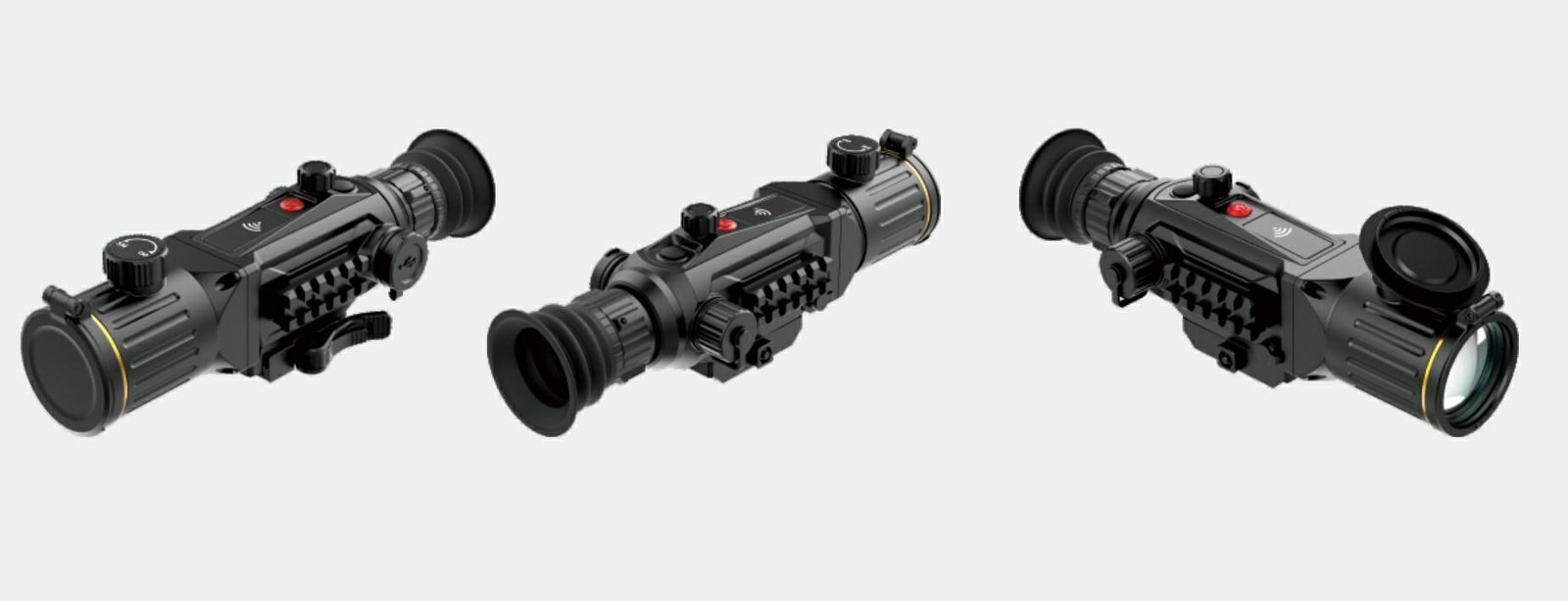
A dedicated thermal weapon sight functions as a standalone optoelectronic system. It completely replaces the traditional glass day optic. The architecture consists of an objective germanium lens, a Focal Plane Array (FPA)—typically a Vanadium Oxide (VOx) uncooled microbolometer—an image processing core, and an ocular display (OLED or LCOS).
Digital Reticle Generation and Zeroing
In a dedicated system, the reticle is generated digitally within the image processing pipeline. This allows for infinite customization of reticle patterns, colors, and ballistic profiles. The “zeroing” process involves shifting the X/Y coordinates of the digital reticle overlay on the microdisplay to align with the barrel’s point of impact.
Because the sight acts as the primary aiming device, the mechanical mount must hold zero under significant recoil shock (often tested up to 1000g). Integrators must ensure the mounting interface (usually MIL-STD-1913 Picatinny) is machined to tight tolerances to prevent point-of-impact (POI) shift during repeated firing.
Optical Performance Advantages
Dedicated sights maximize light transmission. There is no intermediate glass between the shooter’s eye and the display other than the eyepiece. This direct view eliminates light loss associated with the multiple lens elements found in day scopes. Furthermore, the f-number of the germanium objective lens can be optimized specifically for the sensor size (e.g., F/1.0 or F/1.2), ensuring maximum thermal energy reaches the 12μm pixel pitch sensor.
Analyzing Clip-on Thermal Imager Architecture
Clip-on Thermal Imagers (COTI) or Inline Thermal Sights are designed to mount directly in front of an existing day optic. This configuration converts a standard rifle into a night-fighting system without removing the day scope or altering its zero.
The Physics of Collimation
The defining engineering challenge of a clip-on is the rear optical assembly. Unlike a dedicated sight that uses a magnifying eyepiece, a clip-on uses a collimating lens system. This assembly takes the image from the internal display and projects it at infinity focus (unity magnification, 1x).
The day scope “sees” this virtual image just as it would see a physical target downrange. Critical integration factors include:
- Boresight Accuracy: The optical axis of the clip-on must be perfectly aligned with the mechanical axis of the mount. Any deviation here results in POI shift. High-end clip-ons are factory aligned to <1 MOA deviation.
- Parallax Management: Poorly collimated units introduce parallax errors when the shooter’s head position shifts behind the day scope.
- Exit Pupil Matching: The clip-on’s display output must be large enough to cover the field of view of the day scope, although high magnification on the day scope often leads to “pixelation” of the thermal image.
System Weight and Power (SWaP) Analysis
For modern infantry and tactical teams, every ounce matters. System Integrators must calculate the total burden on the weapon platform.
Weight Distribution Metrics
A dedicated thermal sight typically weighs between 400g and 900g, depending on lens size (e.g., 50mm vs 75mm). This replaces the day optic, resulting in a net neutral or slight weight increase.
Conversely, a clip-on configuration is additive. A standard LPVO (Low Power Variable Optic) weighs roughly 600g, plus the mount (150g), plus the clip-on unit (400g-700g). The total system weight often exceeds 1.2kg. Furthermore, mounting a clip-on far forward on the rail shifts the center of gravity toward the muzzle, increasing shooter fatigue and negatively affecting weapon handling dynamics.
Operational and Logistical Comparisons
Beyond physics, the choice between thermal weapon sight vs clip-on dictates operational doctrine.
Mission Versatility
Clip-ons offer superior versatility for multi-role units. A sniper team can operate in daylight using high-fidelity glass optics for identification and precision. As darkness falls, the clip-on is attached in seconds without tools. The “zero” remains controlled by the day scope turrets. This capability is critical for missions spanning day-night cycles.
Digital Features and Ballistics
Dedicated thermal sights are increasingly evolving into ballistic computers. With onboard Laser Range Finders (LRF) and ballistic calculators, a dedicated sight can automatically adjust the digital reticle for bullet drop. Clip-ons act primarily as image providers; they rely on the day scope’s reticle (which usually lacks digital integration) for holdovers, limiting the utility of smart firing solutions unless the clip-on has an internal LRF and display overlay.
Technical Specifications Comparison Table
The following table outlines the critical specification deltas between a standard dedicated unit and a clip-on unit utilizing the same sensor core (e.g., 640×512, 12μm).
| Feature | Dedicated Thermal Sight | Clip-on Thermal Imager |
|---|---|---|
| Zeroing Mechanism | Digital Reticle Shift (XYZ) | Uses Day Optic Zero (Collimated) |
| Magnification | Digital + Optical (Fixed Lens) | 1x Optical (Unity) + Day Scope Mag |
| Boresight Retention | Critical (Must hold zero) | Critical (Must maintain alignment) |
| Start-up Time | < 3 Seconds | < 3 Seconds |
| NETD Sensitivity | < 30mK (Standard) | < 30mK (Standard) |
| System Weight | Lighter (Standalone) | Heavier (Additive) |
| Power Consumption | Moderate | Moderate |
| Reticle Options | Unlimited Digital Profiles | Physical/Etched Glass of Day Scope |
| Deployment Speed | Slow (Requires swap & zero) | Fast (Snap-on usage) |
Procurement Recommendations
For System Integrators advising defense clients or designing EO/IR packages, the recommendation relies on the user profile.
Select Dedicated Sights when:
- Weight reduction is the primary requirement.
- The weapon is dedicated strictly to night operations (e.g., feral hog control or specific tactical raids).
- Budget constraints exist (Dedicated sights are often 20-30% cheaper than collimated clip-ons of equal sensor quality).
- Smart features like auto-ballistic calculation are required.
Select Clip-on Sights when:
- Operators require seamless Day/Night transition without re-zeroing.
- The inventory already includes high-quality day optics (e.g., Schmidt & Bender, Nightforce).
- Mission profiles require visual identification (PID) capability during the day that thermal cannot provide.
- Versatility across multiple calibers and platforms is prioritized.
Frequently Asked Questions
Does a clip-on thermal sight affect the zero of the day scope?
What is the maximum magnification for a thermal clip-on?
Why are clip-on thermal units more expensive than dedicated sights?
Can I use a dedicated thermal sight as a handheld scanner?