
China Moneypro
Thermal Imaging Surveillance Technology for 24/7 Perimeter Security
Enhance perimeter defense with thermal imaging surveillance. Learn how VOx sensors, low NETD optics, and AI analytics provide superior night vision capabilities.
This article is part of our Applications section. For a complete overview, visit our Knowledge Hub guide.
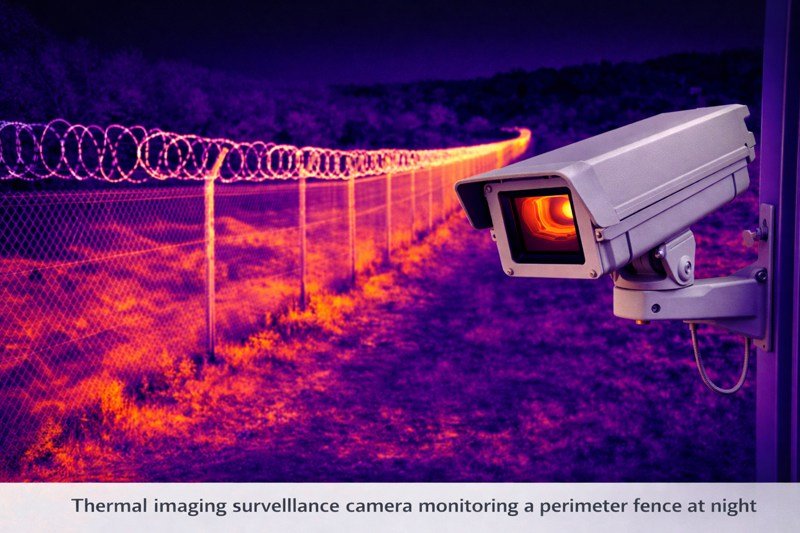
Traditional video surveillance relies heavily on visible light. When lighting conditions deteriorate due to darkness, smoke, fog, or glaring sunlight, standard optical cameras lose their effectiveness. Thermal imaging surveillance fundamentally changes this dynamic by detecting heat signatures rather than reflected light. This capability makes thermal cameras the gold standard for critical infrastructure protection, border security, and high-stakes perimeter defense.
By utilizing the Long-Wave Infrared (LWIR) spectrum, these systems visualize temperature differences as small as 0.03°C. This article explores the engineering principles behind thermal security cameras, the critical role of VOx microbolometers, and why this technology offers superior detection rates compared to conventional CCTV systems.
Key Takeaways for Security Professionals
- Total Darkness Operation creates visibility without any external illumination sources by detecting radiated heat energy.
- False Alarm Reduction occurs because thermal sensors ignore visual noise like moving shadows, headlights, or insects.
- Long-Range Detection capabilities allow human detection beyond 1km using uncooled VOx microbolometers.
- Atmospheric Penetration enables thermal cameras to see clearly through fog, smoke, and light foliage where optical cameras fail.
Physics of Infrared Radiation in Security Applications
All objects with a temperature above absolute zero emit infrared radiation. This physical law, known as Planck’s Law, forms the basis of thermal imaging surveillance. Unlike night vision goggles that amplify available light (image intensification), thermal cameras act as sensors that translate thermal energy into a visible image.
Surveillance cameras typically operate in the Long-Wave Infrared (LWIR) spectral band, ranging from 8μm to 14μm. This range is ideal for terrestrial security because it corresponds to the peak thermal emission of humans and vehicles at ambient temperatures. Furthermore, the atmosphere is highly transparent to LWIR wavelengths, minimizing signal attenuation caused by humidity or atmospheric particles.
Uncooled VOx Microbolometers Explained
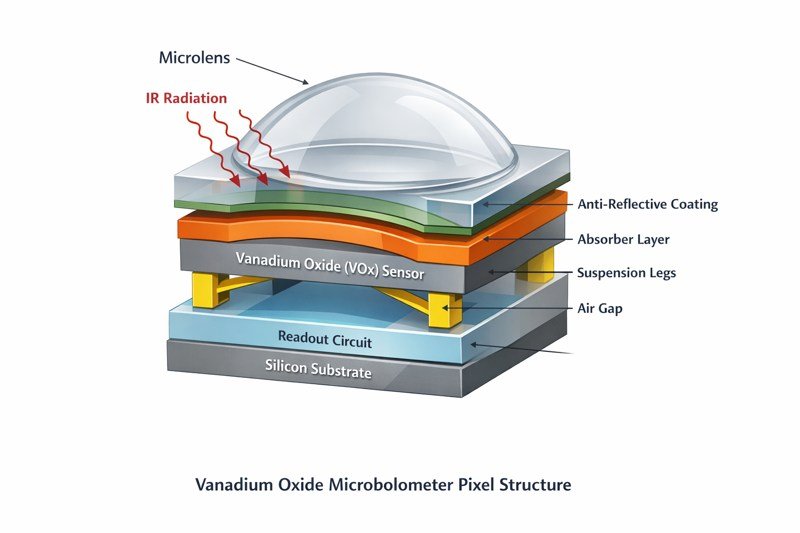
The heart of a modern security thermal camera is the Focal Plane Array (FPA). For the vast majority of commercial surveillance applications, the industry utilizes uncooled microbolometers. Among the materials used, Vanadium Oxide (VOx) stands out as the superior choice over Amorphous Silicon (a-Si) due to its higher temperature coefficient of resistance (TCR) and lower noise.
A VOx microbolometer works by changing its electrical resistance as it absorbs infrared radiation. A Readout Integrated Circuit (ROIC) measures these resistance changes and converts them into a digital video signal. Modern manufacturing processes have reduced the pixel pitch—the distance between the centers of two pixels—from 25μm down to 12μm. Smaller pixel pitch allows for smaller lens optics without sacrificing range performance, reducing the overall cost and size of the camera unit.
Critical Specifications for Procurement
Selecting the right thermal imaging surveillance hardware requires understanding three critical performance metrics. Ignoring these specs can lead to systems that fail to detect intruders at the required distances.
NETD Sensitivity
Noise Equivalent Temperature Difference (NETD) measures the sensor’s ability to distinguish small temperature differences. It is expressed in milli-Kelvins (mK). A lower number indicates better performance. High-end surveillance cameras feature an NETD of <40mK or even <30mK. This high sensitivity is crucial for low-contrast scenes, such as a person standing in front of a wall that has been heated by the sun, where the temperature delta is minimal.
Resolution and DRI Criteria
Thermal resolution differs from optical resolution. Standard thermal resolutions are 320×240 (entry-level), 640×512 (professional standard), and 1280×1024 (HD). Security professionals use the Johnson Criteria to define range performance, categorized into Detection, Recognition, and Identification (DRI).
- Detection means distinguishing an object from the background (something is there).
- Recognition means classifying the object type (human vs. animal vs. car).
- Identification means discerning specific details (holding a weapon).
Comparison of Surveillance Technologies
To understand where thermal fits in a security ecosystem, it is helpful to compare it directly against visible light cameras and active illumination systems.
| Feature | Visible Light Camera | Active IR (Night Vision) | Thermal Imaging |
|---|---|---|---|
| Lighting Requirement | High (Sun or Lamps) | Moderate (IR Illuminator) | None (Passive) |
| Range Performance | Dependent on Light | Limited by Illuminator | Very Long (Km+) |
| Atmospheric Clarity | Poor (Blocked by Fog) | Poor (Reflection Issues) | High (Penetrates) |
| Contrast Source | Reflected Color | Reflected IR Light | Emitted Heat |
| False Alarm Rate | High (Shadows/Bugs) | High (Spiders/Rain) | Very Low |
Integration with AI Video Analytics
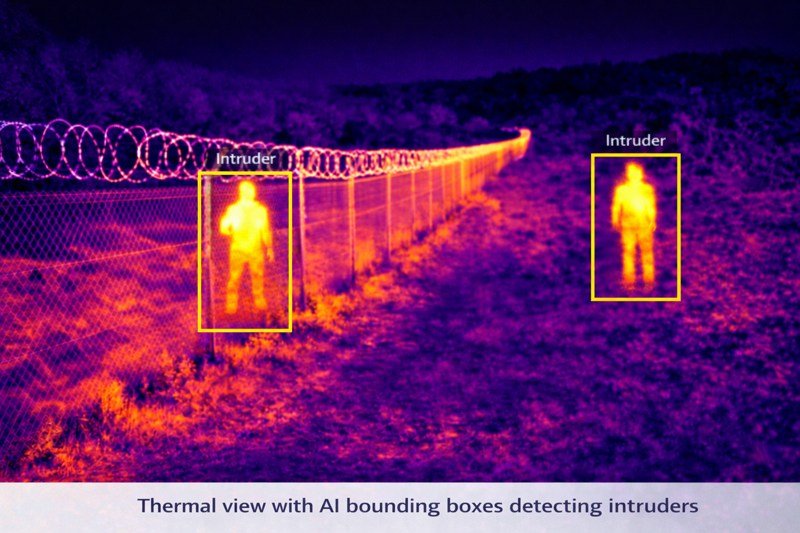
The high-contrast images produced by thermal sensors are ideal for Video Content Analysis (VCA) and Artificial Intelligence. Standard optical cameras often struggle with shadows, changing light conditions, or camouflage patterns, which confuse motion detection algorithms. Thermal imaging surveillance creates a crisp silhouette of a human or vehicle against the background environment regardless of lighting.
This distinct contrast allows AI algorithms to classify objects with vastly superior accuracy. Integrators deploying perimeter intrusion detection systems (PIDS) find that thermal cameras significantly reduce false positives. This reduction lowers the operational burden on security personnel who no longer need to investigate alarms caused by swaying trees or headlights sweeping across a fence line.
Applications in Critical Infrastructure
Thermal cameras serve as the primary detection layer for high-security environments. In electrical substations, they perform a dual role: detecting intruders and monitoring equipment temperatures to prevent overheating failures (radiometry). For maritime and port security, thermal imagers are indispensable for detecting small vessels or swimmers in the water at night, a task that radar and visual cameras often fail to perform reliably close to the shoreline.
Future Trends in Electro-Optical Systems
The future of thermal surveillance lies in sensor fusion. Modern EO/IR (Electro-Optical/Infrared) systems combine a high-resolution visible camera and a thermal imager on a single pan-tilt-zoom (PTZ) unit. Advanced software overlays the thermal data onto the visual feed or switches seamlessly between them based on environmental conditions. As VOx manufacturing yields improve, the cost of high-resolution thermal cores continues to drop, making this technology accessible for commercial and residential security applications previously reserved for military use.