
China Moneypro
Advanced Thermal Imaging Systems for Search and Rescue Operations
Explore how VOx microbolometers and high-sensitivity IR sensors revolutionize search and rescue. Learn about NETD, resolution, and drone payloads.
This article is part of our Applications section. For a complete overview, visit our Knowledge Hub guide.
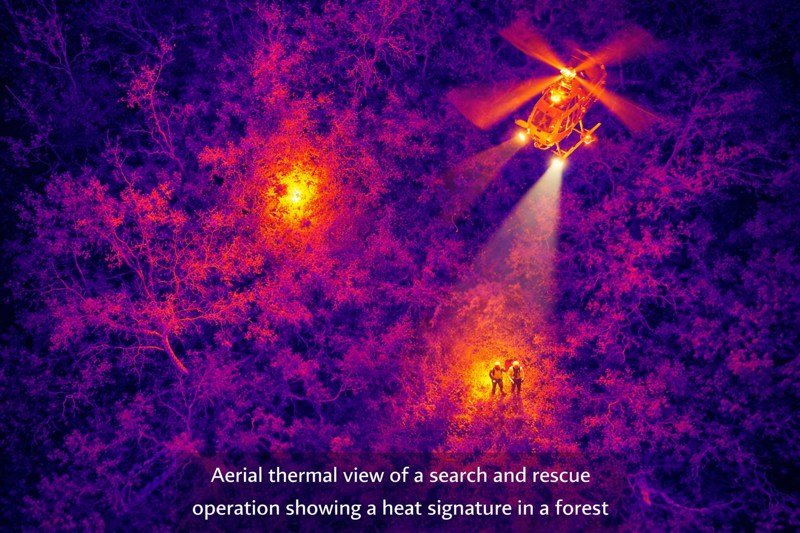
Time remains the most critical variable in any search and rescue (SAR) operation. Every passing minute reduces the probability of survival for lost hikers, disaster survivors, or maritime accident victims. Traditional visual searches rely heavily on daylight and clear weather conditions, severely limiting operational windows. Thermal imaging technology shatters these limitations by converting heat signatures into visible images, allowing rescue teams to operate effectively in total darkness, dense fog, and smoke.
Modern infrared detectors do not merely offer night vision. They utilize sophisticated Vanadium Oxide (VOx) uncooled microbolometers and high-performance optics to detect minute temperature differences against complex backgrounds. This engineering deep dive explores the optoelectronic principles that make thermal imaging the standard for SAR missions worldwide.
Key Takeaways for Rescue Professionals
- Heat Signatures Overcome Visual Barriers: Infrared sensors detect thermal radiation rather than reflected light, enabling visibility through smoke, foliage, and complete darkness.
- NETD Sensitivity Matters: A lower Noise Equivalent Temperature Difference (NETD), ideally below 40mK, is crucial for distinguishing human body heat from environmental clutter.
- Resolution Dictates Range: Higher Focal Plane Array (FPA) resolutions like 640×512 allow for detection at greater distances, essential for aerial drone operations.
- Multi-Spectral Fusion: Combining thermal data with visible light sensors enhances situational awareness and identification accuracy.
The Physics of Heat Detection in SAR Environments
All objects with a temperature above absolute zero emit infrared radiation. In the context of search and rescue, the primary target is the human body, which typically exhibits a skin temperature contrasting with the ambient environment. Thermal cameras designed for SAR operate primarily in the Long-Wave Infrared (LWIR) spectral band, typically between 8μm and 14μm. This range is optimal because it experiences minimal attenuation from the atmosphere and matches the peak emission of objects at terrestrial temperatures.
VOx Uncooled Microbolometers Lead the Industry
The vast majority of SAR thermal imagers utilize uncooled microbolometers. These sensors rely on Vanadium Oxide (VOx) or Amorphous Silicon (a-Si) materials that change electrical resistance when heated by incoming infrared radiation. VOx is generally preferred in high-end SAR applications due to its superior Temperature Coefficient of Resistance (TCR) and lower 1/f noise characteristics. This results in a cleaner image and better sensitivity, allowing operators to spot a faint heat signature from a lost subject even when the ground temperature is relatively high.
Critical Performance Metrics for Rescue Scenarios
Selecting the right thermal imaging module involves balancing several optoelectronic specifications. For mission-critical deployments, understanding these metrics ensures that the equipment can perform under stress.
NETD Sensitivity Determines Success in Low Contrast
Noise Equivalent Temperature Difference (NETD) represents the smallest temperature difference a thermal detector can distinguish from the noise floor. It is measured in millikelvins (mK). In SAR operations, the contrast between a survivor and the background can be minimal, especially if the person is hypothermic or wearing heavy insulation. A sensor with an NETD of <30mK provides vastly superior image detail compared to a standard <50mK sensor. This high sensitivity allows the imager to resolve the texture of terrain and clothing, helping distinguish a person from a heated rock or animal.
High Resolution Defines Detection Distance
The resolution of the Focal Plane Array (FPA) directly impacts how far away a target can be detected. This is governed by Johnson’s Criteria, which defines the number of pixels required to detect, recognize, or identify a target. Common resolutions include:
- 384 x 288: Suitable for short-range handheld devices.
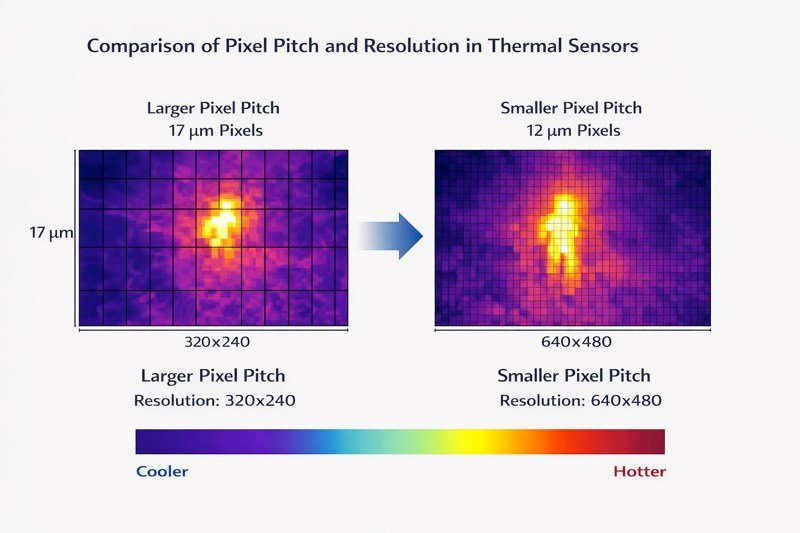
- 640 x 512: The industry standard for professional SAR drones and vehicle mounts, offering a balance of range and field of view.
- 1280 x 1024: High-definition thermal imaging used in fixed-wing aircraft or long-range surveillance, capable of detecting human activity from kilometers away.
A smaller pixel pitch, such as 12μm, allows for smaller optics without sacrificing range, making it ideal for weight-constrained drone payloads.
Deployment Platforms and Tactical Integration
Thermal imaging technology has evolved to fit various deployment platforms, each serving a specific tactical role in the search chain.
UAV Thermal Payloads for Wide Area Scanning
Unmanned Aerial Vehicles (UAVs) equipped with radiometric thermal cameras have revolutionized SAR. A drone flying at 50 meters altitude can scan a large area in minutes that would take a ground team hours to cover. Advanced UAV gimbals stabilize the camera, while onboard processing can automatically tag heat signatures that resemble human outlines. The 12μm pixel pitch allows for lighter lenses, extending flight times—a critical factor when covering vast wilderness areas.
Handheld Units for Ground Team Navigation
Once an approximate location is identified, ground teams deploy with handheld thermal monoculars or thermal binoculars. These devices must be ruggedized (IP67 rated) and offer fast startup times. They allow rescuers to navigate difficult terrain at night without revealing their position or using flashlights that might disorient a confused victim. Bi-ocular systems are often preferred for extended searching to reduce eye fatigue.
Technical Comparison of Detector Technologies
While uncooled sensors dominate, cooled thermal cameras play a niche role. Understanding the trade-offs is vital for procurement.
| Feature | Uncooled Microbolometer (VOx) | Cooled Photodetector (MCT/InSb) |
|---|---|---|
| Operating Principle | Resistance change due to heat | Photon detection (Quantum effect) |
| Sensitivity (NETD) | Typically <40mK to <50mK | Extremely high (<25mK) |
| Start-up Time | Instant to seconds | Several minutes (Cool-down required) |
| Maintenance | Zero maintenance, solid state | Cooler requires service (MTBF ~10k hours) |
| Cost | Moderate | Very High |
| Best For | Drones, Handhelds, Ground Vehicles | Long-range coastal patrol, High-altitude SAR |
Advanced Image Processing for Target Identification
Raw thermal data is often low contrast. Manufacturers employ advanced digital signal processing to make the image interpretable for human operators.
Digital Detail Enhancement and Edge Sharpening
Algorithms such as Digital Detail Enhancement (DDE) amplify high-frequency spatial information. This draws out edges and textures, preventing the “washed out” look common in scenes with uniform temperatures. For a SAR operator, this means seeing the outline of a person clearly against the ground, rather than just a blurry hotspot.
Selecting the Right Color Palettes
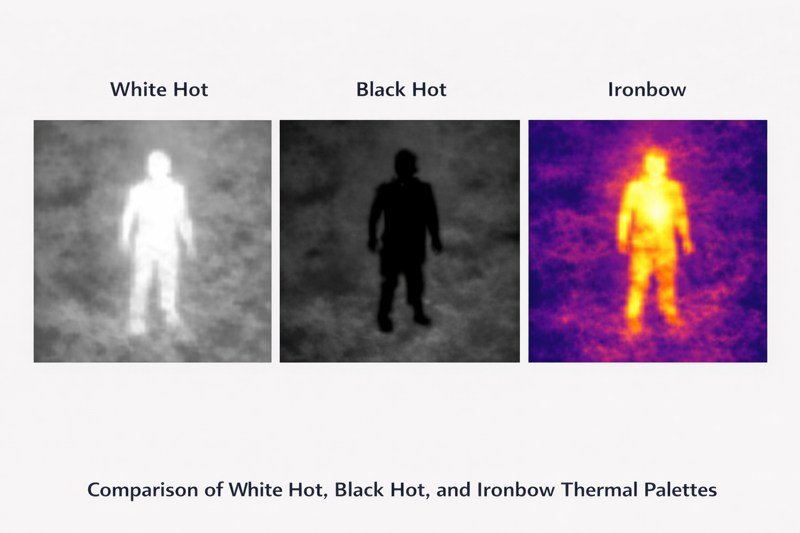
While “White Hot” and “Black Hot” are industry standards for general observation, SAR operations often benefit from specific pseudo-color palettes.
- White Hot: Best for general detection; heat sources appear white.
- Ironbow: Increases contrast in the warmer temperature bands, helping to differentiate body heat from warm rocks.
- Isotherms: This advanced feature highlights a specific temperature range (e.g., 30°C to 40°C) in a bright color like red. This instantly alerts the pilot or operator to biological targets while ignoring cooler background clutter.
Future Innovations in Automated Detection
The future of SAR lies in the integration of Artificial Intelligence (AI) with thermal hardware. Edge computing modules are now being integrated directly into camera cores. These systems process thermal video in real-time, using machine learning models trained on infrared datasets to automatically identify humans and vehicles. This reduces the cognitive load on operators and decreases the likelihood of missing a target due to fatigue.
By combining high-sensitivity VOx sensors with AI-driven analytics, the next generation of thermal imaging systems will not just show the operator the world in infrared—it will actively help them save lives.
Frequently Asked Questions
Can thermal imaging see through walls during a rescue?
How far can a thermal drone detect a human?
Does thermal imaging work in heavy rain or fog?
Why are uncooled microbolometers preferred for SAR over cooled detectors?
Discover UAV Payload Solutions for Advanced Aerial Sensing Challenge.