
China Moneypro
Thermal Imaging for Industrial Inspection Maximizes Uptime and Safety
Reduce downtime with thermal imaging for industrial inspection. Explore VOx microbolometer technology, radiometric accuracy, and predictive maintenance strategies.
This article is part of our Applications section. For a complete overview, visit our Knowledge Hub guide.
Unplanned downtime costs global manufacturers an estimated $50 billion annually. In the high-stakes environment of industrial processing and manufacturing, equipment failure is not merely an inconvenience but a catastrophic financial operational risk. Thermal imaging for industrial inspection has evolved from a niche diagnostic tool into a cornerstone of predictive maintenance (PdM) strategies. By leveraging advanced infrared detector technologies, facility managers can visualize thermal anomalies before they escalate into critical system failures.
This deep dive examines the engineering principles behind modern thermography, the specific sensor specifications required for accurate diagnostics, and the integration of radiometric data into Industry 4.0 ecosystems. We move beyond basic heat maps to understand how thermal sensitivity and spatial resolution drive decision-making in complex industrial environments.
Core Insights on Industrial Thermography
- Predictive Capability Detects thermal irregularities in electrical and mechanical systems weeks before failure occurs.
- Sensor Technology VOx uncooled microbolometers offer the optimal balance of sensitivity and durability for most facility inspections.
- Critical Metrics NETD values below 40mK are essential for distinguishing subtle temperature differentials in high-noise environments.
- Automation Integration Fixed-mount radiometric cameras enable 24/7 condition monitoring and seamless SCADA integration.
The Physics of Infrared Detection in Industry
At the heart of every industrial thermal camera lies the Focal Plane Array (FPA). For the vast majority of industrial inspection applications, the industry standard is the uncooled Vanadium Oxide (VOx) microbolometer. Unlike cooled detectors which require cryogenic cooling and are reserved for specialized R&D or gas detection, VOx sensors operate at ambient temperatures. This results in significantly higher Mean Time Between Failures (MTBF) and lower total cost of ownership.
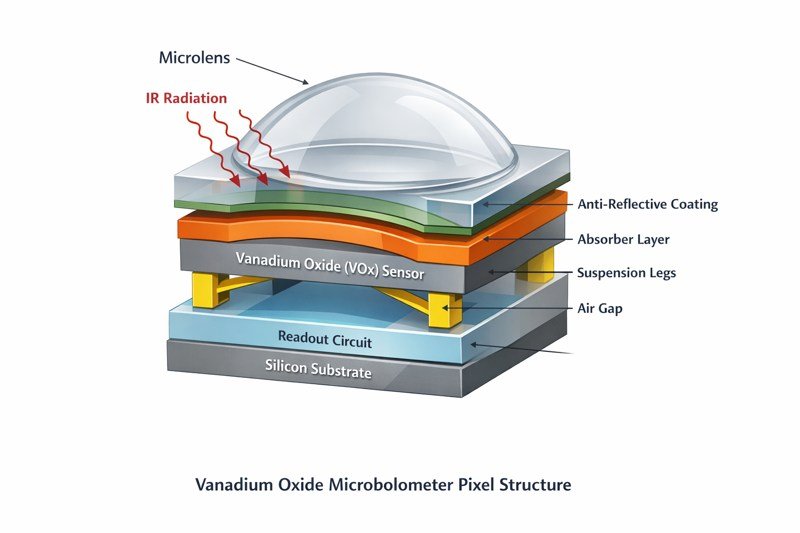
Modern FPAs typically utilize a pixel pitch of 12μm or 17μm. A smaller pixel pitch allows for smaller lens optics while maintaining high resolution, leading to more compact handheld units without sacrificing image quality. When inspecting a distant transformer or a high-overhead bus duct, the resolution of the detector determines the Spot Size Ratio (SSR). A higher resolution ensures that the measurement spot usually falls entirely on the target object, ensuring accurate radiometric temperature readings rather than an average of the background and the target.
NETD and Radiometric Accuracy Essentials
Engineers selecting a camera for industrial inspection must prioritize Noise Equivalent Temperature Difference (NETD). This metric defines the thermal sensitivity of the camera. An NETD of <30mK indicates that the detector can distinguish temperature differences as small as 0.03°C. In predictive maintenance, early signs of wear often manifest as very subtle thermal signatures. A high-sensitivity sensor allows technicians to identify a slightly overheating bearing or a loose electrical connection long before it reaches a critical temperature threshold.
Furthermore, radiometric accuracy is non-negotiable. Industrial thermal cameras measure the absolute temperature of every pixel in the image. To achieve typical accuracy of ±2°C or ±2%, the system must account for emissivity (the material’s ability to emit infrared energy) and reflected apparent temperature. Advanced thermal imaging software allows inspectors to adjust these parameters in post-processing to generate compliant reports.
Electrical System Inspection
Electrical faults represent the most common application for thermal imaging in industrial settings. As resistance increases due to loose connections, corrosion, or load imbalances, heat is generated. This relationship is defined by Joule’s Law ($P=I^2R$).
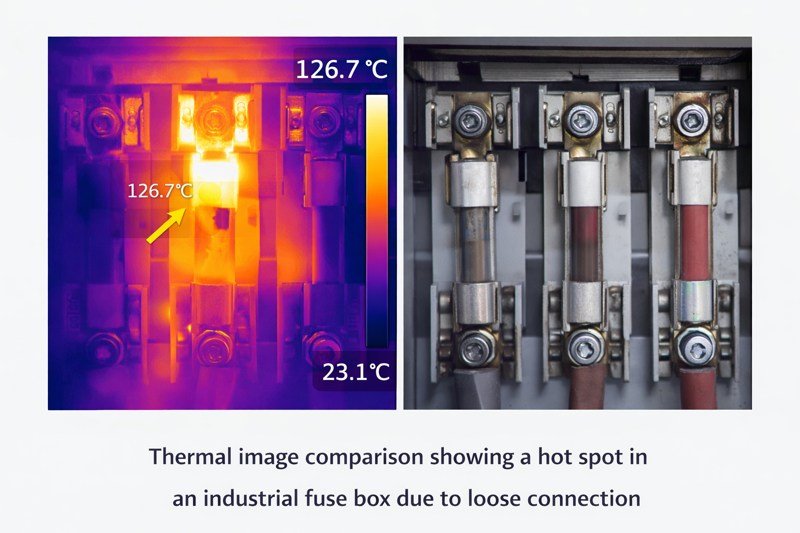
Thermographers routinely scan:
- Switchgear and Motor Control Centers Identifying loose busbar connections or overloaded fuses.
- Transformers Checking for blocked cooling fins or internal winding faults.
- High Voltage Lines Detecting corona effects (using specialized UV/IR combos) or splice failures.
Mechanical and Rotating Equipment Monitoring
Mechanical systems generate heat through friction. While some heat is normal, excessive thermal signatures indicate lubrication failure, misalignment, or component fatigue. Thermal imaging provides a non-contact method to inspect moving parts that would be dangerous to touch or difficult to access with contact probes.
For example, a conveyor belt motor showing a distinct thermal gradient across its housing may suggest a stator fault or bearing misalignment. By trending this data over time, maintenance teams can plan repairs during scheduled shutdowns rather than reacting to a catastrophic line stoppage.
Comparing Handheld vs Fixed Thermal Systems
The market is divided between portable handheld cameras for route-based inspection and fixed-mount sensors for continuous monitoring. The choice depends on criticality and accessibility.
| Feature | Handheld Thermal Cameras | Fixed-Mount Thermal Camera |
|---|---|---|
| Usage Scenario | Route-based monthly/quarterly inspections | Continuous 24/7 condition monitoring |
| Operator Requirement | Requires trained Level I/II Thermographer | Automated with alarm outputs to PLC/SCADA |
| Data Granularity | Snapshot in time | Long-term trending and real-time alerts |
| Installation Cost | Low (One unit covers many assets) | Higher (Dedicated unit per asset/zone) |
| Typical Application | Facility-wide audits, Electrical panels | Critical vessel monitoring, Fire prevention |
Process Control and Quality Assurance
Beyond maintenance, thermal imaging plays a vital role in process control. In injection molding, ensuring uniform mold temperatures is critical for part consistency. Thermal cameras can verify cooling channel performance and detect hot spots that lead to warping. similarly, in the steel and glass industries, monitoring the temperature profile of the product as it moves through furnaces and cooling zones ensures structural integrity.
Integration with IIoT and AI Analysis
The future of industrial inspection lies in the integration of thermal data with the Industrial Internet of Things (IIoT). Modern thermal cores output radiometric video streams (via GigE Vision or RTSP) directly to edge computing devices. Machine learning algorithms can then analyze these streams in real-time to classify anomalies.
Instead of a human operator interpreting a color palette, an AI model can identify that a specific pattern on a ladle corresponds to refractory lining failure with 95% confidence. This shifts the paradigm from human-dependent interpretation to automated, data-driven insights.
Conclusion
Thermal imaging for industrial inspection is a mature, high-ROI technology. Whether utilizing high-resolution handheld cameras for periodic electrical audits or deploying ruggedized fixed sensors for critical asset monitoring, the ability to visualize thermal energy is a powerful defense against downtime. As sensor costs decrease and software capabilities expand, the adoption of thermal data as a primary input for plant operations will only accelerate.
Frequently Asked Questions
What is the ideal resolution for an industrial thermal camera?
How often should industrial thermal inspections be performed?
Can thermal imaging see through walls or metal cabinets?
What is the difference between thermal sensitivity and accuracy?
Dive into the Industrial Thermography Solution for for industrial inspection, enabling non-contact temperature measurement, fault detection, and predictive maintenance.