
China Moneypro
Thermal Imaging for UAVs and Drone
Optimize aerial thermography systems. Learn how pixel pitch, NETD, and VOx detectors impact SWaP-C and mission success in UAV thermal imaging integration.
Unmanned Aerial Vehicles (UAVs) have transitioned from simple surveillance tools to sophisticated radiometric data collection platforms. For system integrators and payload designers, the challenge lies in selecting the correct infrared hardware. Integrating thermal imaging for UAVs requires a strict balance of Size, Weight, Power, and Cost (SWaP-C) while maintaining high thermal sensitivity. This engineering guide explores the technical parameters defining modern aerial infrared systems.
Key Takeaways
- 12μm Pixel Pitch Dominates: Smaller pitch sizes enable lighter optics and longer flight times without sacrificing resolution.
- NETD Sensitivity Matters: For industrial inspection, a Noise Equivalent Temperature Difference (NETD) of <40mK is critical for detecting subtle faults.
- Radiometric Calibration: Essential for quantitative analysis in solar, agriculture, and utility inspections.
- Interface Selection: MIPI CSI-2 and LVDS offer lower latency compared to USB or analog video for flight control loops.
- Athermalization: Lens assemblies must be passively athermalized to maintain focus during rapid altitude temperature shifts.
The Role of Vanadium Oxide Microbolometers in Aerial Systems
The core of any UAV thermal payload is the sensor itself. In the uncooled Long-Wave Infrared (LWIR) category, Vanadium Oxide (VOx) microbolometers have established themselves as the industry standard over Amorphous Silicon (a-Si). VOx detectors generally offer lower electrical resistance and higher Temperature Coefficient of Resistance (TCR), resulting in better sensitivity and lower image noise.
System integrators must prioritize high sensitivity. A lower NETD value indicates a more sensitive detector. For applications like search and rescue (SAR) or solar panel inspection, distinguishing a target from the background requires an NETD of <40mK or even <30mK in premium cores. This sensitivity allows the UAV to fly at higher altitudes while still resolving minute temperature differences on the ground.
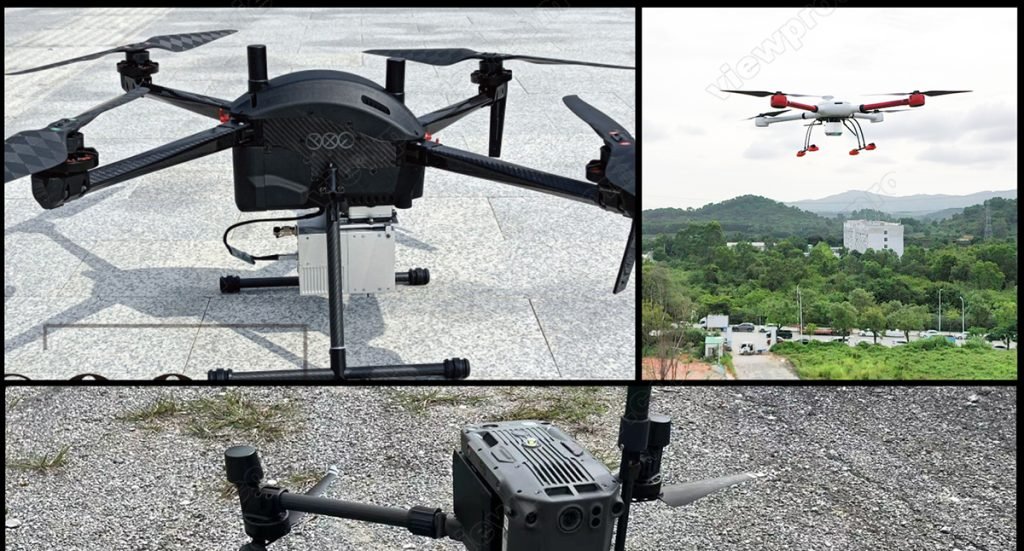
Pixel Pitch Reduction and Flight Time Optimization
The shift from 17μm to 12μm pixel pitch significantly impacts UAV design. A smaller pixel pitch allows for a smaller Focal Plane Array (FPA) dimensions for the same resolution. Consequently, the optics required to achieve a specific Field of View (FOV) become physically smaller and lighter.
For a drone, every gram of payload weight correlates directly to battery consumption and flight duration. By moving to a 12μm architecture, integrators can reduce the lens weight by approximately 30% compared to legacy 17μm systems. This weight saving allows for extended mission times or the inclusion of additional sensors, such as LiDAR or high-definition RGB cameras, within the same gimbal payload limit.
Optical Considerations and Athermalization
Aerial thermography presents unique optical challenges. UAVs frequently experience rapid changes in ambient temperature as they ascend or descend. Standard germanium optics have a high refractive index change with temperature, leading to defocusing issues during flight.
Integrators must specify passively athermalized lenses. These lens assemblies use a combination of materials and mechanical design to compensate for thermal expansion and refractive index shifts automatically. This ensures the image remains sharp from takeoff to maximum altitude without requiring heavy, power-consuming motorized focus mechanisms.
Radiometry and Quantitative Data Analysis
Distinction must be made between thermal imaging and thermal measurement. Basic imaging provides a qualitative visual representation of heat. Radiometry provides quantitative temperature data for every pixel in the image.
For industrial B2B applications, radiometric capability is mandatory. During power line inspections, the software must calculate the exact temperature rise of a failing insulator to classify the severity of the fault. System integrators should look for thermal cores that support radiometric output in raw formats (typically 14-bit or 16-bit TIFF) to allow for post-process analysis where emissivity and atmospheric attenuation parameters can be adjusted.
Data Interfaces and Latency Management
The interface between the thermal core and the UAVs onboard processor affects both data quality and flight control. High latency in the video feed can make First Person View (FPV) piloting nearly impossible.
While USB is convenient for ground testing, it often introduces inconsistent latency and CPU overhead. For professional integration, MIPI CSI-2 or parallel digital interfaces are preferred. They provide direct access to raw sensor data with minimal latency, enabling real-time image processing algorithms such as object tracking or scene-based Non-Uniformity Correction (NUC) to run efficiently on edge computing modules like the NVIDIA Jetson.
Comparing Cooled MWIR and Uncooled LWIR for UAVs
While uncooled LWIR dominates the commercial drone market due to cost and weight, Cooled Mid-Wave Infrared (MWIR) systems have a place in specialized high-altitude or gas detection missions. The following table outlines the trade-offs.
| Feature | Uncooled LWIR (Microbolometer) | Cooled MWIR (Photon Detector) |
|---|---|---|
| Spectral Band | 8μm – 14μm | 3μm – 5μm |
| Sensitivity (NETD) | <30mK to <50mK | <15mK to <25mK |
| Weight Impact | Extremely Low (Core <20g) | High (Requires Cryocooler) |
| Startup Time | Instant (<5 seconds) | Slow (5-8 minutes cooldown) |
| Maintenance | Maintenance-free | Cooler requires service (MTBF) |
| Primary UAV Use | Inspection, SAR, Agriculture, Fire | Long-range Security, Gas Leak (OGI) |
Emerging Trends in AI and Edge Processing
The future of thermal imaging for UAVs lies in edge AI. Instead of streaming raw data to the ground for human interpretation, onboard AI models are now analyzing thermal streams in real-time. These systems can automatically identify solar panel hotspots, track moving vehicles, or detect humans in dense foliage.
Integrators must therefore ensure that the chosen thermal module supports synchronization with RGB cameras. Sensor fusion—overlaying high-contrast thermal edges onto high-resolution visible images—enhances situational awareness and improves the accuracy of AI classification models.
FAQ:
What is the optimal resolution for UAV thermal cameras?
How does pixel pitch affect drone flight time?
Why is radiometric calibration necessary for solar inspections?
What is the difference between VOx and a-Si detectors?
Can thermal cameras see through clouds or fog?