
China Moneypro
Thermal Imager vs Thermal Camera vs Thermal Sight
Discover the critical engineering differences between thermal imagers, cameras, and sights. Expert guide on radiometry, sensor architecture, and application.
This article is part of our Comparisons & Buying Guides section. For a complete overview, visit our Knowledge Hub guide.
Infrared technology has evolved rapidly from military-exclusive hardware to accessible tools for industry, hunting, and security. However, terminology often creates confusion for buyers and procurement officers. The terms “thermal imager,” “thermal camera,” and “thermal sight” are frequently used interchangeably, yet they refer to distinct categories of optoelectronic systems with vastly different engineering architectures and intended applications.
Understanding these differences requires looking beyond the exterior housing and analyzing the sensor core, image processing pipeline, and structural integrity. Whether you require precise temperature measurement for predictive maintenance, a ruggedized optic for target acquisition, or a handheld device for search and rescue, selecting the correct nomenclature helps ensure you obtain the specific capabilities required for the mission.
Key Takeaways on Infrared Terminology
- Thermal Imagers are primarily designed for observation and detection. They provide a qualitative representation of heat scenes without necessarily offering precise temperature data.
- Thermal Cameras usually imply radiometric capabilities. They measure absolute temperature values for every pixel, making them essential for industrial inspections and research.
- Thermal Sights are ruggedized systems integrated with reticles and mounting rails. They are engineered to withstand high G-force recoil and maintain zero for tactical or hunting applications.
- Core Technology across all three relies on VOx or a-Si microbolometers, but the backend electronics and software processing differ significantly based on the end-use.
Understanding Thermal Imagers for Observation
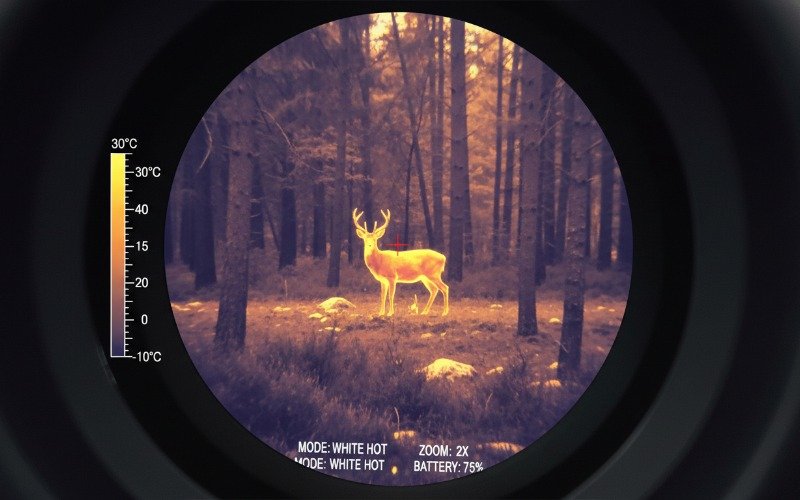
The term “thermal imager” typically refers to handheld monoculars or binoculars used for visual observation. The primary engineering goal of a thermal imager is detection and recognition. Users of these devices need to distinguish a heat signature from the background clutter, such as spotting a deer in a forest or a person in a search and rescue scenario.
Technically, these devices prioritize image contrast and scene dynamic range over absolute temperature accuracy. The image processing algorithms, such as Digital Detail Enhancement (DDE) or histogram equalization, are tuned to make hot objects pop against cold backgrounds. While many modern imagers display a center-spot temperature reading, they generally lack full radiometric data recording capabilities.
Form Factor and Ergonomics
Thermal imagers are designed for portability. They often feature ergonomic grips, long battery life (often 8+ hours), and viewfinders (LCOS or OLED displays) meant for direct eye interface. They are not designed to be mounted on machinery or weapons, lacking the necessary shock absorption or data output interfaces (like GigE or Camera Link) found in industrial counterparts.
Defining Thermal Cameras for Radiometry
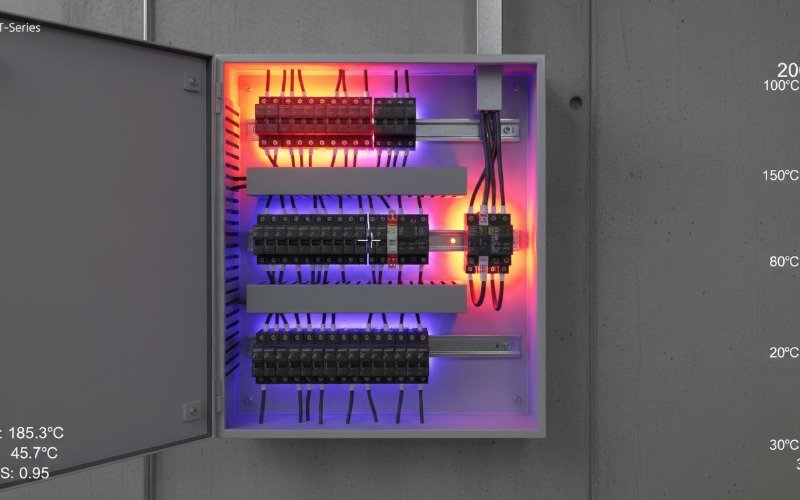
A “thermal camera” is a sophisticated instrument designed for measurement and analysis. In the optoelectronics industry, this category is synonymous with “thermography.” The defining feature of a true thermal camera is radiometry. This means the device does not just show a picture of heat; it calculates the temperature value of every individual pixel on the sensor array.
For example, a standard industrial thermal camera with a resolution of 640×512 pixels provides 327,680 individual non-contact temperature measurement points. This capability is critical for predictive maintenance (inspecting electrical panels for overheating), building diagnostics (finding moisture or insulation gaps), and R&D (analyzing thermal dissipation on circuit boards).
Calibration and Sensitivity
Thermal cameras undergo rigorous calibration processes in climate-controlled chambers to ensure accuracy, typically within ±2°C or ±2%. They allow users to adjust parameters such as emissivity, reflected temperature, and atmospheric transmission to correct the temperature reading. Unlike simple imagers, thermal cameras often include software suites for post-processing thermal data, generating reports, and analyzing temperature trends over time.
Analyzing Thermal Sights for Tactical Use
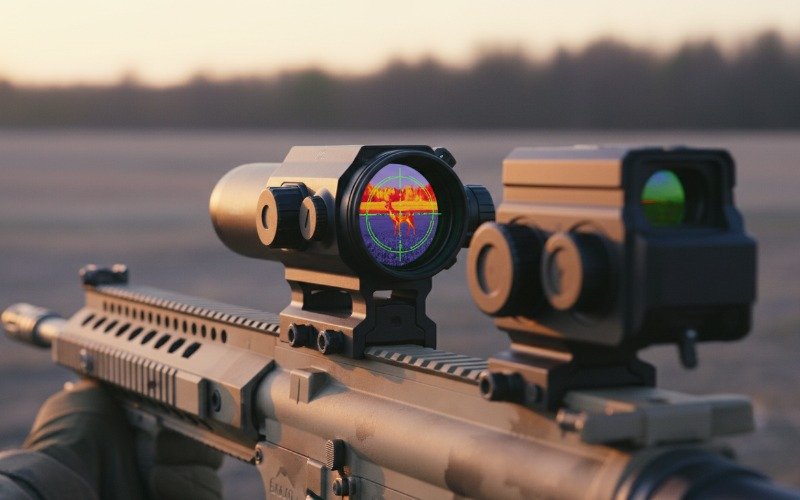
A “thermal sight” (or thermal scope) is a specialized subset of thermal imaging engineered specifically for targeting and weapon integration. While they share the same fundamental Vanadium Oxide (VOx) or Amorphous Silicon (a-Si) detectors as imagers and cameras, their mechanical housing and software are radically different.
Recoil Resistance and Zero Retention
The most critical differentiator for a thermal sight is its shock rating. When a firearm discharges, it generates significant recoil energy, measured in G-force. A standard thermal camera or imager would likely suffer catastrophic sensor failure or lose power if subjected to the recoil of high-caliber rounds (such as .308 or .338 Lapua). Thermal sights are potted and reinforced to withstand recoil up to 1000g or roughly 6000 Joules of energy.
Furthermore, the internal optical assembly must remain perfectly static relative to the mount. If the sensor or lens shifts even a fraction of a millimeter during recoil, the point of impact will shift, rendering the sight useless. This capability is known as “holding zero.”
Reticles and Ballistics
Software in thermal sights includes digital reticles (crosshairs) that can be adjusted for windage and elevation. Advanced models incorporate laser rangefinders and ballistic calculators that automatically adjust the reticle position based on the distance to the target. These features are absent in standard thermal cameras and imagers.
Technical Comparison of Core Architectures
To provide a clear engineering perspective, the following table breaks down the typical specifications and capabilities found in these three distinct categories.
| Feature | Thermal Imager (Observation) | Thermal Camera (Radiometric) | Thermal Sight (Tactical) |
|---|---|---|---|
| Primary Function | Detection & Scouting | Temperature Measurement | Target Acquisition |
| Radiometry | Limited (Center Spot) | Full Pixel Radiometry | Rare / Not Priority |
| Recoil Rating | Low (Drop resistant only) | Low (Static use) | High (Rated 6000J+) |
| Reticles/Zeroing | No | No | Yes |
| NETD Sensitivity | <35mK to <50mK | <40mK to <60mK | <25mK to <35mK |
| Refresh Rate | 50Hz / 60Hz (Fluid motion) | 9Hz or 30Hz/60Hz | 50Hz (Critical for moving targets) |
| Form Factor | Handheld Monocular | Pistol Grip / Fixed Mount | Picatinny Rail Mount |
Selecting the Right Infrared Device
Choosing between a thermal imager, camera, and sight depends entirely on the operational requirements. Purchasing the wrong device can result in wasted budget and operational failure.
Scenario A: Outdoor Enthusiast or Security
If the goal is to spot intruders on a perimeter or locate wildlife before sunrise, a Thermal Imager is the optimal choice. It offers the best ergonomics for scanning large areas and typically provides the highest detection range per dollar. A thermal sight would be too heavy for prolonged handheld scanning, and a thermal camera would be overly complex and expensive for simple detection tasks.
Scenario B: Industrial Inspection
For an electrical engineer needing to certify a breaker panel, a Thermal Camera is the only option. An imager or sight might show a hot spot, but without precise radiometric data (e.g., “Phase B is 45°C hotter than Phase A”), the data is anecdotal and insufficient for compliance reports.
Scenario C: Precision Hunting
For pest control or hunting invasive species at night, a Thermal Sight is mandatory. While clip-on thermal devices exist (which sit in front of a standard day optic), a dedicated thermal sight offers the most robust solution. Using a standard handheld imager taped to a firearm is dangerous and ineffective, as the recoil will destroy the electronics and the lack of a reticle makes aiming impossible.
The Future of Integrated Systems
As sensor technology advances, the lines between these categories are beginning to blur. We are seeing the emergence of “multispectral” devices that combine thermal imaging with low-light CMOS sensors, and hybrid units that offer both onboard recording and limited ballistic calculation. However, the core physical constraints—shock resistance for sights and calibration for radiometric cameras—will likely keep these categories distinct for professional applications for the foreseeable future.
Frequently Asked Questions
Below are common technical questions regarding the classification and application of thermal devices.
Can I use a thermal sight as a handheld imager?
Why are thermal cameras more expensive than thermal imagers?
What is a clip-on thermal device?
Does pixel pitch matter for these devices?