
China Moneypro
Thermal Camera Selection Guide
Expert guide on selecting thermal cameras for integration. Analysis of NETD, VOx sensors, 12μm pixel pitch, and interface protocols for OEM engineers.
Key Takeaways for Engineering Procurement
- Prioritize NETD for low-contrast environments where a sensitivity below 40mK distinguishes critical details.
- Select Pixel Pitch based on size constraints, as shifting from 17μm to 12μm significantly reduces lens size and overall SWaP.
- Analyze DRI Requirements using Johnson’s Criteria to ensure detection ranges meet mission objectives.
- Evaluate Integration Interfaces such as MIPI CSI-2, USB 3.0, or CameraLink based on bandwidth and latency requirements.
Selecting the correct infrared imaging module requires balancing strict SWaP-C (Size, Weight, Power, and Cost) constraints against performance metrics. For B2B system integrators developing UAV payloads, automotive night vision systems, or industrial monitoring solutions, the datasheet specifications often tell only half the story. This guide delves into the physics and engineering principles necessary to choose a thermal camera module that delivers reliability and precision.
Defining Application Requirements and Environmental Constraints
Before evaluating sensor specifications, engineers must quantify the operational envelope. The choice between a cooled and uncooled system relies heavily on the thermal dynamics of the target and the integration platform.
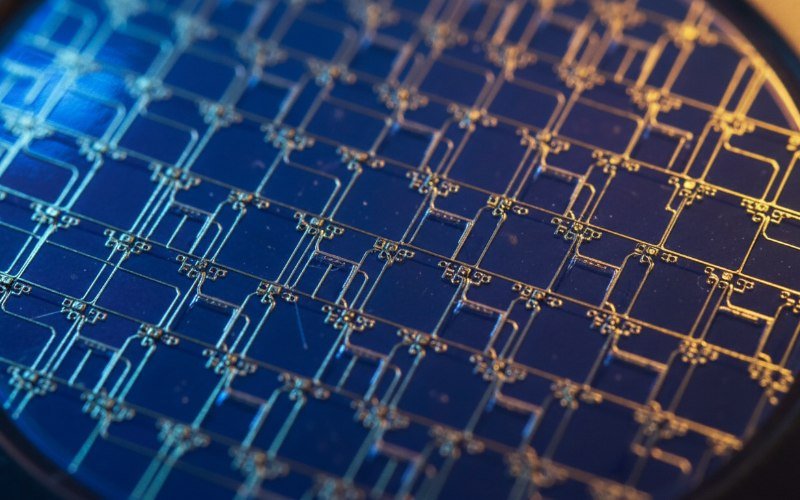
For mostly static industrial inspection or short-range security, uncooled Long-Wave Infrared (LWIR) microbolometers are the standard. They operate in the 8-14μm spectral band and offer high reliability with no moving mechanical cooling parts. Conversely, applications requiring extreme sensitivity, high frame rates, or long-range detection of fast-moving targets often demand cooled Mid-Wave Infrared (MWIR) detectors operating in the 3-5μm band.
Analyzing Detector Technology
The core of any thermal camera is the Focal Plane Array (FPA). Understanding the substrate material and fabrication process is critical for predicting long-term performance and image stability.
Vanadium Oxide versus Amorphous Silicon
Two primary materials dominate the uncooled microbolometer market. Vanadium Oxide (VOx) generally offers a higher Temperature Coefficient of Resistance (TCR) compared to Amorphous Silicon (a-Si). A higher TCR translates to better sensitivity (lower NETD) and a more stable image with less fixed-pattern noise.
While a-Si sensors have historically been cheaper to manufacture due to standard silicon foundry processes, VOx technology has matured significantly. For system integrators prioritizing image quality and consistent radiometric accuracy, VOx represents the superior choice despite a marginal cost difference.
Evaluating Sensitivity and NETD Metrics
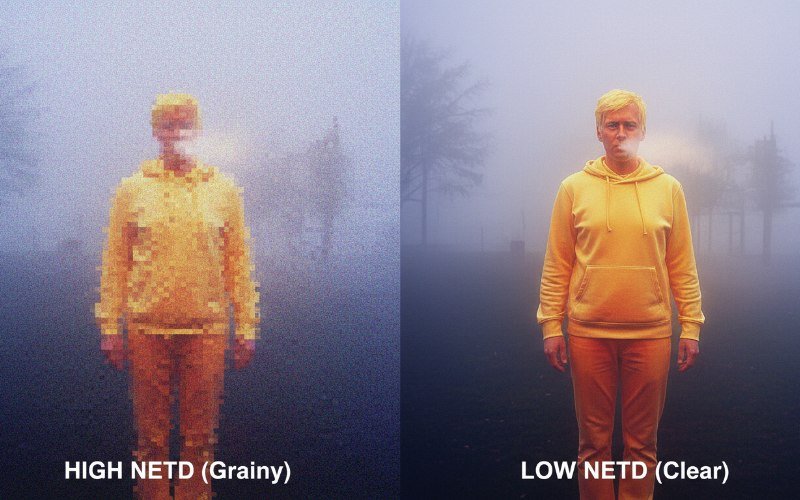
Noise Equivalent Temperature Difference (NETD) serves as the primary figure of merit for detector sensitivity. It measures the smallest temperature difference the camera can distinguish from the noise floor. This metric is expressed in millikelvins (mK).
A lower NETD value indicates superior performance. Standard industrial cameras often feature an NETD of <50mK. However, for advanced applications such as search and rescue (SAR) or gas leak detection, an NETD of <30mK or even <20mK becomes necessary. In low-contrast scenes, such as a foggy landscape where the target and background temperatures are nearly identical, a high-sensitivity sensor allows the image processing algorithms to extract usable data where higher-noise sensors would show only static.
Pixel Pitch and Resolution Impact on SWaP
The industry is currently transitioning from 17μm pixel pitch to 12μm and smaller. This reduction in pixel size allows for smaller Focal Plane Arrays (FPAs) for the same resolution, or higher resolution on the same size die.
For the integrator, the primary advantage of a 12μm pitch is the reduction in optics size. According to optical physics, a smaller sensor requires a lens with a shorter focal length to achieve the same Field of View (FOV). Since germanium lenses are heavy and expensive, moving to a 12μm sensor can reduce the overall payload weight by 20-30%, a critical factor for battery-powered UAVs.
Understanding Optical Parameters and DRI Ranges
Choosing the right lens is just as important as the sensor. Integrators must calculate the Detection, Recognition, and Identification (DRI) ranges based on Johnson’s Criteria. These criteria define the number of pixels required across a target dimension to perform a specific task.
- Detection requires 1.5 pixels (Is something there?)
- Recognition requires 6 pixels (Is it a truck or a tank?)
- Identification requires 12 pixels (Is it a friendly T-72 tank?)
Ensure the camera module supports interchangeable lenses or comes with a fixed lens that matches your specific HFOV (Horizontal Field of View) requirements. A wide-angle lens (e.g., 90° HFOV) is suitable for situational awareness, while a narrow telephoto lens (e.g., 6° HFOV) is required for long-range target acquisition.
Digital Interfaces and Integration Protocols
The physical and logical interface determines how easily the thermal core integrates into the host system. Legacy systems often rely on analog video (PAL/NTSC), but modern digital architectures demand raw data access for edge computing and AI analysis.
USB 3.0 and GigE Vision are common for industrial automation due to their plug-and-play nature. However, for embedded systems, MIPI CSI-2 is the preferred interface. It offers high bandwidth and low power consumption, connecting directly to FPGA or ARM-based processors like the NVIDIA Jetson series. Ensure the manufacturer provides a robust SDK (Software Development Kit) and Linux drivers to facilitate rapid development.
Technical Comparison of Sensor Technologies
| Feature | Uncooled VOx Microbolometer | Cooled MWIR Detector |
|---|---|---|
| Spectral Band | LWIR (8-14 μm) | MWIR (3-5 μm) |
| Sensitivity (NETD) | <40 mK – <50 mK | <20 mK – <25 mK |
| Frame Rate | 30Hz – 60Hz (typically) | 100Hz+ (High speed capable) |
| Maintenance | Zero maintenance | Cooler replacement every 10k-20k hours |
| Cost | Low to Mid | Very High |
| Best Use Case | Drones, Security, Automotive | Long-range defense, Gas imaging, R&D |
Frequently Asked Questions
What constitutes the difference between radiometric and non-radiometric cameras
Why do some thermal cameras have a mechanical shutter
How does frame rate impact export regulations
Does pixel pitch affect the detection range