
China Moneypro
MWIR vs LWIR Thermal Imaging Technology Comparison
Discover the critical differences between MWIR vs LWIR thermal sensors. We analyze cooled versus uncooled detectors, atmospheric transmission, and NETD performance.
This article is part of our Infrared & Thermal Technology section. For a complete overview, visit our Knowledge Hub guide.
Selecting the correct infrared band is the single most critical decision in designing electro-optical systems. When engineers and procurement managers evaluate thermal imaging solutions, the choice almost always narrows down to two distinct spectral bands. These are Mid-Wave Infrared (MWIR) and Long-Wave Infrared (LWIR).
While both technologies detect infrared radiation to create thermal images, the underlying physics, detector materials, and operational capabilities differ radically. MWIR systems typically operate in the 3μm to 5μm bandwidth and often require cryogenic cooling. LWIR systems usually operate in the 8μm to 14μm range and function primarily using uncooled microbolometers.
This technical guide provides a deep engineering analysis of MWIR vs LWIR. We will explore the trade-offs between sensitivity (NETD), atmospheric transmission, system lifespan, and cost to help you determine the optimal sensor for your specific application.
Key Takeaways regarding MWIR vs LWIR
- Detector Architecture: MWIR sensors generally use cooled photon detectors (InSb, MCT) for high speed, while LWIR sensors typically use uncooled thermal microbolometers (VOx, a-Si).
- Thermal Contrast: MWIR provides superior thermal contrast and resolution at long ranges due to higher blackbody radiance changes in the 3-5μm band.
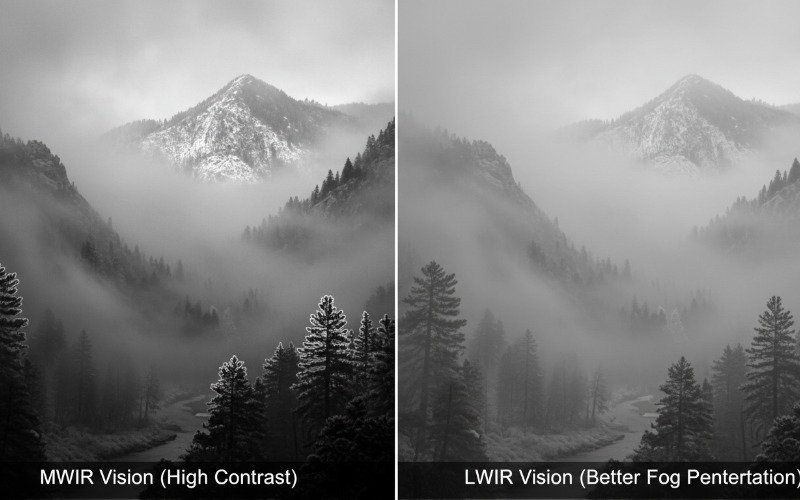
- Atmospheric Windows: LWIR offers better penetration through smoke, dust, and heavy fog due to reduced scattering at longer wavelengths.
- Cost and Maintenance: Uncooled LWIR cores are significantly cheaper and require no maintenance, whereas cooled MWIR systems require cooler replacement every 10,000 to 20,000 hours.
The Electromagnetic Spectrum and Infrared Bands
All objects above absolute zero emit thermal radiation. The intensity and spectral distribution of this radiation follow Planck’s Law. For terrestrial targets roughly near 300K (ambient temperature), the peak emission occurs directly within the LWIR band. However, the decision to use MWIR or LWIR is not solely defined by peak emission but by atmospheric transmission windows.
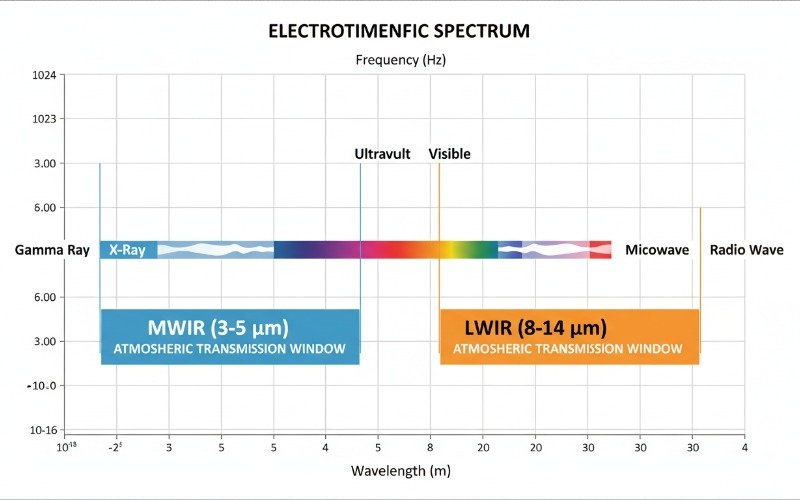
The atmosphere contains molecules like water vapor ($H_2O$) and carbon dioxide ($CO_2$) that absorb infrared radiation. This absorption creates “blind” spots in the spectrum. Electro-optical engineers design sensors to operate specifically within the two primary atmospheric transmission windows where absorption is minimal.
- MWIR Window: 3.0μm to 5.0μm. This band is highly susceptible to solar reflection but offers distinct advantages in thermal contrast.
- LWIR Window: 8.0μm to 14.0μm. This band encompasses the peak thermal emission of ambient objects and is less affected by solar glare.
Long Wave Infrared LWIR Technology Overview
Long-Wave Infrared technology is the backbone of commercial, industrial, and automotive thermal imaging. The vast majority of LWIR systems utilize uncooled microbolometers.
Uncooled VOx and a-Si Microbolometers
LWIR detectors function based on a thermal principle rather than a quantum (photon) principle. The pixels in the Focal Plane Array (FPA) are microscopic resistors made of materials with a high Temperature Coefficient of Resistance (TCR), typically Vanadium Oxide (VOx) or Amorphous Silicon (a-Si).
When infrared radiation hits the pixel, the material heats up, changing its electrical resistance. The Readout Integrated Circuit (ROIC) measures this change and converts it into a digital signal. Because these sensors do not require cryogenic cooling to suppress thermal noise, they are lighter, smaller, and more durable.
Modern uncooled LWIR cores have achieved remarkable sensitivity, with Noise Equivalent Temperature Difference (NETD) values frequently dropping below 30mK or even 20mK in premium modules. Pixel pitches have also shrunk from 17μm to 12μm and recently to 10μm, allowing for higher resolution in smaller form factors.
Mid Wave Infrared MWIR Technology Overview
Mid-Wave Infrared systems represent the pinnacle of high-performance thermal imaging, particularly for long-range surveillance and scientific applications. Unlike LWIR thermal detectors, MWIR sensors usually employ photon detectors.
Cooled Photon Detectors
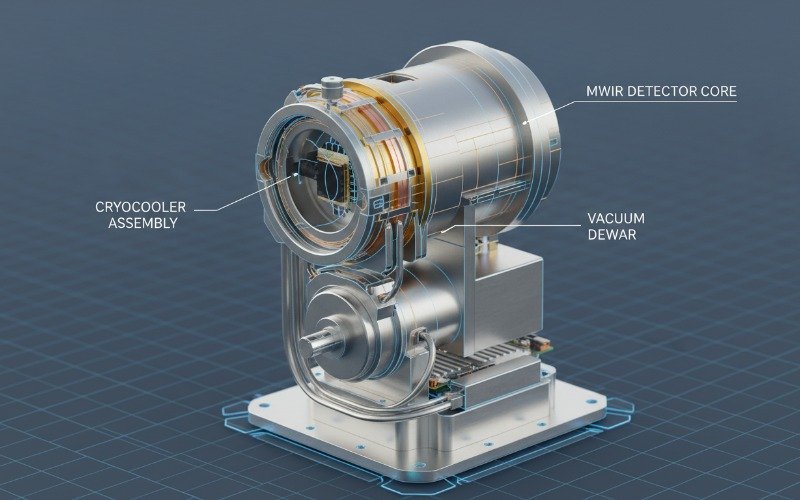
MWIR sensors use exotic semiconductor materials such as Indium Antimonide (InSb), Mercury Cadmium Telluride (MCT), or Type II Superlattices (T2SL). These materials operate on quantum physics principles where incident photons excite electrons directly from the valence band to the conduction band.
To function correctly, these detectors must be cooled to cryogenic temperatures (typically 77K or -196°C) to prevent thermally induced dark current from swamping the signal. This is achieved using an integrated Stirling cycle cryocooler.
The cooling requirement introduces size, weight, and power (SWaP) penalties. However, the benefits are substantial. Cooled MWIR systems offer ultra-fast integration times (measured in microseconds), allowing them to freeze fast-moving targets without motion blur. They also provide superior spectral filtering capabilities.
Performance Comparison MWIR vs LWIR
To assist engineering teams in selection, we compare the key performance metrics of these two infrared bands in the table below.
| Feature | Uncooled LWIR (8-14μm) | Cooled MWIR (3-5μm) |
|---|---|---|
| Detector Type | Thermal (Microbolometer) | Quantum (Photon Detector) |
| Sensitivity (NETD) | Good (<30mK to <50mK) | Excellent (<20mK to <25mK) |
| Response Time | Slower (Thermal constant ~8-12ms) | Fast (Microseconds) |
| Contrast | Lower contrast on scene details | High thermal contrast |
| Lens Diameter | Larger lenses required (Diffraction limit) | Smaller lenses possible |
| Maintenance | None (Solid state) | Cryocooler service (10k-20k hours) |
| Cost | Low to Moderate | High to Very High |
Atmospheric Transmission and Environmental Factors
The environment dictates the winner in the MWIR vs LWIR debate. While laboratory specifications are important, real-world atmospheric conditions are the ultimate filter for performance.
Humidity and Water Vapor
Long-range imaging over water or in humid maritime environments generally favors MWIR. While both bands suffer attenuation, MWIR often retains better contrast in high absolute humidity compared to LWIR, provided the path length is significant. However, specific sub-bands within LWIR can also perform well.
Smoke, Dust, and Aerosols
For battlefield obscurants, firefighting, or industrial monitoring, LWIR is generally superior. The physics of Rayleigh scattering dictates that scattering decreases as wavelength increases. Because the LWIR wavelength (8-14μm) is significantly larger than the average particle size of smoke or fine dust, the radiation penetrates these obscurants more effectively than the shorter MWIR waves.
Solar Glare and Reflection Issues
MWIR operates in a spectral band where solar radiation is still measurable. This creates a phenomenon known as “sun glint,” where reflections from the sun off water, glass, or polished metal can saturate the detector or create false hot spots. LWIR is essentially immune to solar reflection, as the sun’s energy output in the 8-14μm band is negligible compared to terrestrial thermal emission.
Choosing the Right Sensor for Your Application
Selecting between MWIR and LWIR requires balancing performance requirements against budget and maintenance capabilities.
When to Choose LWIR
LWIR is the standard choice for 90% of thermal applications. If your project involves automotive ADAS, security perimeter monitoring, drone payloads for inspection, or handheld thermography, LWIR is ideal. The solid-state nature of uncooled VOx microbolometers ensures high shock resistance and instant-on capability without the cooldown time of cryocoolers.
When to Choose MWIR
MWIR is reserved for scenarios where compromise is not an option. If the application involves Long-Range Intelligence, Surveillance, and Reconnaissance (ISR), identifying targets at 10km+, or tracking high-speed projectiles, MWIR is necessary. The higher resolution (due to the diffraction limit allowing smaller details to be resolved with smaller optics) and extreme sensitivity make it the preferred choice for naval defense and border security.
Additionally, MWIR is essential for specific gas detection (Optical Gas Imaging) where gases like methane absorb specifically in the mid-wave band.
Frequently Asked Questions
Below are definitive answers to common engineering questions regarding infrared spectrum selection.
Which has better range, MWIR or LWIR?
Is LWIR always uncooled?
Can MWIR cameras see through glass?
Why is MWIR more expensive than LWIR?