
China Moneypro
Infrared Detector vs Sensor
Technical guide comparing infrared detectors and sensors. Analysis of FPAs, ROIC integration, VOx technology, and module selection for B2B system integrators.
The terminology used in optoelectronics can often blur the lines between component levels, specifically when distinguishing between an infrared detector and an infrared sensor. For B2B system integrators and procurement engineers, understanding this distinction is not merely semantic. It dictates the architecture of the thermal imaging system, the complexity of the integration process, and the ultimate SWaP-C (Size, Weight, Power, and Cost) of the final product.
Key Takeaways
- The Detector is the Chip: An infrared detector typically refers to the bare Focal Plane Array (FPA), such as a VOx microbolometer or InSb semiconductor, without signal processing logic.
- The Sensor is the System: An infrared sensor or thermal module includes the detector bonded to a Read-Out Integrated Circuit (ROIC), often with basic optics, housing, and correction algorithms applied.
- Integration Complexity: Sourcing raw detectors requires advanced capability in wire bonding, vacuum packaging, and ROIC design, while sensors offer a plug-and-play solution via standard interfaces like MIPI or Camera Link.
- Performance Metrics: Both levels are governed by NETD (Noise Equivalent Temperature Difference) and pixel pitch, but sensors introduce considerations regarding frame rate latency and onboard image processing.
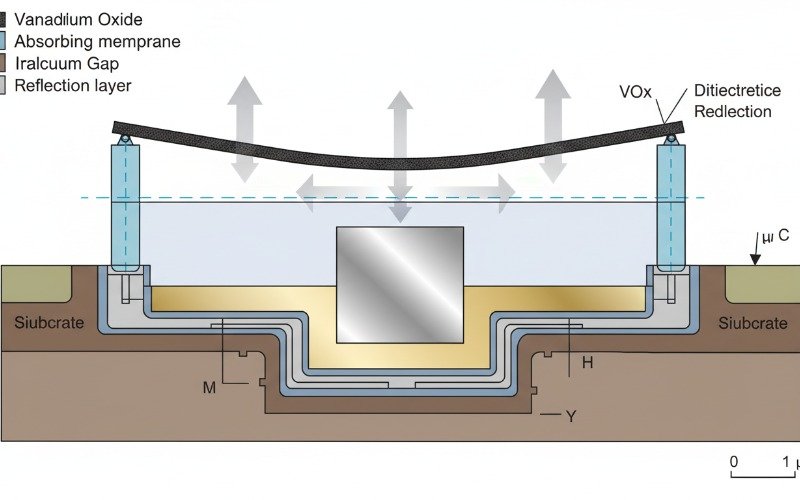
Defining the Infrared Detector Architecture
At the most fundamental level of the supply chain lies the infrared detector. In the context of high-performance thermal imaging, the detector is the transducer element responsible for converting incident infrared radiation (photons) into an electrical signal. This component is the heart of any thermal system.
Uncooled Microbolometers
For Long-Wave Infrared (LWIR) applications typically operating in the 8μm to 14μm spectral range, the detector is most commonly an uncooled microbolometer. The industry standard utilizes Vanadium Oxide (VOx) or Amorphous Silicon (a-Si) as the sensing material. These detectors operate based on the principle of resistance change due to heating. As infrared radiation strikes the suspended pixel structure, the temperature rises, changing the electrical resistance.
Purchasing a “detector” usually means acquiring the bare Focal Plane Array (FPA) or a vacuum-packaged chip. This level of component sourcing is reserved for Original Equipment Manufacturers (OEMs) with extensive in-house capabilities to design the vacuum package and the immediate readout circuitry.
Cooled Photon Detectors
In Mid-Wave Infrared (MWIR) and Short-Wave Infrared (SWIR) bands, the detector architecture shifts from thermal detection to quantum detection. Materials like Mercury Cadmium Telluride (MCT/HgCdTe) or Indium Antimonide (InSb) are used. Here, the “detector” includes the semiconductor material and the dewar assembly required to cryogenically cool the FPA to cryogenic temperatures (often 77K). The detector in this context is a photovoltaic or photoconductive device that generates electron-hole pairs directly from photon absorption.
Defining the Infrared Sensor and Thermal Module
When the industry refers to an infrared sensor or a thermal camera core, the scope of the component expands. A sensor is an integrated assembly that bridges the gap between the raw physics of the detector and the digital requirements of a host system.
The Role of the ROIC
The primary differentiator is the inclusion of the Read-Out Integrated Circuit (ROIC). While the detector pixels generate the analog response, the ROIC—usually a silicon chip bonded directly to the detector array—multiplexes these signals and performs the initial Analog-to-Digital (A/D) conversion. An infrared sensor module will deliver a formatted digital video stream rather than raw analog voltages.
Onboard Image Processing
Modern infrared sensors (modules) include an FPGA or ASIC that handles essential calibration processes. A raw detector has inherent non-uniformities; no two pixels respond exactly the same way to thermal energy. The sensor module applies Non-Uniformity Correction (NUC) algorithms to normalize the image. Without this processing, the output from a raw detector would appear as noisy static rather than a coherent thermal image.
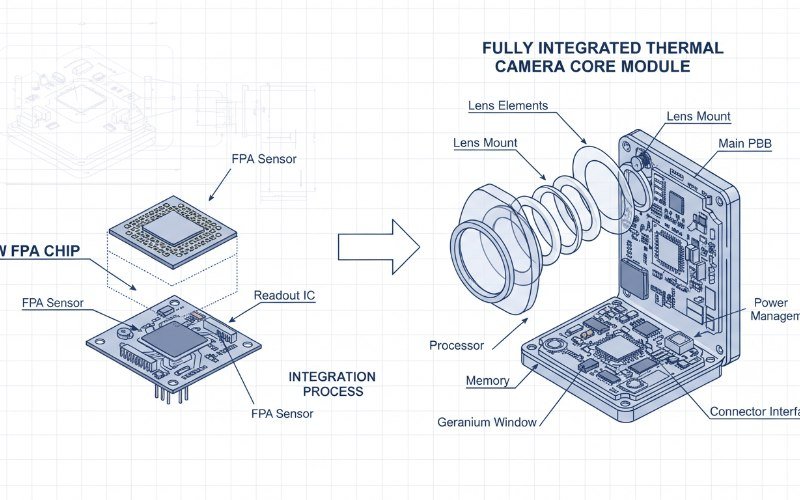
Technical Comparison of Detectors and Sensors
For system integrators deciding between sourcing a detector (FPA) or a sensor (Module), the following technical parameters illustrate the distinct differences in engineering responsibility.
| Feature | Infrared Detector (FPA) | Infrared Sensor (Module/Core) |
|---|---|---|
| Output Signal | Raw Analog (Changes in resistance or voltage) | Digital Video (14-bit raw, CMOS, MIPI) |
| Calibration | None (Integrator must perform NUC) | Factory Calibrated (NUC applied) |
| Integration Level | Chip/Package Level (Requires PCB design) | Board/Module Level (Plug-and-play) |
| Complexity | Extremely High (Vacuum packaging, ROIC bonding) | Moderate (Lens mounting, communication protocol) |
| Typical Buyer | Advanced Camera Manufacturers | Drone Integrators, Surveillance OEMs, Auto Tier 1 |
| Primary Metric | Pixel Pitch (e.g., 12μm), Material (VOx) | NETD (<40mK), Frame Rate (60Hz) |
Strategic Selection for System Integrators
Choosing between a raw detector and a sensor module depends heavily on the volume of production and the engineering resources available. The integration of a raw detector allows for ultimate customization but introduces significant technical risk.
When to Select a Raw Infrared Detector
Opting for a raw detector is the correct path for manufacturers building high-volume, proprietary camera systems where form factor and cost must be controlled at the semiconductor level. If an integrator requires a custom pixel pitch or a specific spectral response curve (e.g., specialized gas detection) that is not available in off-the-shelf modules, working with the bare detector is necessary.
However, this route requires mastery of Wafer-Level Packaging (WLP). The detector must be maintained in a vacuum to prevent conductive heat transfer from obscuring the thermal signal. If the vacuum seal fails, the detector’s sensitivity (NETD) degrades rapidly.
When to Select an Infrared Sensor Module
For 90% of B2B applications—including security surveillance, UAV payloads, and automotive night vision—the infrared sensor module is the superior choice. These “cores” come with the vacuum packaging secured and the ROIC optimized. The integrator’s task shifts from semiconductor physics to optics and software integration.
Modules using 12μm VOx technology provide NETD values below 40mK or even 30mK, which is sufficient for high-contrast imaging. The standardized interfaces allow for rapid prototyping and faster time-to-market. By utilizing a sensor module, the integrator avoids the multimillion-dollar investment required for cleanroom packaging facilities.
Impact of Pixel Pitch and Resolution
Whether discussing detectors or sensors, the industry trend is driving toward smaller pixel pitch. The shift from 17μm to 12μm and now 10μm pixel pitch allows for smaller detectors. A smaller detector (FPA) means smaller optics can be used to achieve the same Field of View (FOV). This is critical for SWaP-constrained applications like handheld scopes or drone gimbals.
However, as pixel size decreases, the amount of infrared energy collected per pixel drops. This challenges the Signal-to-Noise Ratio (SNR). Advanced VOx manufacturing techniques are required to maintain high sensitivity (low NETD) as pixel dimensions shrink. When evaluating a sensor, engineers must verify that the reduced pixel pitch has not compromised the NETD performance.
Thermal Management Considerations
Integration of either component requires rigorous thermal management. An infrared detector is essentially a thermometer; if the housing temperature fluctuates rapidly, it introduces “thermal drift.” Sensor modules often include TEC-less (Thermo-Electric Cooler) designs that rely on complex algorithms to compensate for ambient temperature changes. When integrating these modules, the chassis must act as an efficient heat sink to prevent the sensor processing unit from overheating, which introduces noise into the image stream.
Frequently Asked Questions
Does a lower NETD always mean a better sensor
Can I use a standard image sensor processor for infrared
What is the difference between VOx and a-Si detectors