
China Moneypro
Handheld vs Fixed Thermal Cameras
Compare handheld and fixed thermal cameras for industrial integration. Analyze NETD specs, connectivity protocols, and ROI for B2B system integrators.
System integrators often face a critical decision when designing infrared monitoring solutions. The choice between handheld and fixed thermal cameras dictates not only the hardware architecture but also the data flow, software integration strategy, and long-term operational costs. While both utilize Vanadium Oxide (VOx) or Amorphous Silicon (a-Si) microbolometers to detect infrared radiation, their applications in the industrial internet of things (IIoT) diverge significantly based on form factor, connectivity, and duty cycle.
Key Takeaways
- Continuous vs Periodic: Fixed cameras enable 24/7 automated monitoring via SCADA/PLC integration, whereas handheld units excel in operator-led predictive maintenance (PdM).
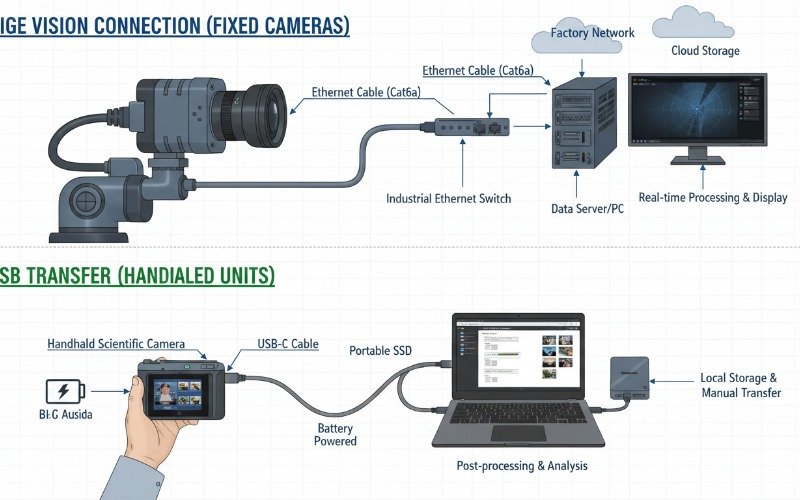
- Data Connectivity: Fixed systems utilize robust protocols like GigE Vision, RTSP, and Modbus TCP for real-time radiometric data streaming. Handhelds primarily rely on SD card storage or intermittent Wi-Fi streaming.
- Form Factor Constraints: Fixed IP67 housings allow for harsh environment installation, while handheld designs prioritize ergonomics and display resolution for immediate human analysis.
- Integration Cost: Fixed solutions require higher upfront investment in cabling and software development (SDKs) but offer lower operational costs for continuous inspection tasks.
The Role Of Fixed Mount Thermal Cameras In Automation
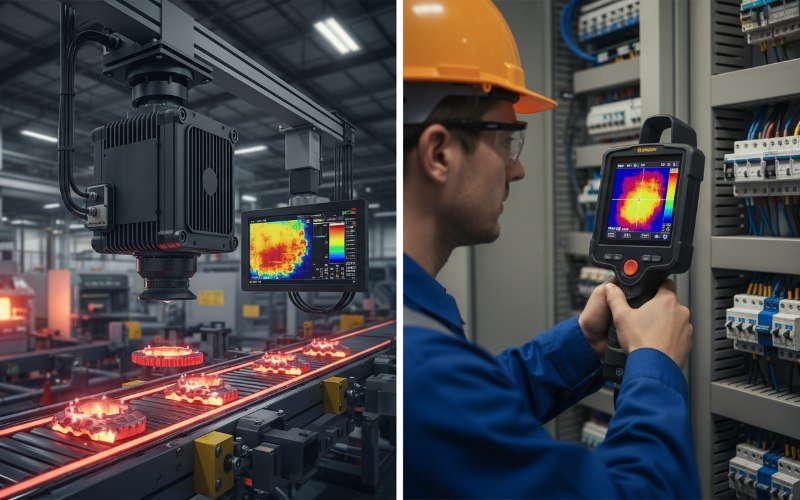
Fixed mount thermal cameras serve as the eyes of automated process control systems. These units are engineered for continuous operation, often functioning as high-performance sensors within a larger feedback loop. Unlike their handheld counterparts, fixed mounted thermal cameras strip away on-board displays and batteries in favor of robust I/O interfaces and compact, ruggedized housings.
For system integrators, the primary appeal of fixed thermal imaging lies in its ability to stream raw radiometric data directly to a central processor. This allows for edge computing or server-side analysis where algorithms can trigger alarms based on specific temperature thresholds or thermal gradients.
Connectivity And Protocols For Fixed Systems
Successful integration of fixed thermal cameras relies heavily on standard industrial protocols. High-end automation cameras typically support GigE Vision or GenICam standards. This compatibility ensures that the thermal imager behaves like a standard machine vision camera, allowing integrators to use established libraries such as OpenCV, LabVIEW, or MATLAB for image acquisition and processing.
Furthermore, fixed units often include digital I/O ports (GPIO) to interface directly with PLCs. This hardware-level integration allows the camera to physically trigger a rejection mechanism on a conveyor belt if a thermal anomaly is detected, minimizing latency compared to software-based triggers.
Handheld Thermal Imagers For Portable Diagnostics
Handheld thermal cameras prioritize the human operator. These devices function as standalone diagnostic tools designed for portability, immediate visualization, and qualitative analysis. While they house sophisticated uncooled microbolometer arrays—often with pixel pitches ranging from 12μm to 17μm—their data architecture is built for post-process reporting rather than real-time automated control.
The ergonomic design focuses on single-handed operation, featuring pistol grips, integrated LCD or OLED touchscreens, and ruggedized casings to withstand drops. For maintenance teams, the handheld thermal imaging camera unit is invaluable for conducting route-based inspections of electrical panels, mechanical motors, and building envelopes.
Limitations In Automated Integration
Integrators attempting to use handheld cameras in fixed applications often encounter significant hurdles. Most handheld units do not support streaming raw radiometric data over a wired network. Instead, they stream compressed video (MPEG/H.264) via USB or Wi-Fi, which strips away the temperature data required for precise algorithmic analysis. Additionally, battery management becomes a failure point in 24/7 operations, even when USB charging is available, as the consumer-grade charging circuits are rarely designed for continuous load.
Comparative Technical Specifications
To make an informed engineering decision, integrators must analyze the specific technical disparities between these two form factors. The table below outlines the critical differences impacting system architecture.
| Feature Specification | Fixed Mount Thermal Camera | Handheld Thermal Camera |
|---|---|---|
| Primary Interface | GigE Vision, Ethernet/IP, Modbus TCP | USB-C, Wi-Fi, SD Card |
| Data Stream Type | 14-bit / 16-bit Raw Radiometric | Compressed Video (non-radiometric) or Radiometric JPEG |
| Power Source | PoE (Power over Ethernet) or 12-24V DC | Rechargeable Li-ion Battery |
| NETD Sensitivity | Typically <40mK to <50mK | Typically <30mK to <60mK (Model Dependent) |
| Frame Rate | 30Hz / 60Hz (9Hz options for export) | 30Hz / 60Hz (often 9Hz to bypass EAR restrictions) |
| Integration Tools | Comprehensive SDK (C++, C#, Python) | Proprietary Desktop Reporting Software |
| IP Rating | IP67 (Dust/Water tight), Ex-rated housings avail. | IP54 (Splash resistant) typically |
Thermal Sensor Technology And Image Processing
The core sensor technology often remains consistent across both platforms. Modern uncooled VOx microbolometers offer high sensitivity and stability. However, the image processing pipeline differs significantly. Handheld units apply heavy non-uniformity correction (NUC) and image enhancement (like multi-spectral dynamic imaging) to make the image clearer for the human eye. This processing can sometimes obscure the raw thermal data needed for machine vision algorithms.
Fixed cameras allow the integrator to access the raw sensor data before heavy processing is applied.