
China Moneypro
Gen 1 vs Gen 2 vs Gen 3 Night Vision Technology Guide
Discover the technical differences between EO, IR, Thermal, and Night Vision technologies. Expert analysis on spectral ranges, sensors, and operational use cases.
This article is part of our Nigh Vision Technology section. For a complete overview, visit our Knowledge Hub guide.
Key Takeaways
- Gen 1 Limitations rely on electrostatic focusing and S-20 photocathodes which creates significant edge distortion and requires active IR illumination.
- Gen 2 Breakthroughs introduced the Microchannel Plate (MCP) for signal amplification which increases light gain by 20,000x and eliminates fisheye distortion.
- Gen 3 Superiority utilizes Gallium Arsenide (GaAs) photocathodes to achieve sensitivity over 1,500 µA/lm and exceptionally low signal-to-noise ratios.
- Figure of Merit (FOM) is the definitive metric for comparing modern tubes calculated by multiplying resolution (lp/mm) by the Signal-to-Noise Ratio (SNR).
Night vision technology has evolved from simple light amplification devices used in the Vietnam War to the highly sophisticated Gallium Arsenide detectors used by special forces today. For procurement officers, engineers, and enthusiasts, understanding the distinction between generations is not merely about price but about the fundamental architecture of the Image Intensifier Tube (IIT).
The US military designates these technological leaps as Generations (Gen 0 through Gen 3). Each generation represents a shift in photocathode chemistry, electron acceleration methods, and micro-optics. This guide provides an engineering-level breakdown of Gen 1 vs Gen 2 vs Gen 3 night vision systems to clarify performance metrics like Signal-to-Noise Ratio (SNR) and Resolution.
Fundamentals of Image Intensification
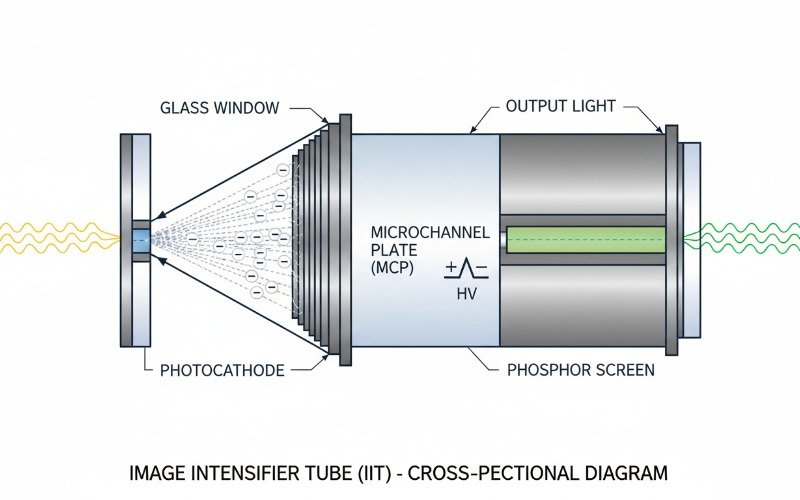
All analog night vision devices operate on the principle of image intensification. Photons enter the objective lens and strike a photocathode. This component converts photons into electrons. These electrons are then accelerated through a vacuum field or a Microchannel Plate (MCP) to increase their energy and quantity. Finally, the amplified electrons strike a phosphor screen which converts the electron energy back into visible light (photons), usually green or white phosphor.
The efficiency of this conversion defines the “Generation” of the device. We measure this efficiency through system gain, photosensitivity (µA/lm), and resolution (line pairs per millimeter).
Generation 1 Technology Overview
Generation 1 represents the earliest passive night vision technology. While largely obsolete in military applications, it remains common in entry-level consumer optics due to low manufacturing costs.
Gen 1 Technical Architecture
Gen 1 tubes utilize an S-20 photocathode (Tri-Alkali). The defining feature of Gen 1 is the method of electron acceleration. It relies on electrostatic focusing where high voltage accelerates electrons directly from the cathode to the phosphor screen. There is no Microchannel Plate (MCP) in a Gen 1 tube.
Because the electrons are accelerated via a conical geometric structure, the image suffers from significant geometric distortion. This is often visible as a “fisheye” effect where the center of the image is clear but the edges are blurry and distorted. The system gain is relatively low, typically around 300x to 900x.
Performance Characteristics of Gen 1
Due to low photosensitivity, Gen 1 devices struggle heavily in passive environments. Without ambient moonlight or starlight, they are effectively blind. Consequently, Gen 1 units almost always require a built-in Infrared (IR) Illuminator to function in deep darkness. This makes the user visible to any other night vision device, rendering Gen 1 unsuitable for tactical applications.
- Lifespan Approx 1,000 to 1,500 hours.
- blooming Highly susceptible to blooming (halo effects) when viewing bright light sources.
- Audio Often emits a high-pitched whine due to the high-voltage power supply.
Generation 2 Technology Advancements
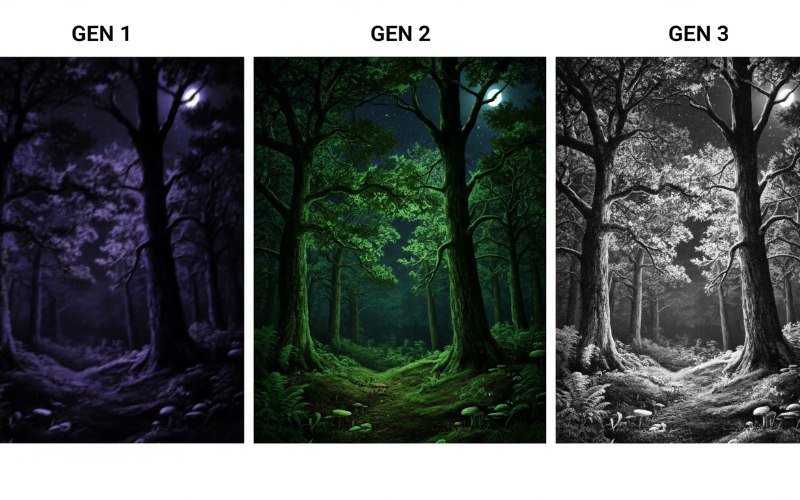
The leap to Generation 2 marked the most significant architectural change in night vision history. This generation introduced the Microchannel Plate (MCP), a component that radically altered signal amplification capabilities.
The Microchannel Plate Revolution
An MCP is a thin glass disc containing millions of microscopic parallel tubes (channels). When an electron enters a channel, it strikes the channel walls, releasing secondary electrons. These secondary electrons strike the wall again, releasing more electrons. This cascade effect allows a single electron to generate thousands of output electrons.
By placing the MCP between the photocathode (typically S-25 extended red) and the phosphor screen, Gen 2 tubes achieve system gains of 20,000x to 30,000x. This allows operation in much darker conditions without active IR illumination.
Gen 2 Performance Improvements
The introduction of the MCP eliminated the need for electrostatic focusing. This resulted in a flat image with excellent edge-to-edge clarity, removing the fisheye distortion found in Gen 1. Gen 2 tubes typically offer resolutions between 45 and 51 lp/mm.
Modern variants, often referred to as Gen 2+ or “SuperGen,” utilize improved photocathode sensitivities and reduced MCP pore sizes to rival standard Gen 3 performance. These high-end Gen 2 tubes remain standard issue for many European military forces due to export restrictions on US Gen 3 technology (ITAR).
Generation 3 The Gold Standard
Generation 3 is the current standard for US military and NATO special forces. The primary differentiator between Gen 2 and Gen 3 is the chemistry of the photocathode. While Gen 2 uses Multi-Alkali compounds, Gen 3 utilizes Gallium Arsenide (GaAs).
Gallium Arsenide Photocathode Superiority
GaAs is a semiconductor material that is extremely efficient at converting photons into electrons. A typical Gen 3 photocathode has a photosensitivity exceeding 1,500 to 2,000 µA/lm (microamps per lumen), compared to roughly 300-600 µA/lm for Gen 2. This allows Gen 3 devices to operate in extremely low light conditions, detecting targets deep in the shadows or under heavy cloud cover where Gen 2 would fail.
Ion Barrier Film and Lifespan
The high-energy electrons in Gen 3 tubes can damage the photocathode through positive ion feedback. To prevent this, engineers added an Ion Barrier Film to the MCP. While this film extends the tube lifespan to over 10,000 hours, it slightly reduces the Signal-to-Noise Ratio by blocking some electrons. Advancements in “Filmless” or “Thin-Filmed” tubes (sometimes colloquially called Gen 4) have mitigated this issue, providing higher SNR while maintaining durability.
Comparing Technical Specifications
To accurately compare these generations, engineers look at specific metrics. The Figure of Merit (FOM) has become the global standard for determining overall tube performance.
| Feature | Gen 1 | Gen 2 (Standard) | Gen 3 (Standard) |
|---|---|---|---|
| Photocathode | S-20 (Tri-Alkali) | S-25 (Multi-Alkali) | GaAs (Gallium Arsenide) |
| Life Expectancy | 1,000 Hours | 5,000 Hours | 10,000+ Hours |
| System Gain | 300x – 900x | 20,000x – 30,000x | 40,000x – 70,000x |
| Resolution | 20-30 lp/mm | 45-51 lp/mm | 64-81+ lp/mm |
| Photosensitivity | 180-200 µA/lm | 300-600 µA/lm | 1,500-2,500+ µA/lm |
| Edge Distortion | Significant (Geometric) | Minimal | None |
| Typical Use | Civilian / Hobby | Law Enforcement / Hunting | Military / Special Ops |
Understanding Figure of Merit FOM
When purchasing modern night vision, looking at the Generation alone is insufficient. High-end Gen 2+ tubes can outperform low-end Gen 3 tubes. The Figure of Merit (FOM) provides a unified calculation for performance.
FOM = Resolution (lp/mm) x Signal-to-Noise Ratio (SNR)
For example, a tube with 64 lp/mm resolution and an SNR of 25 would have an FOM of 1600. Current top-tier aviation and special forces tubes often boast FOM ratings exceeding 2300 or even 3000. Export restrictions (ITAR) heavily regulate the sale of high-FOM tubes outside of the United States.
White Phosphor vs Green Phosphor

While historically associated with the green glow (P43 phosphor), modern Gen 3 devices are increasingly moving toward White Phosphor (P45). White Phosphor does not necessarily indicate a different “Generation,” but rather a different screen coating.
Studies suggest that White Phosphor provides better contrast and reduces eye fatigue during long-duration missions. It interacts more naturally with the brain’s visual cortex, allowing operators to distinguish shapes and shadows more effectively than with the monochromatic green spectrum.
Frequently Asked Questions
Below are definitive answers to common engineering and operational questions regarding night vision generations.
Is digital night vision better than Gen 2 or Gen 3 analog tubes
Can I legally own Gen 3 night vision
What causes the black spots in night vision images
Does Gen 3 night vision degrade over time