
China Moneypro
Complete Guide to EO IR Thermal and Night Vision Differences
Discover the technical differences between EO, IR, Thermal, and Night Vision technologies. Expert analysis on spectral ranges, sensors, and operational use cases.
This article is part of our Comparisions & Buying Guides section. For a complete overview, visit our Knowledge Hub guide.
Modern surveillance and targeting systems rely on a spectrum of technologies that often confuse procurement officers and enthusiasts alike. The terminology surrounding Electro-Optical (EO), Infrared (IR), Thermal Imaging, and Night Vision (NV) describes distinct physical mechanisms for capturing imagery. Understanding these differences is critical for selecting the right equipment for defense, security, or industrial applications.
While these technologies often overlap in integrated sensor suites, they operate on fundamental principles of physics that dictate their range, resolution, and utility in low-light conditions. This guide dissects the technical specifications and operational capabilities of each system to provide a definitive engineering comparison.
Key Takeaways for Vision System Selection
- Electro-Optical (EO) refers to standard visible light cameras relying on reflected photons in the 0.4μm to 0.7μm spectrum.
- Night Vision (NV) uses image intensification tubes to amplify residual ambient light up to 50,000 times but requires some illumination.
- Thermal Imaging detects emitted heat radiation in the MWIR or LWIR spectrum and functions in total darkness without external light.
- Infrared (IR) is the overarching spectrum containing Near-IR (active illumination), Short-Wave IR (seeing through fog), and Thermal bands.
Electro Optical Systems Utilize Visible Light
The term Electro-Optical (EO) technically encompasses any system converting photons into electrons, but in the industry, it specifically refers to visible light imaging sensors. These systems utilize CMOS (Complementary Metal-Oxide-Semiconductor) or CCD (Charge-Coupled Device) sensors similar to standard consumer photography equipment but engineered for higher durability and precision.
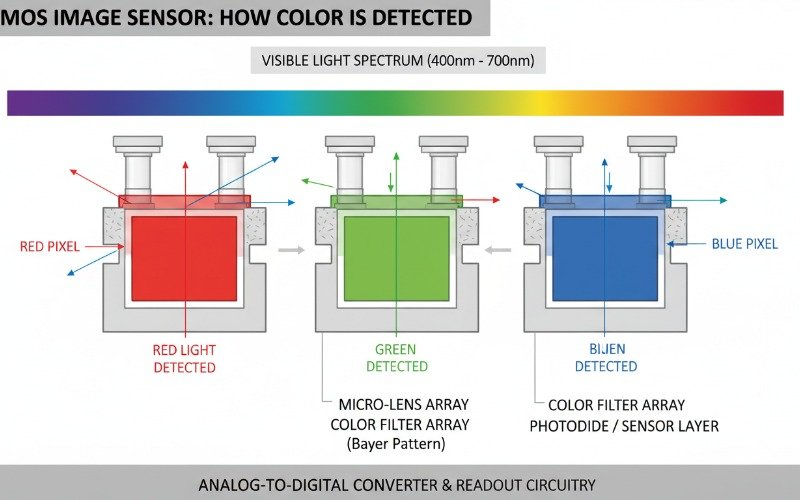
EO systems excel in resolution and color reproduction. Because visible light has a shorter wavelength (0.4μm to 0.7μm) compared to infrared, EO sensors can resolve finer details at long distances. This makes them the primary choice for Positive Identification (PID)—reading license plates, identifying facial features, or observing signage during daylight hours.
The primary limitation of EO sensors is their absolute reliance on reflected light. Without the sun or artificial illumination, a standard EO camera renders a black image. Low-light CMOS sensors have improved significantly, but they still require a photon source to generate a signal.
Night Vision Amplifies Residual Photons
Night Vision technology, technically known as Image Intensification (I2), operates on a different principle than digital cameras. Instead of a silicon chip, these systems use a vacuum tube containing a photocathode plate. When photons from starlight or moonlight hit the photocathode, they are converted into electrons.
These electrons pass through a Microchannel Plate (MCP), a glass disc with millions of microscopic holes. As electrons accelerate through these channels, they multiply exponentially. Finally, they strike a phosphor screen, converting the electron energy back into visible light, typically green or white, for the human eye.
Limitations of Image Intensification
Night vision provides a tactical advantage by retaining the texture and visual context of the environment. However, it suffers from two major engineering constraints. First, it requires ambient light. In a sealed, windowless room or under heavy cloud cover with no moon, standard I2 night vision will fail. Second, it is easily blinded by bright light sources (blooming), although modern auto-gated tubes mitigate this issue.
Infrared Spectrum and Active Illumination
Infrared (IR) is a broad term comprising several spectral bands. Confusion often arises between “Active IR” and “Thermal IR.” Active IR typically utilizes the Near-Infrared (NIR) band (0.7μm to 1.0μm). This band is invisible to the naked human eye but visible to Night Vision devices and specialized silicon sensors.
Security cameras often employ IR illuminators—LEDs that blast NIR light into a scene. To the naked eye, the area remains dark, but to an NIR-sensitive camera, it appears as if lit by a spotlight. This is distinct from thermal imaging because it relies on reflection rather than emission.
Thermal Imaging Detects Heat Signatures
Thermal imaging is the most distinct technology in this comparison. It operates in the Mid-Wave Infrared (MWIR, 3μm–5μm) or Long-Wave Infrared (LWIR, 8μm–14μm) bands. Unlike EO or Night Vision, thermal cameras do not detect reflected light. They detect electromagnetic radiation emitted directly by objects based on their temperature.
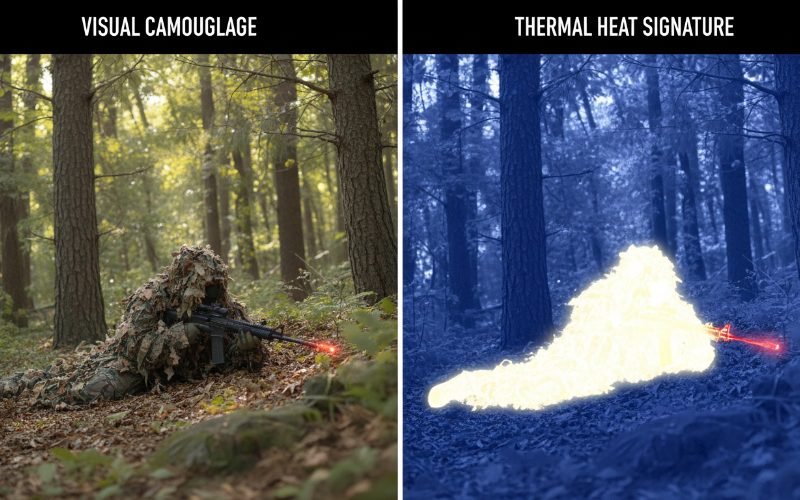
Everything above absolute zero emits thermal radiation. A cryogenically cooled detector (typically Indium Antimonide or Mercury Cadmium Telluride) or an uncooled VOx microbolometer measures these temperature differences. The sensor assigns pixel values based on the intensity of radiation, creating a greyscale image where white or black represents heat.
The engineering advantage of thermal is absolute independence from light. A thermal imager works equally well at high noon and midnight. Furthermore, because it detects heat, it defeats visual camouflage, smoke, and light fog. A human hiding in bushes may be invisible to EO and Night Vision but will stand out clearly as a bright heat source to a thermal sensor.
Technical Comparison of Vision Technologies
To assist in procurement and system design, the following table breaks down the core operational parameters of these four technologies.
| Feature | Electro-Optical (EO) | Night Vision (I2) | Active IR (NIR) | Thermal Imaging (LWIR) |
|---|---|---|---|---|
| Spectral Range | 0.4μm – 0.7μm | 0.7μm – 0.9μm | 0.7μm – 1.0μm | 8μm – 14μm |
| Light Requirement | High (Sun/Artificial) | Low (Stars/Moon) | Illuminator Required | None (Zero Lux) |
| Detection Method | Reflected Photons | Amplified Photons | Reflected NIR Photons | Emitted Heat Radiation |
| Atmospheric Penetration | Poor | Fair | Fair | Excellent (Smoke/Fog) |
| Identification Capability | High (Facial ID) | Medium | Medium | Low (Classification Only) |
Sensor Fusion and Multi Spectral Systems
The future of optoelectronics lies in sensor fusion. Modern EO/IR gimbals and handheld targeting systems often combine multiple sensors into a single unit. By overlaying the high-resolution edge details of an EO or Night Vision image onto a high-contrast thermal layer, operators gain the best of both worlds.
For example, a security perimeter might use thermal analytics to detect an intruder at 1000 meters (where EO would fail to see contrast) and then switch to a high-zoom EO camera to identify the specific individual once they are illuminated or dawn breaks. This integrated approach mitigates the weaknesses of individual wavebands.
Short Wave Infrared Imaging Capabilities
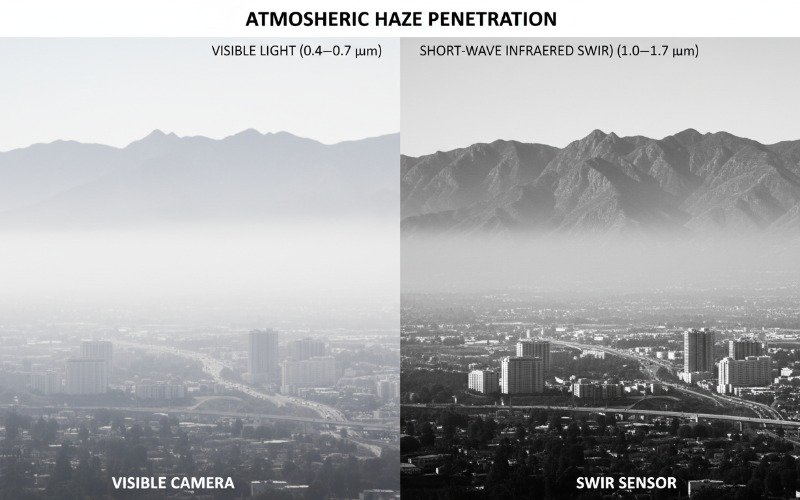
Short-Wave Infrared (SWIR) deserves mention as a bridge technology. Operating between 1μm and 3μm, SWIR sensors (typically InGaAs) detect reflected light like EO cameras but in a spectrum that interacts differently with the atmosphere. SWIR can see through haze and smoke better than visible cameras and can image “night glow” atmospheric radiance, providing night vision capabilities without the blooming artifacts of traditional I2 tubes.
Frequently Asked Questions on Vision Systems
Can thermal imaging see through glass?
Is Night Vision better than Thermal for hunting?
Does thermal imaging work in the daytime?
What is the difference between active and passive IR?