
China Moneypro
EO/IR Payloads for Drones and Unmanned Systems
Discover how EO/IR payloads for drones revolutionize aerial surveillance. Learn about VOx microbolometers, sensor fusion, and stabilization technology.
This article is part of our Application section. For a complete overview, visit our Knowledge Hub guide.
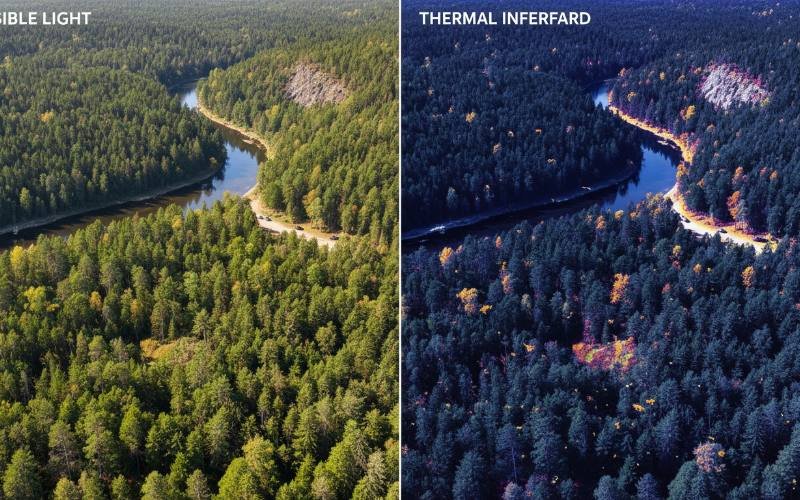
The integration of high-performance optics into unmanned aerial vehicles (UAVs) has fundamentally altered the landscape of modern surveillance, inspection, and reconnaissance. At the heart of this capability lies the EO/IR payload. These sophisticated systems combine Electro-Optical (EO) visible light cameras with Infrared (IR) thermal sensors to provide comprehensive situational awareness regardless of lighting conditions.
Engineers and procurement specialists evaluating these systems must navigate a complex array of technical specifications, from detector sensitivity (NETD) to stabilization accuracy. This guide provides a deep technical analysis of EO/IR payloads for drones, examining the optoelectronic components that drive performance in critical missions.
Key Takeaways for Engineering Decisions
- Multispectral Capability allows operators to overlay visible details onto thermal signatures for superior target identification.
- Stabilization is Critical as micro-vibrations from drone rotors can degrade image quality at high zoom levels without advanced 3-axis gimbal control.
- Detector Selection Matters when choosing between Cooled MWIR for long-range sensitivity and Uncooled VOx LWIR for SWaP-constrained applications.
- Integrated Laser Rangefinders enable precise geo-location and targeting data essential for ISR and industrial mapping.
Defining Electro Optical and Infrared Technology
An EO/IR system is not merely a camera attached to a drone. It is a complex integrated optoelectronic module designed to capture data across different bands of the electromagnetic spectrum simultaneously. The “EO” component typically refers to sensors operating in the visible light spectrum (0.4 to 0.7 micrometers), utilizing CMOS or CCD sensors similar to high-end photography equipment but ruggedized for aerial environments.
The “IR” component addresses the infrared spectrum, usually focusing on Long-Wave Infrared (LWIR) spanning 8 to 14 micrometers or Mid-Wave Infrared (MWIR) spanning 3 to 5 micrometers. Unlike visible cameras that rely on reflected photons, IR sensors detect thermal radiation emitted directly by objects. This distinction allows EO/IR payloads for drones to operate effectively in total darkness, through smoke, and across light fog.
Uncooled VOx Microbolometers in Drone Payloads
The vast majority of commercial and industrial EO/IR payloads utilize uncooled microbolometer technology. The industry standard utilizes Vanadium Oxide (VOx) as the sensing material due to its high Temperature Coefficient of Resistance (TCR) and lower 1/f noise compared to Amorphous Silicon (a-Si) alternatives.
Modern VOx microbolometers have seen a significant reduction in pixel pitch, moving from the legacy 25μm down to 17μm and now commonly 12μm. A smaller pixel pitch allows for smaller optics while maintaining the same Field of View (FOV), or higher magnification with the same optics. This reduction is vital for SWaP (Size, Weight, and Power) optimization in drone payloads.
High-quality uncooled sensors boast a Noise Equivalent Temperature Difference (NETD) of less than 40mK, with top-tier modules achieving <30mK. Lower NETD values indicate a higher sensitivity to minute temperature differences, resulting in sharper, higher-contrast thermal images essential for identifying distant targets.
Stabilization and Gimbal Mechanics
The efficacy of an EO/IR payload is heavily dependent on the stabilization system. Drones are subject to high-frequency vibrations and sudden movements from wind gusts. Without stabilization, the imagery would be unusable, particularly when using narrow fields of view for long-range inspection.
Professional payloads employ 3-axis mechanical gimbals (Pitch, Roll, and Yaw) coupled with electronic stabilization algorithms. High-performance brushless motors, driven by data from MEMS gyroscopes, counteract vehicle movement in real-time. Stabilization accuracy is measured in microradians (μrad). A standard commercial gimbal may offer accuracy around 0.01°, whereas high-end military-grade systems achieve stabilization better than 50 μrad, ensuring pixel-on-target stability at kilometers of distance.
Cooled vs Uncooled Thermal Detectors
Selecting the right infrared detector technology is the most significant cost and performance driver in EO/IR payload specification. While uncooled LWIR sensors are ubiquitous in shorter-range applications, cooled MWIR sensors utilize a cryocooler to lower the sensor temperature to cryogenic levels (typically around 77K). This eliminates thermal noise generated by the sensor itself, allowing for photon detection rather than thermal resistance change.
Cooled detectors offer vastly superior sensitivity and faster integration times, making them suitable for capturing fast-moving targets or performing Long-Range Surveillance (LRS) where atmospheric transmission in the MWIR band is superior to LWIR.
| Feature | Uncooled LWIR (VOx) | Cooled MWIR (InSb/MCT) |
|---|---|---|
| Operating Principle | Thermal (Microbolometer) | Photonic (Quantum Detector) |
| Sensitivity (NETD) | <40mK – <50mK | <20mK – <25mK |
| Spectral Band | 8-14 μm | 3-5 μm |
| Maintenance | Zero maintenance, long MTBF | Requires cryocooler service (typ. 10k-20k hours) |
| Cost | Low to Moderate | High |
| Frame Rates | Typically 30Hz – 60Hz | Can exceed 100Hz+ |
| Primary Use Case | Industrial inspection, Close-range SAR | Long-range border security, Counter-UAS |
Visible Light and Zoom Capabilities
The EO component usually features a visible light camera with significant optical zoom capabilities. Continuous zoom lenses are preferred over step-zoom to maintain visual contact with a target while changing magnification. Modern payloads often integrate 30x or 40x optical zoom lenses coupled with high-resolution CMOS sensors (4K or higher).
Digital zoom is often marketed, but optical zoom preserves the pixel density required for evidence gathering or reading serial numbers on utility assets. The integration of the visible stream with the thermal stream allows for “Picture-in-Picture” (PiP) or fusion modes, where thermal data is overlaid on the high-contrast visible image to highlight heat anomalies.
Laser Rangefinders and Target Geolocation
For an EO/IR payload to be a true tactical or industrial tool, it often requires a Laser Rangefinder (LRF). The LRF emits a laser pulse to measure the distance to the object in the crosshairs. When this distance data is combined with the drone’s GPS coordinates and the gimbal’s angular position (azimuth and elevation), the onboard processor can calculate the precise geolocation of the target.
This capability is mandatory for applications such as artillery spotting, search and rescue coordination, and GIS mapping of infrastructure defects. LRFs used in these payloads must be eye-safe (typically Class 1) while offering ranges from 1km up to 5km or more depending on the size of the module.
Applications in Industrial and Defense Sectors
The versatility of EO/IR payloads for drones drives their adoption across diverse verticals. In the energy sector, radiometric thermal cameras measure the absolute temperature of power lines and solar panels to detect hot spots indicative of failure. Radiometry allows engineers to obtain temperature data for every pixel in the image, facilitating predictive maintenance.
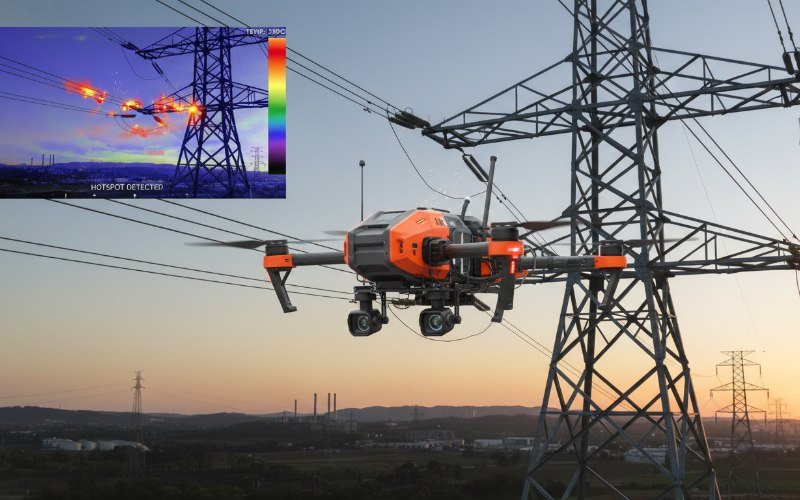
In the defense and border security sector, the focus shifts to detection, recognition, and identification (DRI) ranges. A high-end EO/IR payload can detect a human-sized target at night from several kilometers away. Object tracking algorithms embedded in the payload’s processing unit can automatically lock onto moving vehicles or personnel, reducing operator fatigue and ensuring the target remains in the field of view even during complex drone maneuvers.
Frequently Asked Questions
Understanding the nuances of EO/IR technology helps in selecting the right payload for specific mission requirements. Below are answers to common technical inquiries regarding these systems.
What does EO and IR stand for in drone payloads?
Why is stabilization important for EO/IR sensors?
What is the difference between MWIR and LWIR thermal cameras?
What is NETD and why does it matter?
Can EO/IR payloads measure temperature?