
China Moneypro
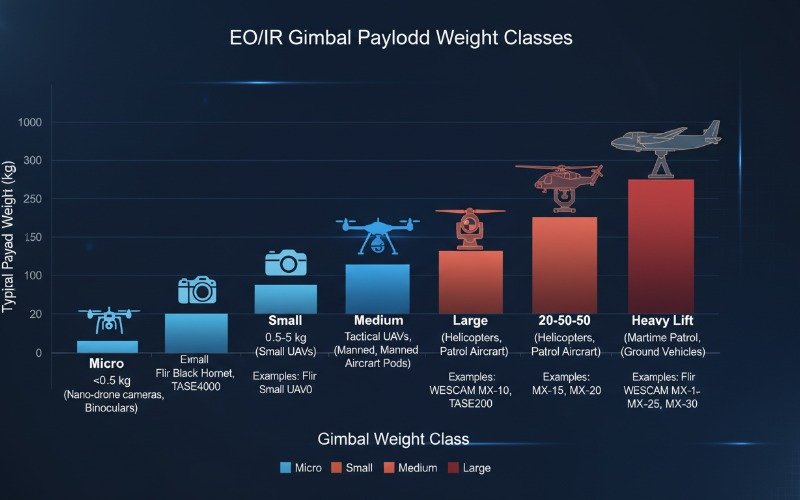
EO/IR Gimbal Weight Classification
Master EO/IR gimbal weight categories from micro payloads to heavy-lift airborne systems. Optimize SWaP for UAVs and manned aircraft integration.
This article is part of our Systems & Payloads section. For a complete overview, visit our Knowledge Hub guide.
Integrating Electro-Optical/Infrared (EO/IR) systems into unmanned aerial vehicles (UAVs) and manned aircraft requires a precise understanding of payload limitations. The balance between sensor performance and flight endurance is dictated almost entirely by the Size, Weight, and Power (SWaP) budget. For system integrators, selecting the correct EO/IR gimbal weight classification is the critical first step in defining mission capabilities.
Weight drives the mechanical design of the airframe and dictates the type of thermal detector technology available. Lighter systems typically rely on uncooled VOx microbolometers, while heavier payloads can accommodate high-performance cooled MWIR detectors and heavy germanium optics. This guide breaks down the industry-standard weight categories for EO/IR gimbals and analyzes the technical trade-offs inherent in each class.
Key Takeaways for Payload Integration
- Micro Class (Under 250g) utilizes uncooled VOx sensors and is optimized for Group 1 UAVs and tactical loitering munitions.
- Light Tactical (250g–1.5kg) introduces multi-axis stabilization and dual-sensor fusion suitable for commercial inspection drones.
- Medium Range (1.5kg–10kg) bridges the gap to cooled MWIR detectors and continuous zoom optics for Group 2 and 3 UAVs.
- Heavy Lift (Over 10kg) supports long-range surveillance with large aperture optics and multi-spectral sensor suites for manned aviation.
- SWaP Optimization requires balancing the mass of Germanium lens elements against the sensitivity requirements of the mission.
Defining the SWaP Constraint in Gimbal Selection
The term SWaP (Size, Weight, and Power) acts as the governing equation for all optoelectronic integration. In the context of EO/IR gimbals, weight is often the most rigid variable. An increase in payload weight reduces the platform’s operational range and loiter time. Conversely, reducing weight often necessitates a compromise in optical aperture size, which directly affects the system’s ability to identify targets at distance (Johnson’s Criteria).
Integrators must categorize gimbals not just by mass, but by the density of capability per gram. Modern 12μm pixel pitch sensors allow for smaller optics without sacrificing resolution, shifting the boundaries of what is possible in lighter weight classes.
Micro Class Gimbals Under 250 Grams
The micro class represents the leading edge of miniaturization in optoelectronics. Designed primarily for Group 1 UAVs (under 20 lbs) and man-portable drones, these gimbals prioritize compactness over long-range performance. Achieving a weight under 250g requires the elimination of active cooling mechanisms and the reduction of metal housing thickness.
Sensor Technology in Micro Gimbals
Micro gimbals rely exclusively on uncooled Long-Wave Infrared (LWIR) detectors. The industry standard is the Vanadium Oxide (VOx) microbolometer. To maintain the low weight profile, manufacturers utilize sensors with smaller pixel pitches, typically 12μm. This allows for shorter focal length lenses to achieve the same Field of View (FOV), significantly reducing the mass of the Germanium glass required.
Stabilization in this class is generally limited to 2-axis electronic stabilization or basic mechanical dampening. The lack of a third axis (yaw) saves weight but limits the system’s ability to maintain a steady image during high-wind flight maneuvers.
Light Tactical Gimbals 250g to 1500g
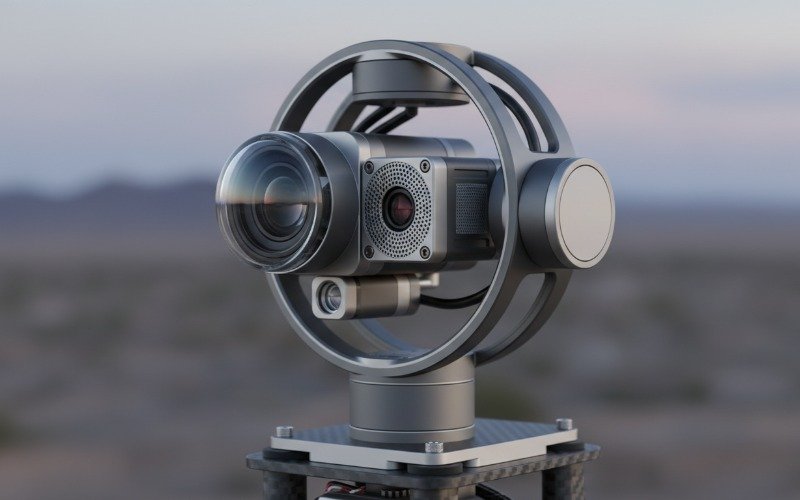
The light tactical class is the workhorse of the commercial and industrial inspection sector. These payloads find homes on quadcopters and small fixed-wing drones used for power line inspection, search and rescue, and short-range surveillance. The increased weight allowance permits the inclusion of robust 3-axis mechanical stabilization using brushless DC motors.
Optics and Rangefinders
In this category, integrators will find dual-sensor configurations combining a high-resolution EO (visible light) camera with a radiometric thermal core. The weight budget allows for the integration of Laser Range Finders (LRF), essential for geolocating targets. While still relying on uncooled LWIR sensors, the optics often feature fixed focal lengths between 19mm and 50mm, providing detection ranges up to 1-2 kilometers for vehicle-sized targets.
Medium Class Systems 1.5kg to 10kg
Crossing the 1.5kg threshold allows for a fundamental shift in detector technology. The Medium Class is where cooled thermal imaging becomes viable. These gimbals are designed for Group 2 and Group 3 UAVs, such as the ScanEagle or Shadow, which require extended standoff distances.
Cooled MWIR Integration
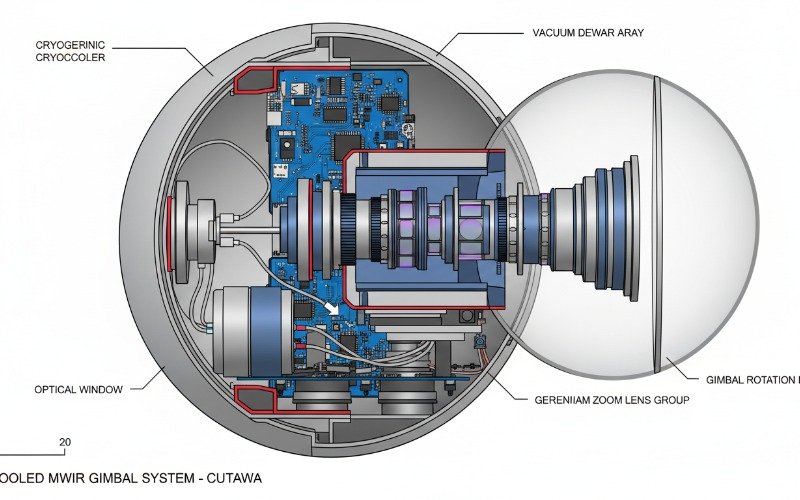
Payloads in this weight class often utilize Medium-Wave Infrared (MWIR) detectors cooled to cryogenic temperatures (typically 77K) using Stirling cycle coolers. The cooling mechanism adds significant weight and power draw but offers superior thermal sensitivity (NETD < 25mK) and works effectively in high-humidity environments.
Continuous Zoom Optics
Unlike lighter classes that use fixed lenses, medium-weight gimbals feature continuous optical zoom assemblies. The mechanics required to move lens elements precisely while maintaining boresight alignment add mass. A typical 15-300mm continuous zoom MWIR lens assembly alone can weigh over 1kg, necessitating a robust gimbal structure to manage the center of mass shifts during operation.
Heavy Lift and Airborne Gimbals Over 10kg
The heavy lift category encompasses large airborne turrets typically mounted on manned helicopters, fixed-wing patrol aircraft, and larger MALE (Medium-Altitude Long-Endurance) UAVs like the Predator or Reaper. These systems are true multi-spectral powerhouses designed for extreme range performance.
Multi-Spectral Capabilities
At this weight class, the gimbal acts as a pod for multiple sensors. A standard configuration might include a High-Definition MWIR camera, a color Low-Light TV (LLTV) spotter scope, a SWIR (Short-Wave Infrared) camera for seeing through smoke and haze, and a high-power Laser Target Designator (LTD). The structural rigidity required to keep these sensors aligned (boresighted) under high vibration adds to the total mass.
Stabilization Performance
Heavy gimbals employ 4-axis or 5-axis stabilization systems (using inner and outer gimbals) to achieve stabilization accuracy of less than 5 microradians (µrad). This level of stability is mandatory for maintaining target lock at ranges exceeding 20 kilometers.
Comparison of EO/IR Gimbal Categories
The following table outlines the technical specifications typically associated with each EO/IR gimbal weight classification, helping integrators match payloads to platforms.
| Class | Weight Range | Detector Tech | NETD Sensitivity | Typical Zoom | Target Platform |
|---|---|---|---|---|---|
| Micro | < 250g | Uncooled VOx (LWIR) | < 50mK | Fixed / Digital | Group 1 UAVs |
| Light Tactical | 250g – 1.5kg | Uncooled VOx (LWIR) | < 40mK | Fixed / Step Zoom | Inspection Drones |
| Medium | 1.5kg – 10kg | Cooled MWIR / LWIR | < 25mK | Continuous Optical | Tactical UAVs |
| Heavy / Airborne | > 10kg | Cooled MCT / T2SL | < 20mK | Long Range Continuous | Manned / MALE UAV |
Selecting the Right Gimbal for Your Platform
Choosing the correct weight class involves calculating the total takeoff weight and the center of gravity of the aircraft. Integrators must also consider the power consumption associated with heavier, cooled systems. While a medium-class gimbal offers superior imaging, the power draw of the Stirling cooler may reduce the flight time of an electric UAV to unacceptable levels.
Furthermore, the environmental ruggedization plays a role in weight. Systems designed to meet MIL-STD-810 standards for shock, vibration, and salt fog intrusion will inherently weigh more due to sealed housings and ruggedized connectors. Always reference the mass balance sheet provided by the gimbal manufacturer to ensure the payload does not exceed the structural limits of the isolation mount.
Frequently Asked Questions
What is the primary trade-off when choosing a lighter EO/IR gimbal?
Why are cooled MWIR gimbals heavier than uncooled LWIR gimbals?
Can a Micro class gimbal include a Laser Range Finder?
What stabilization accuracy is expected from heavy airborne gimbals?