
China Moneypro
Advanced EO/IR Systems Revolutionizing Border Surveillance
Explore how VOx microbolometers and cooled MWIR detectors power EO/IR border security systems. Technical analysis of multispectral fusion and long-range surveillance.
This article is part of our EO Technology section. For a complete overview, visit our Knowledge Hub guide.
Border security agencies face the monumental challenge of monitoring vast, remote, and environmentally hostile perimeters 24 hours a day. Traditional visual surveillance fails when darkness falls or when atmospheric conditions deteriorate. The definitive engineering solution lies in sophisticated Electro-Optical and Infrared (EO/IR) systems. These integrated sensor platforms combine high-definition visible light cameras with advanced thermal imaging detectors to provide situational awareness regardless of lighting conditions.
Key Technical Takeaways for EO/IR Implementation
- Multispectral Synergy combines visible sensors and thermal detectors to overcome camouflage and harsh weather conditions.
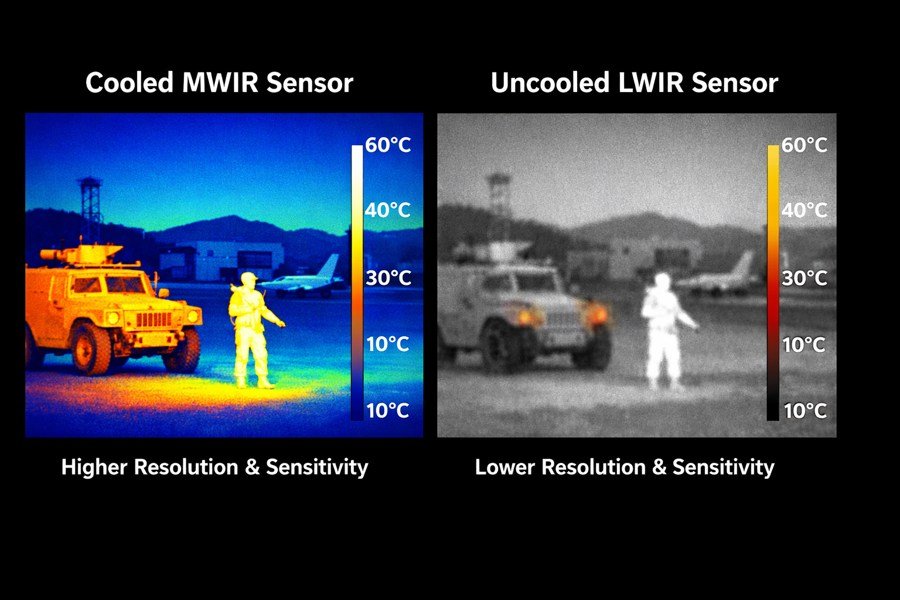
- Cooled MWIR detectors offer superior range and sensitivity for long-distance perimeter monitoring compared to uncooled LWIR options.
- VOx Microbolometers provide a cost-effective and low-maintenance solution for short to medium-range tactical deployment.
- DRI Standards dictate the optical requirements for Detection, Recognition, and Identification of threats at specific distances.
- Sensor Fusion utilizes algorithms to overlay thermal data onto visual feeds for enhanced target classification.
The Fundamentals of EO/IR Sensor Architecture
An EO/IR system is not merely a camera but a complex assembly of optics, sensors, and processing units mounted on a stabilized platform. The architecture typically consists of a visible light camera (Electro-Optical) and a thermal imager (Infrared), often supplemented by laser rangefinders and illuminators. The primary engineering goal is to cover the electromagnetic spectrum from 0.4μm to 14μm, ensuring that no target can hide due to lack of illumination or visual obstruction.
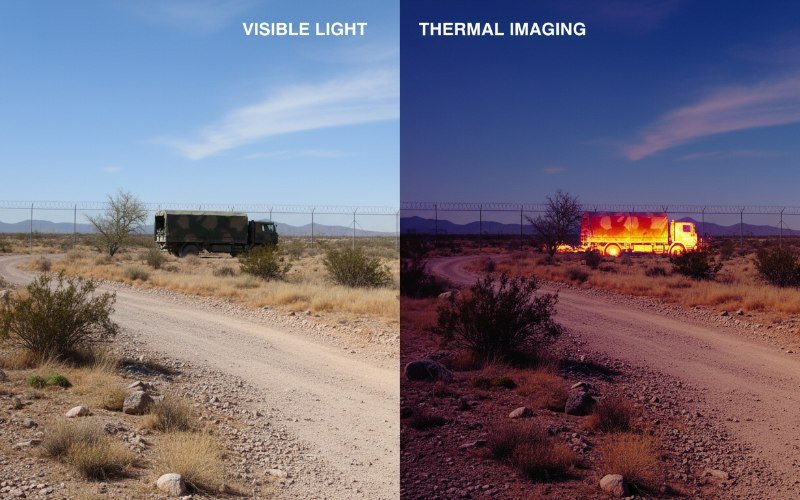
For visible light channels, modern systems utilize low-light CMOS sensors capable of operating in near-darkness (0.0001 lux). However, the true powerhouse of border security is the infrared channel. Thermal imaging detects heat signatures (infrared radiation) emitted by objects, making it immune to darkness and largely unaffected by smoke or light fog.
Uncooled VOx Microbolometers for Tactical Ranges
Vanadium Oxide (VOx) microbolometers represent the standard for uncooled thermal imaging in the Long-Wave Infrared (LWIR) spectrum (8μm to 14μm). These detectors operate at ambient temperatures without the need for cryogenic cooling mechanisms. This results in systems that possess lower SWaP (Size, Weight, and Power) characteristics and significantly higher reliability intervals (MTBF).
Recent advancements in wafer-level packaging have allowed pixel pitches to shrink from 17μm to 12μm. A smaller pixel pitch allows for higher resolution optics in a smaller form factor or greater magnification with the same lens size. For border patrols operating mobile surveillance trucks or portable tripods, VOx sensors with an NETD (Noise Equivalent Temperature Difference) of less than 35mK provide sharp contrast capable of distinguishing human threats from wildlife at distances up to 3 kilometers.
Cooled MWIR Detectors for Long Range Dominance
When the mission profile requires identifying a vehicle at 10 kilometers or a human at 5 kilometers, uncooled sensors hit a physical limit. This is where Cooled Mid-Wave Infrared (MWIR) detectors excel. Operating in the 3μm to 5μm spectral band, these sensors use cryogenic coolers to lower the detector temperature to approximately 77 Kelvin.
Cooling the sensor virtually eliminates thermal noise from the detector itself. This creates an extremely high signal-to-noise ratio, allowing for high-speed continuous optical zoom lenses without significant signal degradation. Materials such as Indium Antimonide (InSb) or Mercury Cadmium Telluride (MCT) are standard for the Focal Plane Arrays (FPA) in these systems. The 3-5μm band also benefits from better transmission through humid atmospheres compared to LWIR, making it the superior choice for coastal border surveillance.
Comparative Analysis of Detector Technologies
| Feature | Uncooled VOx (LWIR) | Cooled InSb/MCT (MWIR) |
|---|---|---|
| Wavelength | 8μm – 14μm | 3μm – 5μm |
| Sensitivity (NETD) | <35mK – <50mK | <20mK – <25mK |
| Detection Range (Human) | Up to 3km | Up to 15km+ |
| Maintenance | Zero maintenance | Cooler replacement every 10k-20k hours |
| Cost | Low to Moderate | High |
| Atmospheric Penetration | Better in smoke/dust | Better in high humidity |
Precision Optics and Continuous Zoom Capabilities
The efficacy of the detector is limited by the quality of the optical assembly. In border security, fixed lenses are rarely sufficient. Continuous optical zoom assemblies are critical for maintaining situational awareness while tracking a target. Unlike digital zoom, which degrades image quality, optical zoom maintains full sensor resolution throughout the magnification range.
Engineers must carefully design these lenses to correct for chromatic aberration and focus shift. In uncooled systems, athermalized lenses are necessary to prevent focus drift as ambient temperatures change. For cooled MWIR systems, the optics must be f-number matched to the cold shield of the detector to prevent stray thermal radiation from washing out the image.
Advanced Image Processing and Sensor Fusion
Raw sensor data often requires significant processing to be useful to an operator. Modern Field Programmable Gate Arrays (FPGAs) embedded within EO/IR modules perform real-time image enhancement. Algorithms such as Digital Detail Enhancement (DDE) and Histogram Equalization manage the wide dynamic range of thermal scenes, ensuring that both hot targets and cold backgrounds remain visible.
Sensor fusion is the frontier of EO/IR technology. By digitally overlaying the high-contrast edges from the visible light camera onto the thermal image, operators receive a composite view that combines the detection ease of thermal with the identification detail of visible light. This is particularly useful for reading lettering on vehicles or identifying armaments, which might appear as featureless hot blobs in standard thermal imaging.
Stabilization and Geolocation Systems
Long-range imaging is susceptible to image jitter caused by wind or platform vibration. A shift of a fraction of a degree can result in the target moving out of the field of view at a 10km distance. High-end border security systems employ multi-axis gyroscopic stabilization to decouple the sensor payload from the movement of the tower or vehicle.
Furthermore, integrated laser rangefinders (LRF) and digital magnetic compasses allow the system to calculate the exact GPS coordinates of a target. When a threat is detected, the system determines the distance and bearing, computing the target’s grid reference. This data is instantly transmitted to command and control centers, enabling rapid interception.
Integrating AI for Automated Threat Detection
The sheer volume of video data generated by 24/7 surveillance can overwhelm human operators. Edge computing modules integrated into EO/IR systems now deploy Deep Learning algorithms trained on vast datasets of humans, vehicles, and animals. These AI models perform continuous scanning, flagging potential threats and filtering out false alarms caused by wildlife or moving vegetation.
By automating the detection phase, operators can focus on the verification and response phases. This significantly reduces fatigue and ensures that critical security breaches are not missed during long shifts.
Frequently Asked Questions
What is the difference between MWIR and LWIR for border security?
How far can an EO/IR system detect a human?
Does thermal imaging work through glass?
What is NETD and why does it matter?