
China Moneypro
Critical Factors Defining Infrared Thermal Image Quality
Explore the engineering variables affecting thermal image quality including NETD, pixel pitch, lens F-number, and image processing for B2B system integration.
Achieving superior performance in electro-optical systems requires a granular understanding of the physics governing infrared detection. For system integrators designing UAV payloads, border security arrays, or industrial process monitoring solutions, selecting a thermal module is not merely about resolution. It involves a complex interplay of detector sensitivity, optical throughput, and digital signal processing algorithms.
This technical analysis dissects the parameters that determine the fidelity of a thermal image. We move beyond basic datasheet specifications to evaluate how variables like NETD, lens F-number, and pixel pitch influence real-world detection, recognition, and identification (DRI) capabilities.
Key Takeaways for System Integrators
- NETD is Paramount: Lower Noise Equivalent Temperature Difference values (sub-30mK) provide superior contrast in low-thermal-contrast scenes.
- Optics Match Sensitivity: Fast lenses (F/1.0) are critical for uncooled sensors to maximize photon irradiance on the Focal Plane Array (FPA).
- Pixel Pitch Trade-offs: While 12μm sensors allow for smaller optics, they demand higher quantum efficiency to match the sensitivity of larger 17μm pixels.
- Processing Define Clarity: Advanced algorithms like Digital Detail Enhancement (DDE) and Non-Uniformity Correction (NUC) are essential for usable video output.
The Role of Detector Sensitivity and NETD
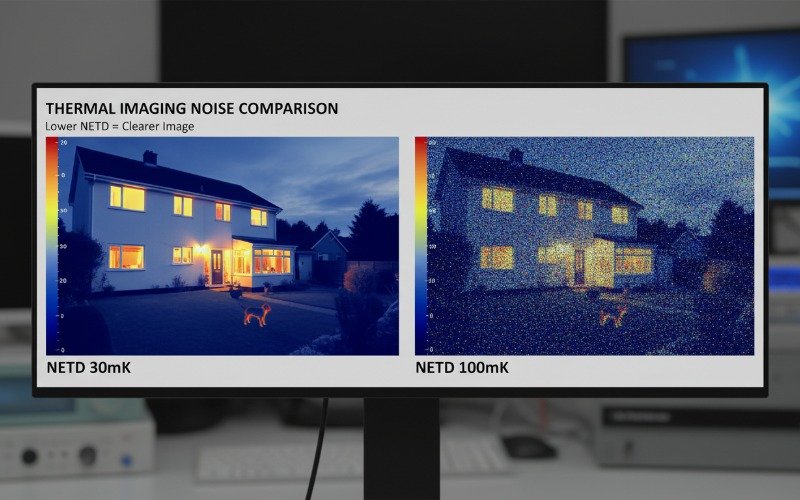
The fundamental metric for thermal image quality in uncooled microbolometers is the Noise Equivalent Temperature Difference (NETD). This parameter represents the smallest temperature difference a detector can distinguish from the background noise. It is measured in milliKelvins (mK).
In high-end Vanadium Oxide (VOx) sensors, an NETD of less than 30mK is the gold standard. A lower NETD results in a cleaner image with less “snow” or temporal noise. For system integrators, this is particularly critical in low-contrast environments. Consider a maritime surveillance application where the target (a boat hull) and the background (water) may differ in temperature by only a fraction of a degree. A sensor with 50mK NETD may fail to resolve the target against the background noise, whereas a 30mK sensor will render a distinct edge.
Vanadium Oxide generally offers a higher Temperature Coefficient of Resistance (TCR) compared to Amorphous Silicon (a-Si), leading to naturally better sensitivity and stability. When sourcing cores, integrators should verify the specific F-number at which the NETD was tested, as manufacturers sometimes inflate specs by testing at F/1.0 even if the supplied lens is F/1.2.
Pixel Pitch and Spatial Resolution
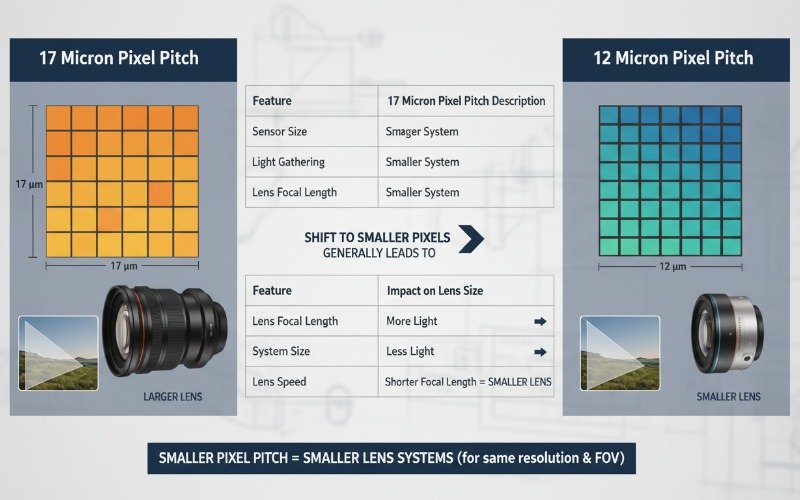
The shift from 17μm to 12μm pixel pitch has dominated recent industry trends. Pixel pitch defines the physical size of the individual detector elements on the Focal Plane Array (FPA). Smaller pixels allow for the production of smaller, lighter, and less expensive lenses for a given field of view (FOV), which is vital for SWaP (Size, Weight, and Power) constrained applications like drone payloads.
However, physics dictates that as pixel area decreases, the amount of thermal energy (photons) collected also decreases. A 12μm pixel has approximately half the surface area of a 17μm pixel. To maintain high image quality, manufacturers must improve the pixel architecture to maximize the fill factor and thermal isolation. When integrating 12μm cores, ensure the optics are optimized for the Modulation Transfer Function (MTF) of the smaller pitch to avoid diffraction-limited blurring.
Optical Throughput and F-Number
The lens constitutes the first stage of the imaging chain. In thermal imaging, the F-number (the ratio of focal length to aperture diameter) is a major determinant of image quality. Infrared energy is relatively scarce compared to visible light, making “fast” lenses essential.
An F/1.0 lens passes significantly more energy to the sensor than an F/1.2 or F/1.4 lens. The relationship is quadratic; shifting from F/1.0 to F/1.4 cuts the thermal energy reaching the sensor by roughly 50%. This reduction directly degrades the effective NETD of the system. For high-performance applications, integrators should prioritize Germanium optics with high-efficiency Anti-Reflective (AR) or Diamond-Like Carbon (DLC) coatings to ensure transmission rates exceed 90% in the Long-Wave Infrared (LWIR) band (8-14μm).
Non-Uniformity Correction and Image Uniformity
Raw output from a microbolometer is inherently non-uniform due to manufacturing variations in pixel resistance. Without correction, the image would appear dominated by fixed-pattern noise (FPN). Non-Uniformity Correction (NUC) is the process of calibrating the gain and offset of every pixel to produce a uniform image.
High-quality thermal cores utilize advanced shutterless NUC algorithms or mechanical shutters that periodically recalibrate the sensor. Poor implementation of NUC results in “ghosting” or vertical streaking in the image, particularly when the camera temperature changes rapidly. For radiometric applications where temperature measurement is required, the stability of the NUC is the limiting factor for accuracy.
Digital Image Processing Algorithms
Once the analog signal is digitized, the image pipeline significantly alters the perceived quality. Since thermal sensors often capture a dynamic range of 14-bits (16,384 levels) but displays are typically 8-bit (256 levels), dynamic range compression is necessary. This is where proprietary algorithms differentiate premium modules from generic ones.
Digital Detail Enhancement (DDE): This technique enhances high-frequency spatial information (edges) while compressing the low-frequency dynamic range. It allows an operator to see the texture of a vehicle’s tires (small temperature variance) even if a burning fire is in the background (huge temperature variance).
Automatic Gain Control (AGC): Histogram equalization methods adaptively map the thermal scene to the display scale. Advanced “Region of Interest” (ROI) AGC ensures that the sky (which is very cold) does not skew the contrast of the ground targets.
Comparison of Detector Technologies
Understanding the underlying detector material is crucial for matching the sensor to the mission profile. Below is a comparison of the dominant technologies available to integrators today.
| Feature | Uncooled VOx (Vanadium Oxide) | Uncooled a-Si (Amorphous Silicon) | Cooled MCT (Mercury Cadmium Telluride) |
|---|---|---|---|
| NETD Sensitivity | <30mK – <50mK | <40mK – <60mK | <15mK – <25mK |
| Responsiveness | High TCR, stable image | Lower TCR, potential image lag | Photon detection (Instant) |
| Cost Profile | Moderate | Low to Moderate | Very High |
| Primary Application | Defense, Industrial, Security | Consumer, Basic Thermography | Long-range ISR, Scientific Gas Detection |
| Maintenance | Zero maintenance (Solid state) | Zero maintenance | Requires cooler replacement (MTTF 10k-20k hours) |
Atmospheric Conditions and Transmission
Even the highest quality thermal imager is subject to the laws of atmospheric physics. System integrators must account for atmospheric transmission, which is affected by humidity, precipitation, and aerosols. While LWIR (8-14μm) penetrates smoke and dust better than visible light or MWIR (3-5μm), high humidity absorbs infrared energy.
In long-range surveillance systems, the “quality” of the image at 5km is determined less by the detector’s NETD and more by the atmospheric extinction coefficient. Algorithms that include turbulence mitigation can help recover image sharpness in hot environments where heat shimmer distorts the optical path.
Frequently Asked Questions
Why is NETD more important than resolution for some applications?
How does the F-number affect the cost of the thermal module?
What is the benefit of 12μm pixel pitch over 17μm?
Does frame rate impact thermal image quality?