


In the specialized world of infrared thermography, the resolution of a Vanadium Oxide (VOx) sensor represents the primary benchmark for handheld thermal camera performance. Unlike visible light sensors that rely on CMOS or CCD technology, long-wave infrared (LWIR) systems utilize uncooled microbolometers to detect thermal radiation. As a Senior Optoelectronics Engineer, understanding the nuances of VOx resolution is critical for selecting equipment that meets the rigorous demands of industrial inspection, electrical maintenance, and research and development. This deep-dive exploration examines the technical architecture of VOx arrays and how resolution dictates the efficacy of thermal data acquisition.
Core Technical Insights
- VOx microbolometers provide superior thermal sensitivity and lower NETD compared to amorphous silicon alternatives.
- Sensor resolution is defined by the Focal Plane Array (FPA) dimensions and dictates the total available measurement points.
- Pixel pitch reductions from 17μm to 12μm allow for higher resolution sensors in compact handheld form factors.
- The Instantaneous Field of View (IFOV) is the mathematical link between sensor resolution and spatial precision.
- Higher resolution directly improves Detection, Recognition, and Identification (DRI) ranges for long-distance thermography.
The Engineering of Vanadium Oxide Microbolometer Arrays
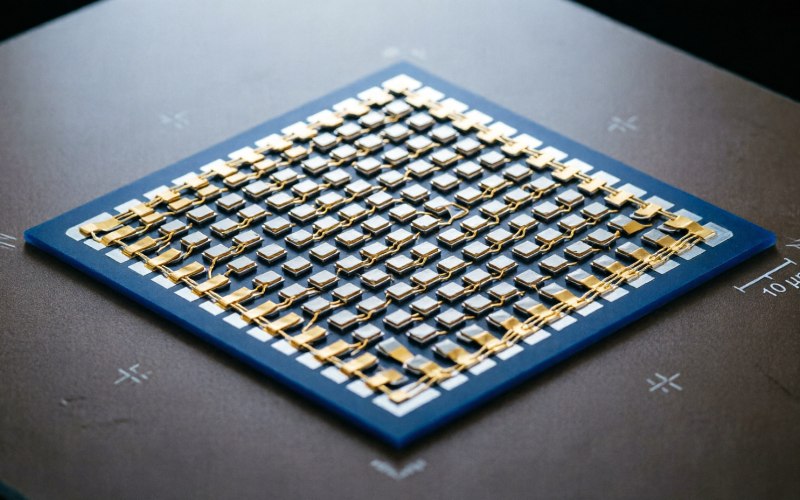
Vanadium Oxide serves as the preferred material for high-performance uncooled infrared detectors due to its high Temperature Coefficient of Resistance (TCR). In a VOx microbolometer, the resolution refers to the number of individual detector elements, or pixels, arranged in a Focal Plane Array (FPA). Each pixel is a microscopic MEMS (Micro-Electro-Mechanical System) structure suspended over a silicon substrate. When infrared radiation strikes the VOx layer, its temperature changes, causing a measurable shift in electrical resistance. This change is processed by a Read-Out Integrated Circuit (ROIC) to generate a thermal map.
The physical density of these pixels determines the native resolution of the handheld thermal camera. Standard industrial resolutions have evolved from legacy 160×120 arrays to the modern 640×512 and 1024×768 HD standards. Higher resolution is not merely about image aesthetics; it is about the reliability of the temperature data. A higher pixel count provides a denser sampling of the thermal scene, reducing the likelihood of missing small thermal anomalies, such as a failing capacitor on a PCB or a loose connection in a high-voltage substation.
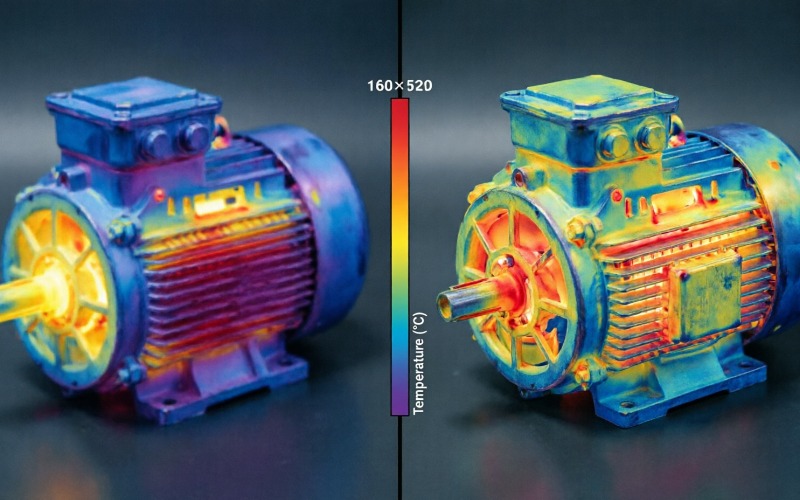
Thermal Resolution Influence on Image Clarity
Resolution in handheld thermal cameras is often misunderstood as being identical to resolution in digital photography. However, in the LWIR spectrum (8-14μm), the physics of diffraction limits play a much larger role. A VOx sensor with a 640×512 resolution captures 327,680 individual temperature data points. This is four times the data captured by a 320×240 sensor. For a professional thermographer, this translates to the ability to stand further away from a target while maintaining the same level of spatial detail.
The impact on image clarity is most evident when inspecting targets with complex thermal gradients. A low-resolution sensor may average the temperatures of a hot component and its cooler surroundings into a single pixel, a phenomenon known as the ‘spot size’ effect. This results in an inaccurate temperature reading that is lower than the actual temperature. High VOx resolution mitigates this risk by ensuring that the target’s thermal energy is captured across multiple pixels, allowing for precise measurement of the peak temperature.
The Engineering Physics of Pixel Pitch and IFOV
One of the most significant advancements in VOx technology is the reduction of pixel pitch. Pixel pitch is the center-to-center distance between adjacent pixels. For many years, 17μm was the industry standard. The transition to 12μm pixel pitch has revolutionized handheld thermal camera design. By shrinking the pixel size, manufacturers can fit more pixels onto a smaller sensor die. This reduction leads to smaller, lighter lenses while maintaining or even increasing the camera’s resolution.
However, smaller pixels come with engineering challenges. As the pixel area decreases, the amount of infrared energy each pixel captures also decreases. This requires a corresponding improvement in the material science of the VOx layer to maintain a high Signal-to-Noise Ratio (SNR). Advanced 12μm sensors often achieve an NETD (Noise Equivalent Temperature Difference) of less than 30mK, ensuring that the increase in resolution does not come at the cost of thermal sensitivity.
The relationship between resolution and the lens system is quantified by the Instantaneous Field of View (IFOV). IFOV measures the spatial resolution of a single pixel at a specific distance. It is calculated by dividing the pixel pitch by the focal length of the lens. A handheld camera with high VOx resolution and a low IFOV can detect small targets at greater distances, which is paramount for high-voltage power line inspections or building envelope assessments.
Comparison of Common Sensor Resolutions
| Resolution Standard | Total Pixel Count | Optimal Application | Typical Pixel Pitch |
|---|---|---|---|
| 160 x 120 | 19,200 | Basic HVAC/DIY | 17μm / 12μm |
| 384 x 288 | 110,592 | General Industrial Maintenance | 12μm |
| 640 x 512 | 327,680 | Professional Substation Inspection | 12μm |
| 1024 x 768 | 786,432 | Long-range R&D and Defense | 12μm / 10μm |
Practical Applications for Professional Grade Cameras
The choice of VOx resolution depends heavily on the specific use case. In electrical utility inspections, where technicians must identify failing components on transformers from a safe distance, a 640×512 resolution is the gold standard. The high pixel density allows the thermographer to clearly see the cooling fins and bushings, identifying localized hot spots that would be invisible on a lower-resolution device.
In the field of building science, high-resolution VOx sensors are used to detect moisture intrusion and insulation gaps. Because thermal differences in buildings are often subtle (less than 1 degree), the combination of high resolution and low NETD is essential. A 640-series camera can map an entire wall section in a single frame with enough detail to trace the exact path of a leak behind drywall.
Furthermore, R&D applications, such as PCB thermal profiling, require the highest possible resolutions combined with macro lenses. When inspecting micro-electronics, each pixel must represent a fraction of a millimeter. High-resolution VOx arrays enable engineers to monitor the heat dissipation of individual integrated circuits (ICs) during stress testing, ensuring that thermal designs meet safety and performance specifications.
Future Trends in Uncooled Infrared Technology
The trajectory of VOx technology is moving toward megapixel uncooled arrays and further integration of AI-driven image processing. As manufacturing yields for large-format FPAs improve, we expect to see 1280×1024 VOx sensors become more common in handheld form factors. These ‘HD’ thermal cameras will offer unprecedented levels of detail, rivaling the performance of cooled mid-wave infrared (MWIR) systems for many terrestrial applications.
Simultaneously, the integration of on-sensor AI is changing how resolution is utilized. Super-resolution algorithms can now process multiple frames in real-time to enhance the perceived resolution of the image, effectively doubling the detail of a standard 384×288 sensor. However, these software enhancements are always limited by the raw data provided by the VOx array, underscoring the continued importance of high native resolution.
Frequently Asked Questions
VOx (Vanadium Oxide) sensors generally offer higher thermal sensitivity and lower noise (NETD) compared to a-Si (Amorphous Silicon) sensors. VOx is the industry standard for high-end professional and military thermal imaging due to its superior performance in varied environmental conditions.
Pixel pitch determines how many pixels can be packed into a specific sensor area. A smaller pixel pitch (like 12μm) allows for higher resolution sensors to be used with smaller lenses, making the handheld camera more portable without sacrificing image quality.
NETD, or Noise Equivalent Temperature Difference, measures a sensor’s sensitivity. In high-resolution cameras, having a low NETD (typically <30mK or <40mK) ensures that the increased number of pixels provides clear, low-noise data, which is vital for detecting small temperature differences.
Some cameras use ‘Super Resolution’ software to combine data from multiple frames and create a higher-resolution image. While this improves the visual appearance, it does not replace the need for high native VOx resolution for critical measurement accuracy.
For professional electrical inspections, a minimum of 384×288 is recommended, though 640×512 is preferred. These resolutions allow for safe standoff distances while ensuring that small components like connectors and fuse clips are properly resolved.