Have Questions? We’re Here for You!
Senectus velit sagittis inceptos fringilla mus mauris convallis lobortis.

China Moneypro
The MS230-Q Two-Axle Four-Frame Three-Light Pod is an advanced optoelectronic surveillance system designed for medium and small-sized UAVs. It integrates an uncooled infrared thermal imager, 30x continuously zoom visible light camera, laser rangefinder, and servo-stabilized platform with autonomous recognition and tracking capabilities. The system delivers real-time infrared and visible light video feeds for round-the-clock target detection, identification, and tracking. Featuring ultra-high stability accuracy and high-precision target positioning, it seamlessly integrates with mainstream Chinese flight control platforms and ViewControlStudio software. Ideal for reconnaissance, border patrol, search and rescue, and forest fire prevention, the MS230-Q weighs 6.6kg and operates on 24VDC power. Its dual-axis platform provides 360-degree azimuth rotation and -110 to +10 degree pitch control with exceptional tracking accuracy of 0.1mrad, making it an essential tool for comprehensive aerial surveillance missions.
The MS230-Q two-axis, four-frame, three-light pod mainly consists of an uncooled infrared thermal imager, a 30x continuously zoom visible light camera, a laser rangefinder, a two-axis, four-frame servo-stabilized platform, and image processing components (autonomous recognition and tracking) . It features automatic target recognition, ultra-high stability accuracy, and high-precision target positioning, and can be applied to medium and small-sized UAVs and high-speed UAVs to complete tasks such as reconnaissance, positioning, and surveillance of target areas.
The optoelectronic pod uses an uncooled infrared thermal imager and a visible light camera to detect, identify, and track ground targets around the clock, while simultaneously outputting infrared and visible light video in real time for mission personnel to view.
The pod has been adapted to several mainstream flight control platforms in China, enabling seamless integration with flight control systems; it can also be connected to the ViewControlStudio display and control software platform of our organization, assisting the overall unit in quickly completing the development of the UAV system.
This optoelectronic pod is mainly used in scenarios such as reconnaissance, border patrol, personnel search and rescue, and forest fire prevention.
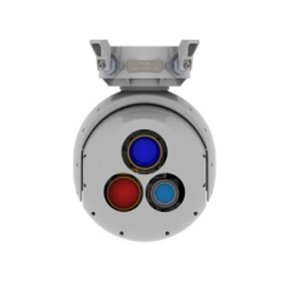
Figure 1 Product Image
a) It has the function of automatic identification and tracking of typical targets;
b) It has self-testing and fault reporting functions;
c) It has a 30x optical zoom function for visible light ;
d) Possesses the ability to move with two degrees of freedom: azimuth and pitch;
e) It has multiple working modes such as automatic search , manual search, follow-up, automatic tracking, and favorites;
f) Possesses the ability to isolate carrier disturbances and stabilize the line of sight;
g) It has the function of locking /unlocking targets, and the pod outputs an image with a tracking frame after locking the target;
h) It has an automatic target tracking function, which can automatically track targets and has the ability to resist natural interference;
i) It has a memory tracking function, which allows the target to be recaptured in a short time after being briefly lost;
j) It has the function of adjusting the gate size;
k) It has a tracking point switching function;
l) Possesses high-precision target positioning capabilities;
m) It can communicate bidirectionally with the control station via serial port /100Mbps Ethernet (UDP) and can output information such as system working status, camera working status, and optical axis position;
n) It has a two-axis, four-frame structure;
o) It has multi-target detection capabilities.
p) It has photo and video recording functions;
Vertical take-off fixed-wing drones, rotary-wing drones, tethered drones, etc.
| model | S230-Q |
| Infrared thermal imager | |
| Detector type | Uncooled focal plane detector |
| Operating band | 8 m 14 m |
| Detector resolution | 640 512 |
| Pixel size | 12 m |
| Lens focal length | 65mm |
| Field of view | 6.8 5.4 (error 5%) |
| Pseudo-color | 6 types |
| Numbers multiplied | 1 4X |
| Noise equivalent temperature difference | NETD 40mK |
| Minimum distinguishable temperature difference | MRTD 500mK |
| Visible light camera | |
| resolution | 1920 1080 |
| Response band | 0.4 m to 0.9 m |
| Pixel size | 2.8 m |
| Optical zoom | 15 times |
| Electron Magnification | 2 times |
| focal length | 12mm to 185mm |
| Field of view | 25 x 14 to 2 x 1 |
| Focusing method | Autofocus, manual focus |
| Minimum Illumination | 0.01 Lux |
| Laser measurement integrated machine | |
| wavelength | 1064nm |
| Maximum ranging distance | 4km (under conditions of visibility 15km) |
| Minimum ranging distance | 20m |
| Distance measurement accuracy | 2m |
| Ranging frequency | 1 5Hz |
| Laser irradiation | 30mJ |
| Servo Platform | |
| Orientation angle | 360 n (360 continuous rotation) |
| Pitch angle | -110 to +10 (positive for upward) |
| Angular accuracy | 1mrad |
| Stable accuracy | 0.05mrad (1 , 1 /2Hz, 2 /1Hz sinusoidal oscillation) |
| Tracking accuracy | 0.1mrad(1 ) |
| Maximum tracking angular velocity | 10 /s |
| Memory tracking time | 3s |
| Maximum angular velocity | Azimuth 60 /s, Pitch 60 /s |
| Maximum angular acceleration | Azimuth 10 /s2, Pitch 10 /s2 |
| System Indicators | |
| Image tracking | Automatically track selected target |
| Rated operating voltage | 24VDC |
| Power supply voltage range | 20V 32VDC |
| power | Stable power consumption: 160W (excluding load) |
| weight | 6.6Kg |
| volume | 230mm 211mm 326mm |
| interface | |
| Control Interface | RS422 |
| Video interface | 100M network |
| Storage interface | 128G memory card (Mini SD card) |
| Image format | JPG format |
| Video format | AVI format |
| Environmental adaptability | |
| Operating temperature | -40 65 |
| Storage temperature | -50 70 |
| Vibration conditions | The acceleration is 2g; 30 minutes each in the vertical, horizontal and longitudinal directions. |
| Impact conditions | Peak acceleration 20g, duration 11ms |
| Protection level | Protect from light rain |
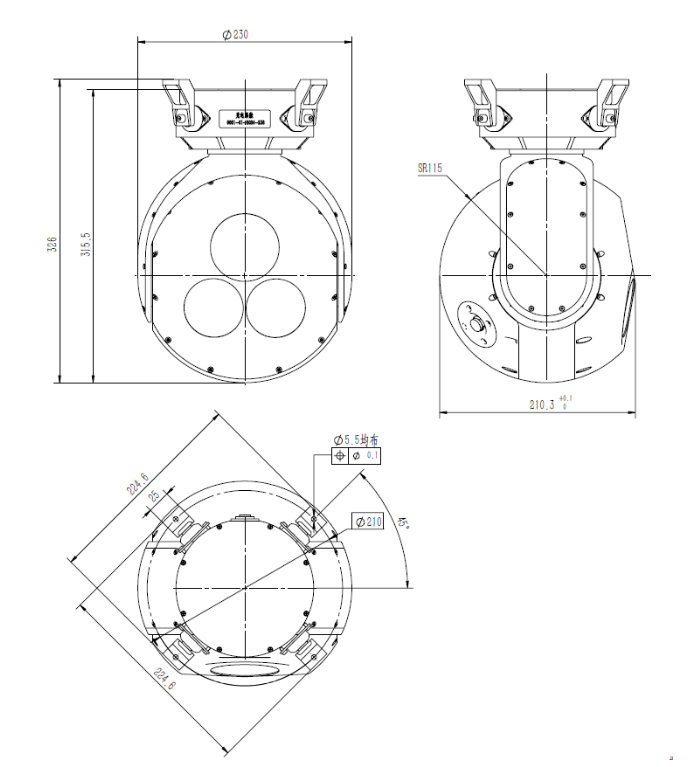
Figure 2 Product mechanical dimensions diagram
| Stabilization | 2-Axis |
|---|---|
| Key Features | Laser Rangefinder (LRF) |
| Sensor Configuration | Multi-Sensor (EO+IR+LRF) |